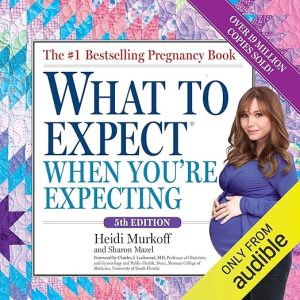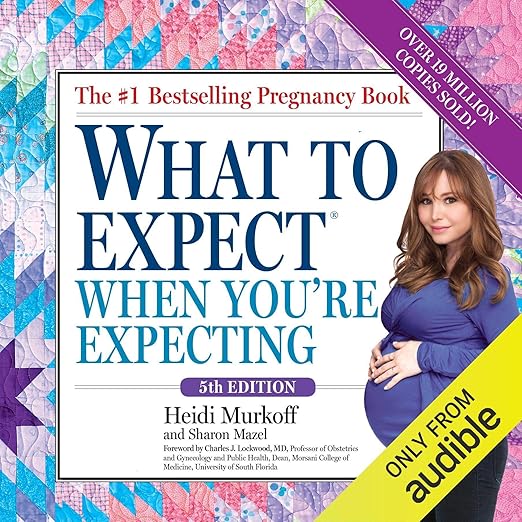
Counting the weeks is the organizing principle here, and the first thing to register before buying is that this audiobook runs thirty-two hours and forty-three minutes. That is a reference work read end to end, not a companion for one evening. Heidi Murkoff wrote the guide and reads it herself, and the publisher's line about hearing it in the voice expectant parents turn to carries most of the page's argument, because almost nothing else on the listing describes what thirty-two hours of medical guidance sounds like once it has been arranged for the ear.
Covering IVF, Water Birth, and Push Presents
Look at what the description promises to cover and the scale stops being surprising. Pregnancy screenings, medications and supplements, IVF, multiple pregnancies, breastfeeding while already expecting again, then every birthing option it can name: VBAC, gentle c-sections, water birth, hypnobirthing. After delivery it keeps going through the first three months, the stretch the guide calls the fourth trimester, including how to spot postpartum depression and other mood disorders. Around all of that sits an entire lifestyle layer, work and working out, travel, beauty and skincare, and a frank section on sex during pregnancy.
Then come the smaller anxieties, and this is where the book shows what it is really for. Juice bars, raw diets, coffee, e-cigarettes and edibles, push presents, bump posting, omega-3s, grass-fed and organic, health food fads, GMOs. None of that is medicine. All of it is what people actually worry about at eleven at night, and a guide that answers those questions in the same register it uses for screening results has made a deliberate choice about who it serves.
Murkoff's Warm Voice Meets Clinical Material
An author reading her own reference book is a different proposition from hiring a professional. You gain the register the material was written in, the one that treats you as a friend rather than a patient, and you accept that a voice chosen for warmth is now responsible for signposting several hundred discrete topics across two working days of audio. That trade is the whole listening question on this record. Play a passage of the postpartum material against one of the lifestyle sections and you will know within minutes whether the delivery holds its shape when the subject turns clinical.
Made for Waiting Rooms and Long Drives
Pregnancy generates an unusual amount of listening time. Waiting rooms, the walks a doctor recommends, laundry, the drive to a scan. A book this long fits that shape far better than it fits a bedside table, and it is genuinely easier to hear a paragraph explaining what a particular test measures than to hunt for it in an index while you are already frightened. A December 2025 entry describes exactly the structure that makes this work: step-by-step chapters through each week and each trimester, with the postpartum material waiting at the end.
Coverage of everyone else in the room is the second argument. The description states outright that expectant fathers are included, and the recording brings in a range of voices rather than leaving one reader alone with two working days of material, among them the author's daughter Emma, who the jacket notes appeared on the cover of an earlier edition while expecting her own first child. For a partner who will never sit down with a guide this size, a passage played aloud in the car does work that forwarding a link does not.
More Voices Than the Narrator Field Shows
Nobody but Murkoff appears in the narrator field, and the description contradicts it two paragraphs in, where the reading is credited to a diverse cast of voices. Emma is named. The rest are not. A buyer scanning the credits sees a solo author reading and receives something closer to a production, which is a pleasant surprise rather than a bad one, though it does mean the page under-reports what was actually recorded, and anyone weighing this against a single-voice pregnancy guide is choosing without the information.
Then the charts. A note at the foot of the description says an accompanying PDF of charts and diagrams arrives alongside the audio, which is the honest arrangement for a reference book full of tables and also a real limitation. Every comparison chart, every week-by-week table, is a file you open on a screen. The reader responses carry their own version of that gap: one February 2026 entry explains the book was bought as a gift by someone who last read it more than twenty years ago, which is a purchase decision about a title rather than a report on a recording.
Read the headline numbers carefully too. Nineteen million copies in print, a USA Today listing among the most influential books of twenty-five years, the claim that ninety-three percent of women who read a pregnancy book read this one: all of those belong to the printed guide and its successive editions. The counter above the reception column reads thirty ratings, with five signed write-ups beneath it, and that small figure is the only thing on the page measuring the 2019 recording rather than the institution behind it.
Partners Who Will Listen but Never Read
Expectant parents who want one comprehensive source and expect to consult it repeatedly across nine months will get their money back, particularly anyone who prefers information delivered calmly instead of in the bullet-point panic of a search result. Partners who will not open a book but will listen while driving are the other clear audience, along with second-time parents who read an older edition and want the updated material on birth options and postpartum mental health.
A slim, opinionated take on pregnancy is not what this is, and neither is a narrative: the guide is a taxonomy, exhaustive by design, and played in order it becomes relentless. Anyone whose real need is visual, growth charts, comparison tables, week-by-week diagrams, is buying the wrong format, because every one of those things lives in the accompanying file. Everything else about the guide survives the move to audio intact.
At a Glance
- Read by: Murkoff reads her own reference book, so the warmth is authentic and the burden of signposting hundreds of topics falls on a voice chosen for reassurance.
- At its heart: Pregnancy week by week, birth options, the fourth trimester, postpartum mental health, partner involvement.
- Vibe: Calm, encyclopedic, faintly relentless.
- Short version: A complete pregnancy reference for the ears, worth buying if you accept that the charts live in a separate file.
Questions Listeners Ask
Does the audiobook include the charts and diagrams from the printed guide?
No. The description says an accompanying PDF of charts and diagrams arrives with the audio in your library rather than inside the recording. The tables exist, but you retrieve them on a screen. Anything visual, growth curves, comparison charts, week-by-week tables, is a separate file you open yourself.
Is nearly 33 hours of pregnancy guidance meant to be heard straight through?
It is built as a lookup tool, not a linear read. The material runs week by week and trimester by trimester, then carries on into the first three months after birth. Most people will move around inside it, which makes chapter navigation the feature that matters most across a file this long.
Does the audiobook cover anything for fathers and non-birthing partners?
Yes. The publisher states plainly that expectant dads are covered, and partners are folded into the sections on work, travel, fitness and sex during pregnancy. It is not a separate volume for partners, so anyone listening alone will pass through material aimed primarily at the pregnant person.
How current is the medical information in a recording released in 2019?
The copy points to updated guidance on screenings, medications, supplements, IVF, multiple pregnancies and birth options including VBAC and hypnobirthing, plus postpartum mood disorders. It was accurate to its edition, and clinical advice moves. Treat it as orientation you bring to appointments rather than a substitute for them.