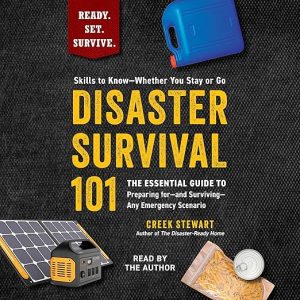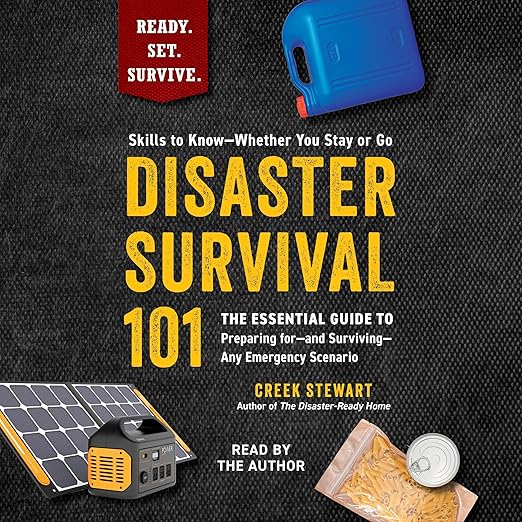
- Voice: Creek Stewart self-narrates with authority and clarity, delivering a complex scenario-based structure at a pace that matches the seriousness of the subject.
- Big ideas: Emergency preparedness, decision-making under pressure, self-sufficiency
- Atmosphere: Calm and practical, with the quiet urgency of someone who actually knows what they are talking about
- Worth it?: An unusually well-organized preparedness audiobook that earns its place on your playlist before you ever need it.
Disaster preparedness audiobooks tend to split into two failure modes: they either condescend to readers who have never thought about emergencies, or they assume so much prior knowledge that newcomers lose the thread within the first chapter. Creek Stewart's Disaster Survival 101 manages to avoid both. I picked up this audiobook after a conversation with a neighbor who had recently dealt with a burst pipe during a winter storm, the kind of situation not dramatic enough to feel like a real emergency until you are standing in cold water at 2 a.m. with no plan. The book felt relevant in a specific, immediate way.
Stewart is not a theoretical survival authority. He is a working professional who has spent years training others in outdoor skills and emergency readiness, and that background shapes the way this audiobook moves through its material. The structure is organized by scenario rather than by category, which turns out to be a significant advantage. Instead of reading a chapter on water sourcing and then a separate chapter on evacuation and then trying to stitch those together during an actual emergency, the listener gets a full playbook for each of more than twenty specific situations.
Stewart Narrates Without Slipping Into Lecture Mode
Creek Stewart narrates his own book, and that choice deserves attention. Self-narration is often a liability in practical nonfiction, where authors sometimes drift into lecture mode or lose the rhythm that a professional narrator would maintain. Stewart avoids those pitfalls. His delivery is direct without being clipped, and he has clearly prepared content intended to be heard rather than simply read aloud from a page. The pacing is brisk but not rushed, and he modulates well between conceptual sections and the step-by-step checklists that anchor each scenario chapter. One reviewer, a survival training colleague, described Stewart as the real deal, and that credential comes through in how the narration handles complexity without losing accessibility. The self-narration advantage here is genuine: Stewart knows which moments in this material deserve emphasis and which should be stated and moved past.
Sheltering and Evacuating as Parallel Options
The practical value of this audiobook is genuine. Stewart covers sheltering in place and evacuation as parallel options, which is more useful than most preparedness resources that treat these as mutually exclusive categories. Detailed chapters on food storage, water sourcing, heating, power generation, and first aid establish the foundation, and then a second tier of scenario-specific guidance walks through the decision logic for each situation individually. The reviewer who experienced an EF2 tornado hitting their home described knowing what to do in advance as the critical differentiator. That reviewer's point about acting ahead of time is exactly what the book is designed to enable.
The prepared mindset framing in the early chapters is also more useful than it sounds. Stewart does not spend much time on the psychology of fear management in the abstract, but the way he sequences information helps listeners internalize a decision-making framework rather than merely accumulating facts. The book's organization by scenario rather than category means that when a specific emergency arrives, a listener who has worked through the relevant chapter will have a decision tree already partially assembled in memory rather than a set of disconnected items to reassemble under pressure.
Calm Delivery Chosen Over Panic Framing
The audiobook format has natural friction with this kind of content. Checklists and step-by-step sequences are easier to reference in print, and the accompanying PDF that comes with the title is a meaningful supplement rather than optional bonus material. Listeners who plan to use the book as an ongoing reference rather than a one-time listen will likely find themselves switching between the audio and the PDF depending on the task at hand. This is not a flaw unique to Stewart's book, but it is worth going in with realistic expectations about how you will use the material across its full seven-plus hours.
The coverage of advanced threats, including nuclear, biological, and chemical scenarios, is genuinely useful context, though the guidance in those sections necessarily becomes more general than in the natural disaster chapters. Stewart is appropriately honest about the limits of individual preparedness in those situations without dismissing the value of knowing your options in advance.
It is also worth considering the psychological dimension of this audiobook that Stewart does not dwell on explicitly but that the format itself delivers. Listening to detailed preparedness guidance in advance, before any emergency has arrived, builds a kind of familiarity with the material that reading about it does not always achieve. Stewart's organized, calm delivery works against the panic framing that emergency preparedness sometimes carries in popular culture. He treats preparedness as a practical and achievable project rather than an expression of anxiety, and that tone sustains itself across the full runtime in a way that makes the audiobook a more useful companion for first-time preparedness planners than most alternatives in the genre.
It is also worth considering the psychological dimension of this audiobook that Stewart does not dwell on explicitly but that the format itself delivers. Listening to detailed preparedness guidance in advance, before any emergency has arrived, builds a kind of familiarity with the material that reading about it does not always achieve. Stewart's organized, calm delivery works against the panic framing that emergency preparedness sometimes carries in popular culture. He treats preparedness as a practical and achievable project rather than an expression of anxiety, and that tone sustains itself across the full runtime in a way that makes the audiobook a more useful companion for first-time preparedness planners than most alternatives in the genre.
Made for People Who Never Found a Starting Point
This audiobook works for anyone who wants a structured, practical preparedness framework and prefers to absorb it through listening rather than reading. It is particularly well-suited to people who have been meaning to get organized around emergency readiness but have not found a starting point that felt manageable. Skip it if you are already deeply versed in survival training and looking for advanced technical content rather than a comprehensive introduction. Stewart covers the full range of likely scenarios with enough depth to be genuinely useful, but the book is oriented toward people building their first serious preparedness plan rather than experienced practitioners looking to push the edges of their knowledge.
A Few Questions About Disaster Survival 101
Does the Disaster Survival 101 audiobook come with any supplementary materials?
Yes. A PDF accompanies the audiobook and contains the checklists and reference materials from the book. Given the step-by-step nature of the content, the PDF is a meaningful companion rather than optional extras.
Is this audiobook useful for someone with no prior survival or preparedness training?
Yes. Stewart explicitly builds from foundational concepts, and the scenario-by-scenario structure makes the content accessible without assuming prior knowledge of emergency response.