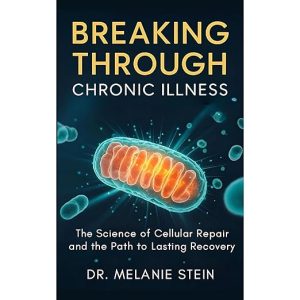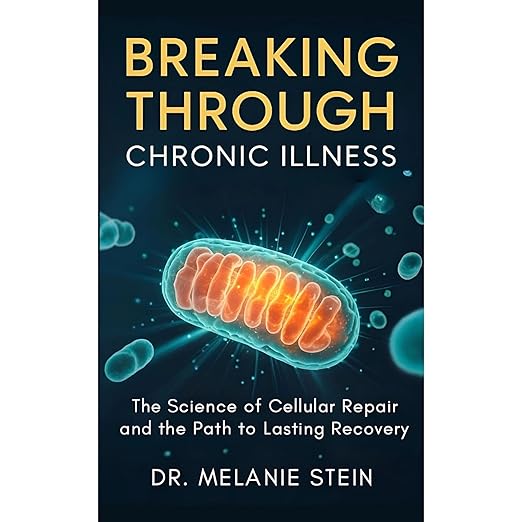
Independently published, three and a half hours long, and read by a machine: the fields on this record tell you a great deal before the audiobook itself starts. Dr. Melanie Stein's argument about why chronic illness keeps coming back arrived in February 2026, and everything unusual about the listing sits in plain view once you know to look at the credit line and at who wrote the entries underneath it.
Locked Into Defense, According to This Diagnosis
Stein's thesis is single and stated early: recovery stalls because treatment addresses symptoms while leaving damage to cell membranes and mitochondria untouched. The mechanism she names is the Cell Danger Response, which she describes as the body locking itself into defense and refusing to come out. The proposed answer is Cell Membrane Therapy, developed and delivered at her Restorative Health Clinic, and the conditions it is offered against are listed by name: Lyme disease, mold toxicity, Long COVID, POTS, mast cell activation, chronic fatigue, autoimmune disease. Behind it sits a personal account of years spent being dismissed by the medical system before cellular breakdown presented itself as the missing link.
An October 2025 five-star, filed on the fifteenth, calls the book an insightful and well-researched exploration of the science behind healing and singles out the root-cause treatment plan as the part that impressed. That reading matches what the book actually does best, which is compression. Three and a half hours is short for a subject this size, and the shortness is a design choice rather than a shortfall: the argument is one idea followed through nutrition, supplements, detox, nervous system regulation and environmental exposure, and it does not wander.
Test the Narration on a Chapter Full of Acronyms
Clarity is the selling point and the record backs it up. A five-star logged on February 9, 2026 describes the book as easy to read and easy to understand, which is not a small compliment on material that includes mitochondrial function and membrane chemistry. Anyone who has spent years inside this diagnostic world knows the two usual failure modes: a book so simplified it says nothing, or a book so technical it becomes a reading assignment on top of an illness. Stein aims between them, and the patient stories carry the weight the biology cannot, because they are the only place the book shows what recovery is supposed to look like on a timeline.
Where a reader's name would go, this listing puts software. The credit reads Virtual Voice, which means no performer is attached to the file and nothing here was interpreted by a person. That matters more than usual on this text specifically, because the book runs on abbreviations, CIRS and POTS and MCAS, and on long clinical nouns that a generated voice either handles consistently or mangles in the same way every time. Consistency is the thing to check. Test it on a chapter where the abbreviations come thick, not on the introduction, which is ordinary English prose and settles nothing.
Her Own Patient Wrote One of the Five-Star Reviews
The reception column needs reading carefully, because a portion of it is not written by readers. A five-star from October 29, 2025 opens by stating outright that its author is a current patient of Dr. Stein and describes going from bedridden to traveling the world. An October 13 entry describes completing the full course of Cell Membrane Therapy, being diagnosed with mold illness in under two minutes at a first appointment, and having that diagnosis confirmed by later testing. Both are sincere and neither is hidden. They are also testimony about a clinic rather than assessments of a book, and they sit inside the same average as everything else.
Endorsements Misname the Book, and No Advisory Appears
The description has its own composition problem. A large share of it is not description at all but endorsement, three separate blurbs from other physicians stacked around the summary, and one of them refers to the book by a title the listing does not use, calling it Breakthrough Chronic Illness rather than Breaking Through Chronic Illness. Small, but it is the kind of slip that tells you how the page was assembled. Three of the five written entries also carry dates that fall before the release date printed on this edition, which is common enough with independently published titles and still worth knowing when you read a grade.
One absence is worth stating plainly. A book recommending supplements, detox protocols and environmental interventions for conditions including Long COVID and autoimmune disease carries no advisory anywhere on this listing, no note about consulting a physician, no statement about what the therapy is and is not cleared to treat. Publishers of medical trade titles usually put one somewhere. Its absence does not make the argument wrong; it does mean the only framing you get is the author's own.
CIRS and POTS Veterans Are the Real Audience
This one belongs to listeners already deep in the CIRS, POTS and long-haul world, the ones who have run the protocols, watched the labs come back normal, and want a coherent account of why the improvement never holds. As a compact statement of one clinician's model, delivered in under four hours, it does a job that a four-hundred-page synthesis does not. It will also be useful to practitioners curious about where membrane-focused thinking has got to, if only as a document of how the case is being made to patients.
Anyone looking for a neutral second opinion should look elsewhere. This is an argument for a specific therapy offered at a specific clinic, presented by the person who developed it, and it is doing exactly what it says it will do. Listeners who want randomized evidence, dosage detail or an account of what the model cannot explain will finish unsatisfied. What the file offers instead is a clear, fast, committed case, and the honest way to use it is as one voice you then go and test against others.
Before You Press Play
- Subjects: cellular repair and mitochondrial damage, the Cell Danger Response, recovery that never holds
- Tone: urgent, clinical, evangelical about one mechanism
- Bottom line: a compact and coherent case for one therapy, best used alongside sources with no stake in it