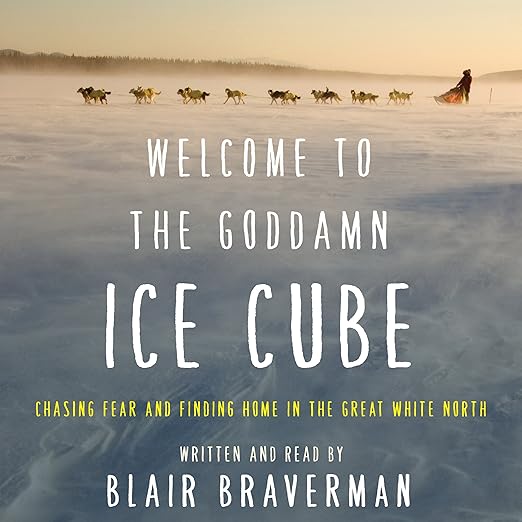
Blair Braverman's prose has a quality that becomes apparent quickly in this audiobook: she refuses the romanticism that memoirs about wild landscapes often default to. Welcome to the Goddamn Ice Cube is a book about dogsledding and Norway and Alaska and misogyny in the Arctic, but more than any of those things it is a book about the gap between who you are trying to become and who the landscape actually reveals you to be. That gap, and the specific physical and emotional terrain Braverman traverses to close it, makes this audiobook unlike most adventure memoirs I have spent time with in twelve years of covering the genre.
Braverman self-narrates, which is the essential structural decision here. The book is structured around the concept of becoming a 'tough girl,' a specific cultural ideal she chased from California to Norway to Alaska. The appeal of hearing Braverman tell this story in her own voice is that it strips away any distance between the person who lived the events and the person accounting for them. She reads with a directness that does not perform toughness but clearly carries it. The voice is neither self-congratulatory nor self-pitying. It is careful and honest, which is harder to maintain over nine hours than it sounds.
Is Welcome to the Goddamn Ice Cube Worth Your Time?
The narration is one of the audiobook's genuine strengths. Braverman's reading voice matches the register of the prose: precise, occasionally wry, capable of moving from beauty to darkness without telegraphing the shift. One reviewer described the book as 'by turns funny and sobering, bold and tender,' and that tonal range is audible in the performance itself. She reads the passages about being buried alive in an ice cave with the same controlled quality she brings to the passages about the strange social world of the Norwegian folkeskole. That consistency creates the kind of listener trust that allows the harder passages to land fully.
The book's three structural threads are worth understanding before you start: Braverman's journey into dogsledding, her relationship with a man who complicates her independence, and her ongoing negotiation with the violence and condescension that characterize being a young woman in extreme outdoor sports culture. One reviewer identified these threads precisely as what makes the book 'pulled in several directions.' That is accurate as description but not as criticism. The threads are not randomly tangled; they are knotted around the same central question about what Braverman is actually running toward when she leaves California for the Arctic.
The Best Parts of Welcome to the Goddamn Ice Cube
The book's physical environment is rendered with the specificity of a writer who knows it from the inside. The Norwegian folkeskole where Braverman first learns to drive dogs is described not as picturesque backdrop but as a social organism with its own hierarchies, rituals, and cruelties. The Alaskan glacier where she works as a tour guide, bundling tourists into dogsled harnesses, is simultaneously spectacular and tedious. Braverman is consistent about refusing to let the North become simply beautiful. It is also dangerous, occasionally corrupt (the episode with corrupt police during a blizzard crossing reads as genuinely terrifying), and resistant to the narrative of triumphant wilderness mastery that memoirs in this genre often reach for.
What this audiobook offers that distinguishes it from comparable Arctic or adventure memoirs is the frankness about gendered experience. Braverman does not treat misogyny as background atmosphere or occasional obstacle. She places it at the center of her account and is specific about how it operates: not as dramatic confrontation but as accumulated small erosions of space and authority that women in male-dominated extreme sports communities learn to navigate or break against. That specificity is uncomfortable and valuable, and it makes the book more interesting than a straightforward wilderness achievement memoir would have been.
Before You Commit to Welcome to the Goddamn Ice Cube
The three-thread structure means the book's emotional pacing is less linear than readers of single-arc adventure memoirs may expect. Braverman moves between the dogsledding progression, the relationship, and the misogyny confrontations in a way that prioritizes thematic accumulation over strict chronology. A few reviewers found this made the book feel unfocused. I found it made the book honest. Real experience does not resolve its themes one at a time, and Braverman seems unwilling to organize her material into a shape that her actual life did not take.
The ending circles back to the beginning with a structural elegance that is quietly satisfying without providing neat resolution, which is appropriate for a memoir about a process that is ongoing when the writing stops. Braverman does not claim to have become the tough girl she was seeking. She arrives somewhere more complicated and more true, and the self-narrated audio delivery makes that arrival feel immediate rather than retrospective.
Should You Listen to Welcome to the Goddamn Ice Cube?
Readers who come for dogsledding and stay for the whole book will find the most rewarding experience. The mushing content is wonderful but not the primary payload, and Braverman herself would probably not want you to come primarily for the dogs. Listeners who enjoy memoirs that take gender politics seriously alongside physical adventure, comparable to Cheryl Strayed's Wild but colder and more specific about misogyny in outdoor culture, will find this a particularly good listen. Braverman's self-narration makes it especially suited to the audio format. Listeners who want triumphant single-arc survival narratives may find the multi-thread structure frustrating; those who find that structure is exactly how life actually works will find this among the more honest adventure memoirs in recent years.
The Short Version
- Narration: Braverman's self-narration is precise and controlled, with a tonal range that moves from wry to sobering without telegraphing shifts.
- Themes: Becoming fearless, gendered experience in extreme outdoor culture, finding home in harsh landscapes.
- Mood: Unflinching and atmospheric, honest about both beauty and danger.
- Verdict: A genuinely unusual Arctic memoir that refuses romantic triumphalism and places misogyny at its center alongside dogsled poetry; Braverman's self-narration is essential to the experience.
Good to Know
Does Blair Braverman narrate her own audiobook and how does it compare to professional narration?
Braverman narrates her own memoir, and it is one of the better examples of author self-narration in the genre. Her voice matches the prose register exactly, with the kind of controlled understatement that a professional narrator would have to work to replicate.
Is the Welcome to the Goddamn Ice Cube audiobook primarily about dogsledding?
Dogsledding is the spine, but the book is equally about gendered experience in Arctic outdoor culture and the specific project of trying to become fearless. One reviewer put it well: it is really about finding your place in the world where you feel valued in the most authentic way.
How does this audiobook handle the difficult content around violence and misogyny?
Directly and without melodrama. Braverman does not minimize or sensationalize the gendered hostility she encounters. She is specific and controlled, which makes those sections land harder than more performative treatments would.