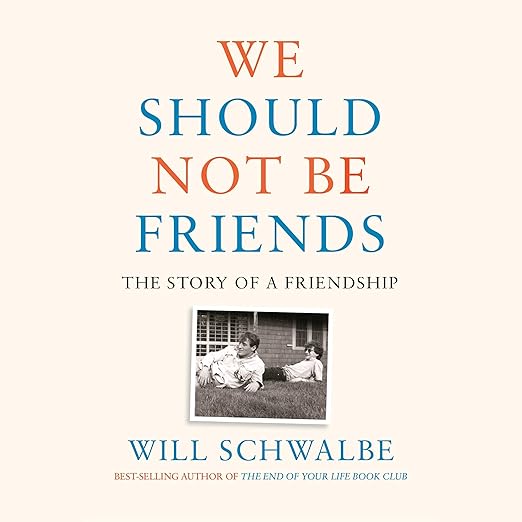
Quick Take
- Narration: Will Schwalbe reading his own memoir is the only casting that makes sense here, his voice carries forty years of affection for Maxey and for the story itself, and the self-narration adds a layer of intimacy the book earns.
- Themes: male friendship across difference, self-acceptance, the long arc of identity
- Mood: Warm, reflective, and quietly moving
- Verdict: A generous, carefully observed memoir about what friendship can do for a person over a lifetime, Schwalbe narrating his own story makes this a particularly worthwhile audio choice.
I came to We Should Not Be Friends having read Schwalbe’s previous book, The End of Your Life Book Club, which is one of the best memoirs I have encountered about reading, grief, and the bond between parent and child. That book prepared me for his particular qualities as a writer, the self-deprecating intelligence, the genuine warmth, the refusal to sentimentalize what is actually sentimental about his subject matter. This one is different in scope but recognizable in voice, and hearing him read it himself makes the memoir feel like being told a story by someone who has been waiting thirty years to find the right way to tell it.
The premise, as Schwalbe describes it, is an improbable friendship formed during his junior year at Yale through a secret society. Will, theater people, classics major, gay, bookish, absolutely certain about the value of avoiding jocks, collides with Chris Maxey, who is everything Will is not: physically imposing, loud, a star wrestler on track to become a Navy SEAL, the kind of person Will had spent his college career carefully not knowing. What follows, over forty years, is a friendship that neither of them particularly planned and both of them needed.
Our Take on We Should Not Be Friends
The book is about friendship in the way that great friendship memoirs usually are about something larger. Schwalbe is interested in how preconception functions as a barrier to genuine encounter, and how the specific circumstances of a forced proximity, the secret society at Yale creates a context where the usual social sorting does not apply, can dissolve those barriers before you have had a chance to rebuild them. This is not a book about two fundamentally similar people who found each other. It is a book about two genuinely different people who did the work of learning each other over decades, and about what that work revealed in both of them.
Schwalbe is also writing, with considerable honesty, about his own process of self-acceptance. His fear of Maxey and people like him in his college years is explicitly connected to his sexuality, the jocks represented a version of masculinity from which he felt excluded and by which he felt threatened. The friendship with Maxey, which gradually reveals Maxey as neither the threat nor the category Schwalbe had assigned him to, is also part of Schwalbe’s own slow-motion reckoning with who he is and what he has been afraid of. A reviewer specifically calls this out as the book’s most affecting layer, and it is.
Why Listen to We Should Not Be Friends
Schwalbe reading his own memoir is the strongest argument for the audio format of this book. He knows where the jokes are and delivers them with a lightness that prevents them from landing as setups. He knows where the emotional weight lives and does not overplay it. The result is a narrator who sounds genuinely at ease with his own story in a way that suggests real distance and perspective, this is not the urgency of fresh grief or recent discovery but the clarity of someone who has lived with something long enough to understand it fully.
At nine hours and forty-three minutes, the book is comfortable but not brief. It earns its length because Schwalbe is not padding, he is tracking the relationship across genuinely different life phases, and each phase adds something to the picture. The Hong Kong sections, the Panama years, the school in the Bahamas, these are not name-dropped geographic variety but actual chapters in Maxey’s life that Schwalbe observes and reflects on with the attention of a very good listener.
What to Watch For in We Should Not Be Friends
A dissenting note in the reviews suggests that Schwalbe may overestimate how different he and Maxey actually are. That is a fair observation, both are Yale-educated men of a certain class background, and the “opposites” framing has limits. Schwalbe is aware of this to some degree, and the book does not fully rest its weight on the “opposites attract” premise, but readers who want the friendship’s cross-class or ideological dimensions examined more rigorously may find the analysis softer than they prefer.
The book is also, despite its LGBTQ+ genre tag, not primarily a coming-out narrative. Schwalbe’s sexuality is woven into the memoir as context for his fear and his growth, but the relationship with Maxey is the book’s center rather than any specific moment of identity disclosure. Readers looking for a coming-out memoir should find it elsewhere; readers interested in how self-acceptance shapes and is shaped by friendship will find this very rich.
Who Should Listen to We Should Not Be Friends
This is an ideal audio choice for anyone who has read and loved Schwalbe’s previous work, for readers interested in male friendship as a literary subject (which is underrepresented in memoir), or for anyone who has experienced the particular surprise of a friendship that defies their own predictions about who they are capable of loving. The self-narration makes this one of the better arguments for seeking out a memoir in its audio version specifically.
Skip it if you want a fast-moving narrative with high external stakes. This is a quiet book. Its stakes are internal and relational, and its pleasures are the pleasures of prose and reflection rather than event. But for readers attuned to that register, it is a sustained and rewarding listen.
Frequently Asked Questions
Does Will Schwalbe narrating his own memoir significantly improve the listening experience?
Yes, in this case. Schwalbe’s self-narration brings a quality of ease and genuine affection to the material that would be very difficult for an outside narrator to replicate. He knows where the humor lives, he does not overplay the emotional sequences, and the result is a memoir that sounds like it is being told directly to you, which is the ideal register for this kind of book.
Is We Should Not Be Friends connected to Schwalbe’s previous books, and do I need to have read them first?
The books are thematically connected, Schwalbe is consistently interested in relationships, books, and what constitutes a life well-lived, but there is no narrative dependency. We Should Not Be Friends stands entirely on its own. Readers who loved The End of Your Life Book Club will recognize Schwalbe’s voice and sensibility immediately, but prior familiarity is not required.
How central is Schwalbe’s sexuality to the memoir, and is this primarily a coming-out narrative?
Schwalbe’s sexuality is woven into the memoir as important context, his fear of jocks and people like Maxey is explicitly connected to his sexual orientation, and the friendship becomes part of his broader process of self-acceptance. However, the book is centered on the friendship rather than on a coming-out story. There is no single climactic moment of identity disclosure; rather, the memoir tracks how identity and friendship develop in parallel over decades.
The memoir covers forty years, does the pacing sustain interest across that long a timeline?
Schwalbe structures the book episodically rather than as a continuous narrative, which means the forty-year span is organized around key moments and phases rather than a year-by-year account. Each chapter adds a new dimension to both Schwalbe’s and Maxey’s characters rather than simply advancing a chronology. Most readers find the pacing holds throughout, though the middle sections, which involve the most geographic variety, move through more territory than the opening Yale chapters.