The Short Version
- Performance: Ray Porter is exceptional here, he brings sardonic wit and genuine warmth to Bob's voice, making the multiple-clone scenes feel distinct rather than confusing.
- What it covers: Identity and consciousness, space colonization, found purpose after an unexpected life
- Feel: Cheerful and propulsive, with occasional genuine wonder
- Our call: One of the best-matched narrator-to-material pairings in recent science fiction audio, Ray Porter's performance is as much the reason to listen as Dennis Taylor's story.
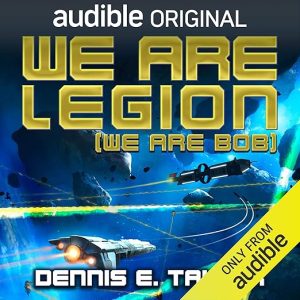
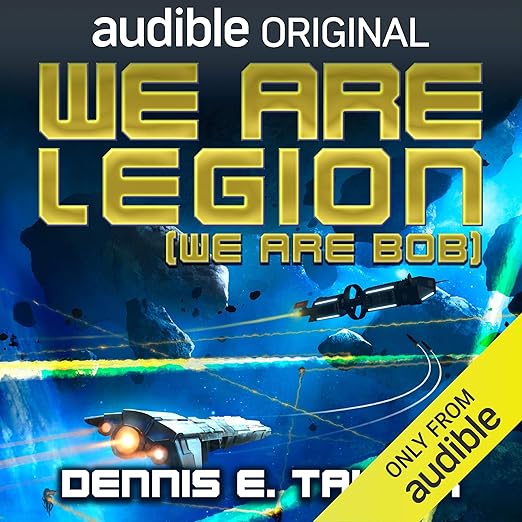
I finished the first two hours of We Are Legion (We Are Bob) on a Saturday morning walk and nearly missed my stop because I was too busy laughing at Bob's internal commentary on being a sentient space probe in a world that has moved on 117 years without him. I have a complicated relationship with hard science fiction, I love the ideas but sometimes find the characters thin and the humor forced. This book solved both problems simultaneously, and I understand now why it became Audible's Best Science Fiction Book of 2016 and why the Bobiverse series has sold over a million copies.
Dennis E. Taylor starts with a premise that sounds absurd and commits to it completely: software engineer Bob Johansson signs up for cryonic preservation on an impulse and promptly gets hit by a car. He wakes up a century later with his consciousness uploaded into a self-replicating space probe, owned by a theocratic future state, and sent out to find new worlds for humanity. The setup is ridiculous in the best possible way. Taylor uses it to explore what consciousness, identity, and purpose actually mean when you're made of silicon, can copy yourself at will, and have a mission you didn't sign up for but are starting to find genuinely compelling.
What makes this work as a novel rather than as a thought experiment is that Bob is a fully realized character. He is funny, self-aware, intellectually curious, and emotionally honest, a recognizable kind of nerd, the kind who would know his Star Trek episodes cold and build a Dyson sphere out of genuine enthusiasm. Taylor doesn't condescend to this character or use him as a vehicle for pop culture references in place of actual personality. Bob's humor is integrated into how he thinks, not pasted over the narrative.
The clone situation, as Bob self-replicates, each copy develops slightly differently, is handled with real imagination. By the midpoint of the book, there are several Bob-descendants with distinct personalities, and keeping them coherent could easily have become a mess. It doesn't. One reviewer mentioned building a family tree to track them, which I also did mentally, and found it added rather than detracted from the experience.
Porter's Timing Makes Every Bob-Clone Distinct
Ray Porter. That's the short answer. Porter's narration is the kind of performance that makes you want to start a series from scratch just to hear him do it. He finds the exact right register for Bob, sardonic but never smug, enthusiastic without being breathless, capable of genuine vulnerability when the story calls for it. The moments where Bob observes humanity's decline, or encounters something vast and beautiful in interstellar space, land with real weight because Porter earns them. He also differentiates the various Bob-clones with sufficient subtlety that you can track who is speaking without the book needing to over-explain.
The humor translates especially well to audio. Bob's internal commentary on his situation, on the absurdity of being a probe, on dealing with artificial intelligences who have different agendas, on the strangeness of watching stars for decades, is funnier spoken than it would be on the page. Porter's timing is impeccable.
Real Physics Worn Lightly, One Thread Left Open
This is the first book in a series, and it reads like one. The ending resolves the primary narrative conflict but leaves multiple threads open, as you'd expect from a series opener. Listeners who need complete self-contained arcs may find the conclusion slightly open-ended. That said, the series has multiple subsequent entries and a devoted fanbase, so the commitment to continuing is well-supported.
The hard science content, Von Neumann probes, Dyson spheres, stellar mechanics, is real and accurate, but Taylor wears it lightly. You don't need a physics background to follow the story; the technical elements are explained through Bob's curiosity rather than through infodump. But if you're a reader who skips over the science in science fiction, you'll miss some of what makes this book genuinely exciting.
Idea-Driven Fans Get Real Character Too
This is an easy recommendation for listeners who enjoy idea-driven science fiction but want actual character to go with the concepts. Fans of Andy Weir's The Martian and Project Hail Mary will find the tone familiar, competent protagonist, genuine humor, rigorous science deployed humanely. If you've bounced off harder science fiction because the characters felt like delivery mechanisms for exposition, start here.
Listeners who prefer emotionally intense drama or plot-driven narratives over character study and intellectual exploration may find the pace too leisurely. And if Ray Porter's voice isn't to your taste, though I'd be surprised, you might consider the text, where Taylor's writing stands well on its own. But the audio version, genuinely, is the definitive way to experience this one.
Before You Listen
Do you need to have read the earlier books in the Bobiverse series to follow this one?
No, this is book one in the Bobiverse series and is the correct starting point. There are no prior books. It sets up the entire premise and introduces all the key characters and concepts from scratch.
How does Ray Porter handle the scenes where multiple Bob-clones appear, does it get confusing?
Porter differentiates the clones with enough vocal distinction that experienced audio listeners can track who is speaking without confusion. The book also gives each clone a distinct name, which helps. One reader mentioned building a mental family tree, which is a reasonable strategy for the later sections where the clone count increases.
Is the science content in this book accessible to non-science readers?
Yes. Taylor explains concepts like Von Neumann probes, Dyson spheres, and stellar mechanics through Bob's perspective and curiosity rather than through technical exposition. You don't need a physics background. The hard science is accurate but worn lightly, it enhances the story without requiring expertise to follow.