LitRPG lives on its interface. Level-up boxes, stat sheets, skill trees and system notifications are the furniture of the genre, and on the page they work as typographic objects you glance at rather than sentences you read. Every audiobook in this category has to solve that before it solves anything else, and Wayward: Running arrives with thirteen hours and fifty-three minutes in which to do it. What makes this particular entry worth the attention is that its protagonist's relationship to bodies, systems and second chances is not decoration around the mechanics. It is the whole book.
How Wayward: Running: An Isekai LitRPG Holds Up
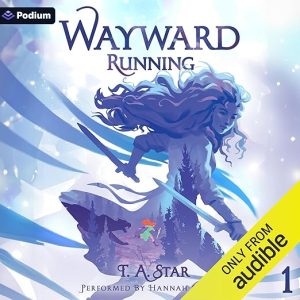
Phoenix Fraser starts the story stuck, and T. A. Star means that in several senses at once. She is stuck in a hospital bed with a chronic illness, stuck without friends or family, stuck with no future to plan for, and, in the book's own phrasing, stuck in the wrong body. Then an entity called the Night Witch offers a transfer to another world, and Phoenix wakes up equipped with a body that matches her spirit. The isekai transmigration device usually exists to reset a power level. Here it is doing two things simultaneously, granting a trans girl the body she recognizes and granting a chronically ill teenager one that works, and the book is honest enough to treat those as related but not identical wishes.
The mechanic that follows is the smartest thing in the setup. Among the abilities Phoenix discovers is respawning, and for most protagonists that is a convenience which lowers the stakes. For this one it is the fantasy underneath the whole premise: a body that cannot be permanently lost. Star does not underline the point, which I appreciated, but every death and return in Makera carries a charge it would not carry for a different character. That is what separates a genre exercise from a book with something at its center.
Why Wayward: Running: An Isekai LitRPG Works as an Audiobook
The publication history explains a lot about how it reads. The copy notes over a million views on Royal Road before print, ebook and audio editions existed, and a serial that accumulates that kind of readership has been tested chapter by chapter against an audience free to stop clicking at any moment. The result is a very particular pacing discipline: frequent turns, regular small payoffs, and chapter ends built to make you continue. In audio that translates into a book which is easy to keep going with and hard to find a natural stopping point in, which is either a feature or a scheduling problem depending on your commute.
The review pool confirms the serial dynamic exactly. All three visible reviews are short and all three end by looking forward rather than back. One reports being 'surprised at how much I found myself enjoying this book' and closes with 'I'm looking forward to more of her journey'. A second says 'Every character has lots of depth, and every interaction feels meaningful' before signing off 'Very excited to read more!'. A third fits into a single line and finishes 'eager for more!'. Nobody is writing a considered assessment; everybody is queuing for the next installment. For a series opener that is arguably the more meaningful signal.
Hannah Church is the credited narrator, and the technical demand here is unusually specific. System text has to arrive audibly marked as system text, distinct from Phoenix's interior voice and from dialogue, and it has to stay consistent across nearly fourteen hours while a cast of mages, mercenaries, nobles, rivals and gods accumulates around her. That is a different job from straight fantasy narration, and it is the axis on which any LitRPG recording succeeds or fails.
Weak Spots in Wayward: Running: An Isekai LitRPG
Start with the readouts, because they are the genre's real audio dividing line. On a page you can let your eye slide over a stat block and pick up the two numbers that changed. In a recording you cannot skim, so every attribute increase and notification arrives at full length and in sequence. Some listeners find that hypnotic and satisfying, a kind of progress rhythm. Others find it grinding. My advice is to sample a chapter from the middle rather than the opening, since early chapters in most LitRPG books carry fewer numbers than the ones that follow.
Understand what you are starting, too. This is volume one of the Wayward series, it runs close to fourteen hours on its own, and the setup points forward rather than closing: Phoenix has to work out who to trust before the powers gathering around her close in. Expect an opening movement rather than a self-contained arc, and budget accordingly if you are the kind of listener who resents cliffhangers.
Be clear, as well, about what kind of trans narrative this is. The transition is granted rather than negotiated, arriving as a gift from a magical entity in a single moment, and the book is genuinely interested in the euphoria that follows rather than in dysphoria as ongoing suffering. Plenty of readers, including some on this listing, find that liberating and overdue in a genre that rarely offers it. Readers who want a contemporary, realist account of transition will find this does something else entirely, and it is better to know that going in than to discover it at hour two.
Note too how little the written reviews actually tell you. Three short, warm entries across 269 ratings leaves you almost nothing on worldbuilding depth, on how well the system mechanics are balanced, or on whether the middle sags. The 4.6 is a healthy number; the commentary behind it is thin.
The Right Listener for Wayward: Running: An Isekai LitRPG
This is a strong pick for LitRPG listeners who want more character than crunch, and an even stronger one for trans and queer readers who have been waiting for a portal fantasy where the transformation is the joy rather than the complication. Chronically ill readers will recognize a great deal in Phoenix before she ever reaches Makera. And anyone who enjoys web-serial pacing, with its constant small forward pressure, will find the shape of this immediately familiar.
Give it a miss if game systems in prose have never worked for you, because the numbers are load-bearing rather than ornamental here and audio removes your ability to skip them. Anyone who needs a complete story in one volume should also wait until more of the series is available. Everyone else gets fourteen hours of a genre premise being used for something it is usually too busy to attempt.
At a Glance
- Narrator: The reading belongs to Hannah Church, up against the standard LitRPG task of keeping system readouts apart from interior voice.
- Subjects: Isekai transmigration, trans identity, chronic illness, found allies, game-system progression
- Tone: Bright, propulsive, unexpectedly tender
- Bottom line: A LitRPG opener that uses its genre machinery for something genuinely personal, and the best reason yet to try the category in audio.
Questions Listeners Ask
How does an audiobook handle LitRPG stat blocks and system notifications?
They are read out in full, which is the format's central compromise. You lose the ability to skim a table and pick out the two numbers that moved. Whether that becomes a pleasant progress rhythm or a slog is the single biggest variable in enjoying any LitRPG recording.
Do I need to know isekai or LitRPG conventions to follow this?
No. The premise explains itself as it goes, and Phoenix is as new to Makera as you are, which handles most of the exposition naturally. Familiarity helps you predict where the mechanics are heading, but nothing here assumes you have read the genre before.
Does the audiobook resolve on its own or do I need the sequels?
It reads as an opening movement. The immediate arc lands, but the larger threats are still gathering as it closes and the series continues from there. Listeners who dislike being handed forward should wait for more volumes; the review pool is visibly made of people who did not mind at all.