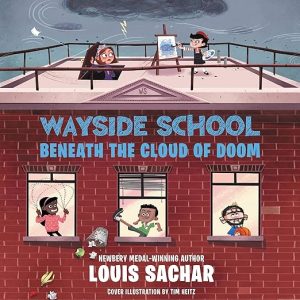
A mysterious Cloud of Doom hangs over the thirtieth story while the whole class scrambles to prepare for something called the Ultimate Test, and that's the setup driving this audiobook, the first new Wayside School entry in twenty-five years according to its own synopsis. Sharie still loves her striped-and-spotted umbrella more than anything, Kathy still suffers from a self-diagnosed case of oppositosis, and Jason is still stuck reading the longest book in the world.
Arunan Tracks a Shift from Jokes to Story Arcs
Returning to a beloved series after a twenty-five-year gap is a real risk for any author, and Louis Sachar's approach here is to bring back the familiar cast wholesale, Mrs. Jewls's class on the thirtieth floor, alongside a genuinely new central mystery rather than just recycling the same joke shapes from the original trilogy. Reviewer susan, who read the first three Wayside books "to elementary school library students for years," specifically calls out Todd, Maurecia, and Mrs. Jewls being "back to continue sharing the joys and struggles" of Wayside life, evidence that the returning cast reads as continuity rather than nostalgia-bait.
arunan's review tracks something more structural: a shift "from single stories in book 1 to long story arcs in book 3," and notes this fourth entry pushes further still, feeling like "a proper novel" rather than a set of standalone chapters. For a series built on episodic absurdity, that's a meaningful evolution, plot and character arcs growing in step with the readership that first met these books decades ago.
The Ultimate Test itself functions as a genuine plot engine rather than a one-off joke the way earlier Wayside conceits often did, a single event the whole class is working toward across the runtime, with the Cloud of Doom looming above it as an actual unresolved mystery rather than background color. That's a different shape than "one weird thing happens per chapter," and it gives a listener a reason to keep going beyond the next isolated gag.
Sachar Narrates His Own Sequel After Twenty-Five Years
Emily P's review captures the generational hinge this book sits on directly: books loved "as a kid in the 80's" now being read to a sibling's kids, with a fourth volume "written for THEM," acknowledging real anxieties without losing the format's core silliness. That's a harder balance to strike than a straightforward comedy sequel, and that review credits the book with landing it by folding a gentler, more current message about friendship and bravery into the same absurdist school logic Sachar established decades earlier.
Charlsie's review adds a useful, concrete data point: an 8-year-old son reading at a "mid/late 2nd grade level" finding this "fun and great," which for a book following three predecessors originally aimed at a slightly older bracket suggests this fourth entry lands accessibly even for younger readers just catching up to the series.
Sachar personally narrating this one after such a long gap is also worth noting on its own: the same voice a reader from the original trilogy's era would remember is the one delivering the sequel, rather than a new narrator standing in for an absent original reading. For anyone whose own memory of these books is bound up with a specific remembered cadence, that continuity of voice across twenty-five years carries weight a fresh narrator simply couldn't replicate.
Full Five-Star Reviews Outscore the Displayed 4.8 Badge
Every one of the five written reviews attached to this listing gives a full five stars, yet the displayed rating sits at 4.8, meaning the visible sentiment actually runs higher than the badge shown above it rather than lower, an unusual direction for a books-data mismatch to run. Whatever produced the 2 counted votes behind that 4.8 figure, the five people who left full write-ups here were uniformly enthusiastic, not split or lukewarm.
susan's review breaks off at "just as schools clo," and arunan's at "book 3 was more plot-driven an." Both reviews still deliver a clear point before the cutoff, susan's enthusiasm for having new material to share with students, arunan's structural comparison to book 3, so the missing endings don't undercut what each already established. HarperCollins publishes this fourth entry, distinct from Listening Library, which handled the earlier trilogy's audio editions, worth knowing if you're tracking which imprint is behind a given Wayside release.
Three Hours Fits Brand-New and Longtime Listeners
Twenty-five years is a long enough gap that longtime fans of the original trilogy and brand-new listeners are arriving at this book from genuinely different starting points, and both groups get served here: Pete B.'s review notes it "can be read on its own" while still keeping "up with characters from the past," which matches how the story is actually built. Families reading across generations, an adult who grew up on the earlier books now sharing them with their own kids, are a specific and real audience this entry seems aimed at.
Newer or younger listeners drawn in purely by this being the current, most recent entry should know it does lean on returning characters and a longer, more novel-like structure than the earlier episodic books; working through the original trilogy first will make the returning cast land with more weight.
At just 3 hours, the runtime itself is no obstacle either way, short enough for one or two sittings regardless of which audience you're coming from. Given a full five stars from every one of the five listeners who bothered to write a review, and a warm reception across an admittedly small sample, the appetite for more Wayside stories after a quarter-century gap looks real rather than manufactured by nostalgia marketing alone.
Frequently Asked Questions
Why did it take so long for a fourth Wayside School audiobook to release?
The synopsis itself describes this as the first new entry in twenty-five years, without explaining the specific reason for the gap. What's confirmed is that HarperCollins, rather than Listening Library, publishes this installment, a change from the earlier trilogy's imprint.
Is this audiobook appropriate for younger kids compared to the earlier Wayside books?
Reviews suggest yes. One parent describes an 8-year-old reading at a mid to late second-grade level enjoying it fully, suggesting this entry lands accessibly even for younger listeners just starting the series rather than only working for its original older readership.