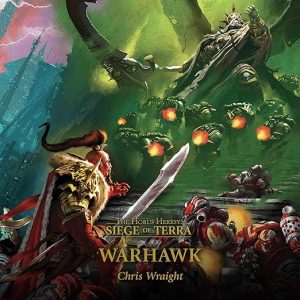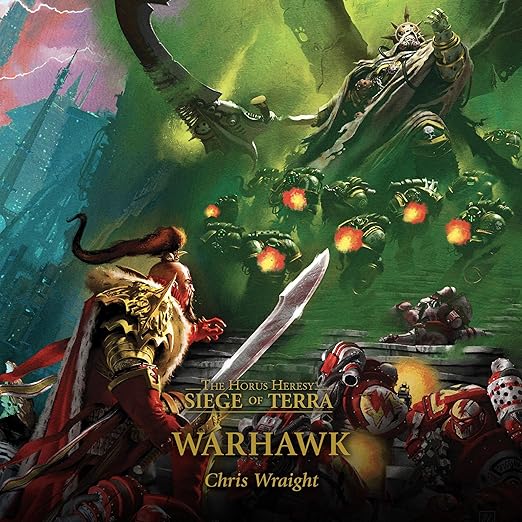
I was not prepared for how much Warhawk would affect me. Chris Wraight has been writing the White Scars across the Horus Heresy series for years, and he has built something rare across that body of work: a Legion that feels genuinely philosophically distinct from its brothers, not just aesthetically different. The White Scars move. They are speed made doctrine, grassland wind given ceramite and chainblade. Watching that speed doctrine meet the Death Guard, Mortarion's Legion of plague and patience and biological inevitability, is watching two incompatible philosophies of existence try to destroy each other. It is one of the most conceptually resonant matchups in the entire Siege of Terra series, and Wraight earns every page of it.
The setup finds the Inner Walls breached, traitor vanguards pressing toward the heart of the Palace, and Jaghatai Khan, the Warhawk of Chogoris, preparing the most audacious counter-offensive of the siege: a drive to retake the Lion's Gate Spaceport from an enemy that holds it with near-overwhelming force. Cut off from any support, the Khan stakes the entire White Scars Legion on a single desperate charge. Wraight knows exactly how to calibrate this kind of all-or-nothing moment, having built toward it across multiple novels and shorter fiction spanning the full arc of the Heresy series.
First, the Big Picture
The Primarch duel between Jaghatai and Mortarion is the book's narrative apex, and reviewer Christopher Capo described it as the titanic, spectacular, and tragic confrontation that the series had been building toward. Both adjectives matter in ways worth unpacking. Spectacular is easy; tragedy requires the author to have made you care about both combatants, and Wraight has done that work across years of storytelling. Mortarion in this book is not a villain but a corrupted figure who made choices that made sense to him and has become something monstrous through the accumulated weight of those choices. The Khan fights him understanding what he was before he was this, and that understanding is what makes the combat more than an action set-piece.
Sigismund receives significant POV time here, and reviewer Christopher Capo specifically encourages fans of the Emperor's Champion to read this book for his arc alone. Sigismund unleashed, his will made manifest, is a different kind of character than the controlled warrior of earlier books, and Wraight handles the tension between his duty and his nature with precision. The black sword rising, forged from spite, is one of the more memorable image clusters in the Siege of Terra series.
Why Warhawk Works as an Audiobook
The Siege of Terra series is moving toward an end that every reader knows is coming, and Keeble has been building the sonic architecture of that approach across every installment he has narrated. In Warhawk, which functions as the White Scars' final major Horus Heresy appearance, his narration carries a quality of elegy alongside the action. The Khan's battle sequences are voiced with the kinetic energy that Wraight's prose demands, but the quieter scenes between the Khan and his commanders, the conversations that know they are last things, are delivered with a restraint that makes them genuinely moving rather than merely competent.
A Few Reservations
The Death Guard's transformation by this point in the Siege is significant to understanding why this battle matters as much as it does. Mortarion's forces are not simply traitors: they are the physical embodiment of a philosophy diametrically opposed to everything the White Scars represent. Speed versus rot. Wind versus disease. The book makes this opposition felt rather than merely stated, which is a craft achievement worth noting. One reviewer noted wishing the book had stayed more exclusively with the White Scars rather than including other-faction POVs, but the Sigismund thread earns its place and the Death Guard perspective is essential to understanding Mortarion's arc.
Who Should Listen to Warhawk
White Scars fans absolutely. Siege of Terra readers who have worked through the preceding volumes will find this one of the most satisfying installments in the subseries. It rewards the accumulated investment of the entire Heresy saga. Newcomers should not start here: the emotional weight requires the series behind it, and the payoff of the Khan and Mortarion's final confrontation is only comprehensible through the lens of everything that has come before.
Before You Press Play
- Narration: Jonathan Keeble delivers what may be his finest performance in the Siege of Terra series, finding the emotional register of a Primarch war that is also a family tragedy.
- Themes: Speed versus endurance as philosophies of war and life, corruption and what it costs to fight it, the meaning of final sacrifice
- Mood: Epic and elegiac, building toward a Primarch confrontation that White Scars fans had been waiting for across the entire series
- Verdict: The strongest White Scars novel in the Horus Heresy and one of the Siege of Terra's genuine peaks.
Is Warhawk the final White Scars novel in the Horus Heresy series?
Yes. Warhawk is the concluding White Scars installment in the Siege of Terra series, and Wraight designed it as a proper sendoff for Jaghatai Khan and his Legion. One reviewer noted wishing the book had stayed more exclusively with the White Scars, but the consensus is that this is a fitting conclusion to years of White Scars storytelling across the full Heresy arc.
Is Jonathan Keeble's narration of Warhawk different from his narration of earlier Siege of Terra entries?
Long-term listeners note that Keeble brings an additional elegiac quality to Warhawk that suits its position as a series farewell for the White Scars. The performance is widely considered among his strongest in the series, particularly in the quieter scenes between the Khan and his commanders before the final battle commences.