Quick Take
- Narration: Cris Dukehart handles the multi-POV demands of M.D. Cooper’s sprawling cast with precision, her voice is clear and differentiated enough to track characters across a complex ensemble.
- Themes: Galactic war and shifting allegiances, the cost of ascension and transformation, strong female leadership in military SF
- Mood: Propulsive and sprawling, best consumed as part of an ongoing binge
- Verdict: Book six of the Orion War delivers on its promise to existing fans of the Aeon 14 universe, but the series’ expanding scope finally starts to create navigational friction in this entry.
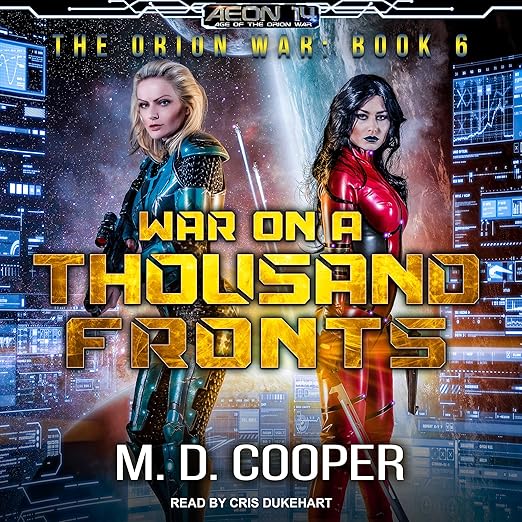
I was somewhere in the middle of a long train journey, the kind where the landscape has long since become repetitive and your attention needs something with genuine velocity to stay anchored. War on a Thousand Fronts was the right choice for that context. M.D. Cooper writes military science fiction that moves, and Cris Dukehart narrates it with the kind of steady energy that keeps eight-plus hours from dragging. The problem I found, and it’s the problem that follows every sprawling space opera by book six, is that the universe has grown faster than any single story can comfortably contain.
This is the sixth installment in Aeon 14: The Orion War, itself one branch of a larger Aeon 14 multiverse that Cooper has been building since the series’ early days. The Allied fleet has beaten back the Nietzscheans at Pyra, but as the synopsis makes clear, the battlefront continues to widen. Tanis must process what happened to her on Pyra’s surface while grappling with truths conveyed by the AI Bob that will reshape her understanding of her role in humanity’s future. Meanwhile, General Greer, Justin, the Caretaker, and Airtha are each advancing their own competing agendas.
A Universe That Has Outgrown Its Seams
The richest praise this series has earned is for its female protagonists, and it’s deserved. Cooper has built a cast where women lead militaries, ascend into post-human intelligence, and carry the weight of civilizational decisions without being defined by their gender. One reviewer who came in as a skeptical reader of hard science fiction admitted being won over specifically by how non-shallow these characterizations are. That strength is still present in this volume.
What’s complicated here is what one reviewer diplomatically called feeling “rushed.” The deeper issue is structural: War on a Thousand Fronts introduces characters whose primary function is to gesture toward other Cooper series. Readers who haven’t engaged with those parallel storylines may find this entry feels less like a complete narrative than an advertisement. That same reviewer chose not to pursue the advertised series, which tells you something about the risk when cross-promotion is too visible in the text itself.
Tanis and the Transformation Problem
The central arc of this book belongs to Tanis, and specifically to the aftermath of her merging with the AI Angela to form Tangel. It’s the kind of post-human transformation that science fiction handles well when the author is willing to let the new entity feel genuinely strange rather than simply more powerful. Cooper is only partially successful here. Tangel is formidable in ways that stretch the imagination, but the emotional interiority remains recognizably Tanis, which makes the transformation feel less like a rupture than an upgrade. That’s a storytelling choice with implications for where the series can go from here.
The parallel storyline involving Sera managing the Transcend in her mother’s absence provides useful contrast. Sera’s difficulties are more immediately relatable, and her arc in this volume has a satisfying internal rhythm that Tanis’s doesn’t quite achieve. The supporting antagonists, particularly Airtha, continue to be among the most interesting figures in the series.
Cris Dukehart Holds It Together
Narrating a series this large requires more than good vocal craft. It requires a listener’s memory. Dukehart clearly knows this universe well, and the continuity of her character work across a cast this sprawling is impressive. New listeners might find the density disorienting even with her performance, but anyone who has been following this series in audio will appreciate how stable and clean her delivery keeps the experience.
The pacing is fast by military SF standards, and that’s a structural feature of the Aeon 14 universe rather than a flaw. Cooper writes in compressed, action-forward chapters that don’t dwell long on any single thread. In a series this interconnected, that compression is what allows the narrative to remain in motion. The tradeoff is that emotional beats sometimes pass before they’ve fully landed.
Who Should Start Here and Who Should Step Back
This book is not an entry point. If you haven’t read the prior five Orion War volumes and at least some of the foundational Aeon 14 material, you will be lost within the first hour. For committed fans of the series, this is exactly what they’ve been waiting for, even if it’s a slightly messier entry than the best previous volumes. The action is large-scale and well-constructed, the stakes are clear, and the connective tissue to what comes next is firmly laid.
If you’ve been on the fence about the Aeon 14 universe, start at the beginning and let the momentum carry you to this point. The series earns its complexity. It’s just that complexity, by book six, requires some patience that the earlier volumes didn’t demand.
Frequently Asked Questions
Can I start Aeon 14: The Orion War with this book, or do I need to read the prior five volumes first?
This is not a standalone entry. The book assumes full familiarity with the events of the previous five Orion War installments and the broader Aeon 14 universe. Starting here would mean missing all the context behind Tanis’s transformation, the political factions, and the core relationships that drive the story.
Does War on a Thousand Fronts require reading the parallel Aeon 14 side series to understand what’s happening?
Cooper states you don’t need to, but some readers have found that certain characters introduced here make more sense if you’ve encountered them in their own series. The main narrative is followable without the side material, but you may feel certain introductions are underdeveloped.
How does Cris Dukehart’s narration handle the large cast of characters?
Very competently. Dukehart has narrated enough of this series to maintain consistency across a complex ensemble. Her differentiation between characters is clear, and her pacing suits Cooper’s fast-moving prose. She’s a strong match for this material.
Is the Tanis and Angela merger resolved in this book, or does it carry forward as an ongoing arc?
The transformation into Tangel is an ongoing arc that continues to evolve. This volume explores the aftermath of the merging and its implications for Tanis’s role in the war, but it does not resolve the question of what this new entity ultimately becomes. That thread runs through the broader series.