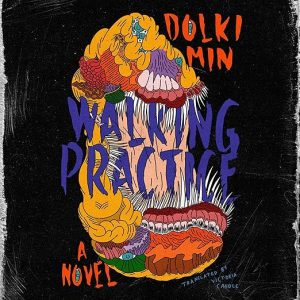
- Narration: Nicky Endres delivers a genuinely fluid performance that matches the alien protagonist's shifting identity, she handles gender fluidity and tonal whiplash with real skill.
- Themes: Alienation and belonging, queerness as otherness, predation and empathy
- Mood: Darkly comic and unsettling, with bursts of psychological intensity
- Verdict: A short, sharp, genre-bending debut that rewards readers willing to sit with its discomforts.
I finished Walking Practice on a Tuesday afternoon when I had about ninety minutes to spare before a call, not expecting it to linger the way it did. Dolki Min's debut, translated from Korean by Victoria Caudle, is the kind of book that arrives with a headline comparison (Squid Game meets The Left Hand of Darkness meets Under the Skin) and somehow manages not to collapse under the weight of it. At four hours and twenty-six minutes, it is brief, but the compression is intentional. This is not a novel that wants to sprawl. It wants to press on a bruise.
The setup is disorienting by design: a shapeshifting alien crash-lands on Earth, disabled by gravity, and learns to navigate human bodies and human desires in order to hunt. Sex is the lure, violence is the method, survival is the motive. It sounds like provocateur fiction, and in the hands of a less careful writer it would be. But Min keeps redirecting the reader toward something more uncomfortable, the way the alien must study and perform identity, reading signals, adapting presentation, mimicking desire. The satire of human social performance is relentless.
How Walking Practice Holds Up
What makes this novel interesting rather than merely transgressive is its empathy problem, or rather, the absence of empathy that slowly develops into something resembling it. The alien does not understand humans as individuals; they are nutrients. But the night the alien fails to kill forces a reckoning with interiority that the book handles with a light, precise touch. Min does not moralize. The alien's shift is not a conversion. It is more like a fracture in a lens.
One reviewer compared it favorably to Jeff VanderMeer's Borne, and I think that is a useful frame: both books ask what it means to be a creature that did not choose its nature, dropped into a world that will not accommodate it. Walking Practice is more sexually explicit than Borne and considerably more satirical, but the underlying question, what does it cost to adapt, and what gets lost, is shared.
The Best Parts of Walking Practice
Nicky Endres is a significant reason this works as an audiobook. The alien narrator shifts gender presentation and tone chapter by chapter, and Endres matches that fluidity without overperforming. She brings a kind of cool observation to the early hunting sequences that tips into something rawer when the psychological weight accumulates. One reviewer noted that the narrator pulled the whole thing together and brought the character to life, and that tracks with my experience. A less careful reader could have turned this into camp. Endres keeps it strange in the right way.
Victoria Caudle's translation deserves acknowledgment too. Korean literary fiction in translation often suffers from a certain flattening of register, but Walking Practice retains its edges. The sentences have tension. The comedy, and this is often darkly funny in ways that sneak up on you, lands.
Before You Commit to Walking Practice
The explicit content is substantial and not incidental to the story's argument. Min is writing about bodies as instruments of performance and violence, and the sex scenes are part of that critique. If you came in expecting the premise to be decorative, you will be surprised by how literally it is pursued. One reviewer described it as delving far deeper into sex than they cared for, and that is an honest assessment, but the content is purposeful, not gratuitous in the way of genre shock fiction.
The pacing flags slightly in the middle sections where the alien's depression and internal monologue stretch out. A couple of reviewers noted this too: the introspective episodes that would likely read as meditative on the page can feel elongated in audio. The ending is abrupt in a way that divides readers, some find it haunting, others feel it was rushed. I landed on the side of haunted.
Should You Listen to Walking Practice?
This is the right listen if you have an appetite for literary science fiction that does not resolve cleanly, enjoy translated Korean fiction, or are drawn to work that uses genre conventions as a vehicle for social critique. Fans of Sayaka Murata's Convenience Store Woman or Han Kang's The Vegetarian will find familiar territory here, the defamiliarization of the mundane, the body as site of societal pressure, the outsider perspective that illuminates the insider. Skip it if explicit content is a dealbreaker, if you prefer science fiction with clear moral frameworks, or if short, ambiguous endings frustrate you. At under four and a half hours, the investment is modest, but the discomfort is real.
A Few Questions About Walking Practice
Is Walking Practice suitable for listeners new to Korean literary fiction?
It can work as an entry point, but it is atypical, more genre-spliced and explicit than most Korean literary fiction available in English translation. If you want something more representative to start, Han Kang or Bora Chung might be a gentler introduction.
How explicit is the sexual content in the audiobook version?
Quite explicit. The alien uses sexual encounters as the mechanism for hunting, so these scenes are detailed and recurring throughout the four-and-a-half-hour runtime. This is central to the book's argument, not incidental.
Does Nicky Endres handle the gender-fluid narration convincingly?
Yes. Multiple reviewers specifically praised her performance for keeping the alien's shifting identity coherent without overacting. She brings a cool, observational quality to the early sections that deepens appropriately as the story progresses.