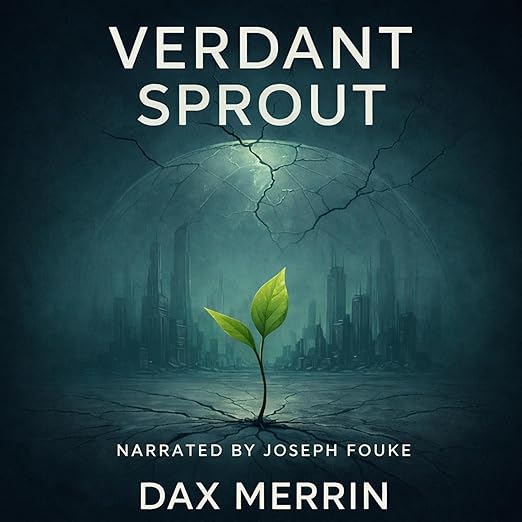
Quick Take
- Narration: Joseph Fouke handles the intimate, philosophical tone well, this is not an action narration but a reflective one, and Fouke sustains the right atmosphere for a story about hope in a sterile world.
- Themes: corporate control, ecological reclamation, the ethics of rebellion
- Mood: Quietly urgent, melancholic but resolving toward warmth
- Verdict: A compact, earnest SF fable that hits harder than its short runtime suggests.
I almost skipped Verdant Sprout because of its length, at just over three hours, it felt like a gap-filler rather than a real commitment. That was a mistake I am glad I caught. Dax Merrin’s debut Veridia Reclamation story is the kind of compact speculative fiction that uses its brevity deliberately, building a fully realized dystopian world and then cracking it open with something that feels genuinely hopeful without being naive.
The single reviewer on its Audible page described spending the runtime feeling the urge to cry, and then the sun came out. That is not a bad summary. Verdant Sprout is not a thriller. It is a fable in science fiction clothing, and it knows exactly what it is.
Our Take on Verdant Sprout
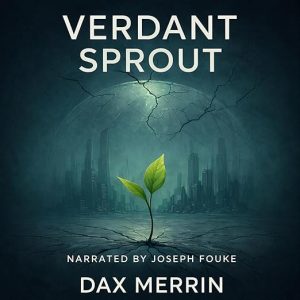
Veridia is a city that has forgotten the color green. Every breath is rationed by SyntheLife Corporation. The artificial sun overhead is precisely calibrated, and every circuit is programmed for sterile order. Merrin builds this world efficiently, you understand what has been lost without lengthy exposition about how the old world ended. The losses feel personal rather than historical, which is the right call for a story this short.
Raina Solen is a scavenger who finds a cracked data-crystal containing what the text calls living code, a fragment of a forbidden project called Verdance. The central metaphor is not subtle: a seed that refuses to obey the logic of the machine, a program that grows toward compassion rather than efficiency. But Merrin earns the metaphor through character. Raina is not a chosen hero. She is someone who happened to be in the right garbage heap at the right time, which makes her credible.
Why Listen to Verdant Sprout
The supporting cast is small but memorable. Lyra, the pragmatic underground leader, carries the weight of people who have been fighting for so long that hope feels dangerous. Jitterbug, the malfunctioning maintenance droid with ninety-one percent optimism, is the kind of character that could easily tip into whimsy but does not. The ninety-one percent detail is a good example of Merrin’s writing instincts, specific enough to be funny, precise enough to carry emotional weight when it matters.
Joseph Fouke’s narration matches the material. This is not a performance that pushes forward with urgency; it moves carefully, letting the philosophical weight of the ideas breathe. For a story about a city learning to breathe again, that seems right. The three-hour runtime means there is no padding, and Fouke does not create any artificially.
What to Watch For in Verdant Sprout
The allegory is front and center throughout. If you prefer your speculative fiction to hide its themes behind plot rather than lead with them, Verdant Sprout may feel too schematic. The SyntheLife Corporation is not a nuanced antagonist, it is a system, an idea, rather than a collection of human villains with competing motivations. That is appropriate to the fable structure, but it limits the kind of complexity readers accustomed to longer SF narratives might expect.
Given the short runtime, the world also remains somewhat underdeveloped in its specifics. We know Veridia through feeling more than architecture. For some listeners that will be a feature; for others, a limitation. The story trusts mood over detail.
There is also something worth saying about what Merrin does not do. He does not explain the Verdance project in exhaustive technical detail. He does not build an elaborate mythology around SyntheLife Corporation’s origins or the precise history of how Veridia forgot the color green. The restraint is intentional: a story about things that grow and breathe does not need to be pinned down with schematics. The living code works because it is mysterious, not because its parameters are documented. That choice requires trust from the reader, and Merrin earns it.
Who Should Listen to Verdant Sprout
This is for listeners who respond to ecological SF and speculative fiction with a philosophical or emotional core, readers who might also reach for works in the tradition of Ursula K. Le Guin’s shorter fiction or Becky Chambers’s Monk and Robot series. It rewards listeners who are comfortable with a story that prioritizes feeling over plot mechanics. If you want tightly plotted action or deep lore, this is not the right three hours. But if you want something that might actually move you, give it a try.
Frequently Asked Questions
Is Verdant Sprout a complete story or does it end on a cliffhanger?
It is a complete story with a resolved emotional arc. The subtitle calls it a Veridia Reclamation Story, suggesting more tales set in this world are possible, but the narrative Merrin tells here reaches a satisfying conclusion.
Is this appropriate for younger science fiction listeners?
Yes. The themes are meaningful without being graphic, and the story is accessible to teenagers and adults alike. Its ecological and ethical concerns are relevant to younger readers especially.
How does Joseph Fouke handle the droid character Jitterbug?
Fouke gives Jitterbug a distinct voice without making it cartoonish, there is warmth and a hint of comic timing that suits the character’s ninety-one percent optimism, while still keeping the tone of the broader story intact.
Is this really science fiction or is it more of a fable?
Honestly, both. The SF trappings, corporations controlling air, data-crystals, maintenance droids, are real enough, but the story operates like a fable with clear allegorical intent. If you need hard science in your science fiction, this is not it.