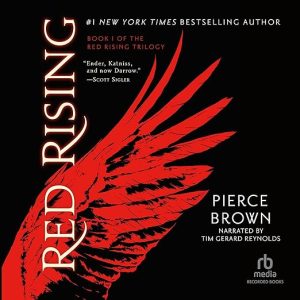
- Performance: Tim Gerard Reynolds reads the 2014 Recorded Books edition, a sustained first person with no second voice to share sixteen hours with.
- What it covers: caste and class war, infiltration and manufactured identity, Roman-styled institutional violence
- Feel: Furious and forward-driving, with a bleak opening act
- Our call: Worth the sixteen hours if you can accept a slow first stretch and a body count that starts early.
Darrow believes he is making Mars livable for his grandchildren, and he is wrong in a way the first hour of this audiobook does not soften. Pierce Brown puts the betrayal early, which matters more in audio than it does on paper: sixteen hours of caste war need a reason to keep going that arrives before the listener has finished deciding whether to. The reason arrives when Darrow learns that the surface was terraformed generations ago and that everything his people bleed for was finished before they were born.
Five-Star Reviews That Don't Match the Average
Ninety-three ratings sit behind the 4.6 on this listing, and all five of the responses you can actually read gave the book five stars. Those two facts do not sit comfortably together. A 4.6 across ninety-three whole-star votes puts the total somewhere between four hundred and twenty-four and four hundred and thirty-two, which means at least thirty-three stars have been withheld from a perfect score and none of that withholding is visible anywhere on the page. The written column is unanimous. The number it supposedly feeds is not. The listing also shelves the book twice, under literary fiction and under science fiction and fantasy, with an action and adventure tag on top, which is three claims about what kind of thing this is and a fair reflection of how hard it is to place.
None of the visible five treats this as a genre exercise. A May 2024 five-star describes an electrifying future society of stark class divisions and places Darrow inside a color-coded hierarchy that mirrors ancient Rome, which is the correct read: the Institute section is Roman on purpose, down to the house structure and the siege logic. That same response uses the phrase hooks readers from the very first page, and page is the operative word for very nearly everything written on this listing. What that response identifies correctly is the mechanism: Darrow does not rebel against the Golds so much as apply to become one, and the copy admits as much in its closing line, that he will stop at nothing even if it means becoming his enemy to do it. The novel spends sixteen hours making that sentence expensive.
Reynolds Carries the Slang-Heavy Institute Alone
Class drives this book and the Institute is where it changes gear. After the betrayal the novel turns into a boarding-school war story in which teenagers are handed a valley, a house name and a mandate to conquer each other, and in which the rules keep quietly failing to apply to the students whose families endowed the place. Sixteen hours and twelve minutes gives that structure room to compound rather than merely to happen. The reader of record on the Recorded Books edition, released January 28, 2014, is Tim Gerard Reynolds, working in a sustained first person that has no second voice to lean on. A book narrated entirely from inside one head is an unusual assignment at this length, because every other character has to be produced by the same person who is also carrying the grief.
Lisa Caskey's 2016 response is the most useful thing on this page for a newcomer trying to calibrate. It sets up a comparison with George RR Martin, describes a few chapters of adjustment before the style clicks, and then reports being unable to stop. That adjustment period is real, and it is a language problem: Brown writes in a compressed slang built out of color names, and the description hands you only two of them, Red and Gold. Everything else has to be assembled from context while the story is already moving. That is a deliberate effect and a real barrier, and it is the reason the first stretch asks more of a listener than of a reader, who can at least glance backward at a paragraph.
Slow Pages First, Then a Spoiler Warning
Pacing is the one recurring reservation, and it comes from the pool's most recent voice. A January 2024 response filed from Sweden puts the slow stretch at roughly the first hundred pages and calls it the ordinary cost of a story that needs foundations before it can build. In audio that stretch runs longer than it sounds, because you cannot skim a mine shaft. The same response, writing ten years after release, is already reading the fourth book in the sequence, which tells you what the payoff rate looks like from the far side of the setup. It also singles out the environments as the thing that stayed with it, which is worth knowing for anybody weighing whether the Institute sequence justifies the mine sequence that precedes it.
Spoilers are the second reason to be careful with this particular page. An October 2019 response filed from Spain opens with its own warning and then quotes a line from late in the novel, which is a fine line and a bad thing to encounter early. That response also explains why it bought digital rather than physical copies before a three-week trip. Taken together, the readable pool here is a reading pool: pages turned, print copies left at home, digital editions loaded for travel, a blog address in the first line of a review. Nothing about that invalidates the enthusiasm, but it does mean the sixteen-hour recording published by Recorded Books is being sold on the strength of verdicts about the text.
Real Political Stakes for Readers Wanting Grown-Up Sci-Fi
Readers who want political science fiction with real stakes and no interest in being gentle should start here. The pool's geography is its own recommendation, drawing on four countries, and one response written entirely in Dutch calls the book a tense, well-made story resembling The Hunger Games but more grown up. That comparison is the most efficient shorthand anywhere in the review column, and it sets expectations accurately for both the violence and the politics. Anyone who reached this book through the marketing rather than through friends will find the pool unusually consistent about the same two things: the opening drags, and then it does not.
Print loyalists and anyone who wants no lethal violence among young characters should look elsewhere, since the Institute makes competing for your life the curriculum and the description says as much outright. Listeners who need clean stopping points will also struggle, because the escalation is continuous once Darrow is inside the walls. Sixteen hours is a serious commitment, and what this edition offers in exchange is a novel that stops pretending its hero is innocent somewhere around the halfway mark. The description promises a proving ground. It delivers an education, which is a colder and more interesting thing, and the reason people keep going to the fourth book.
Common Questions
Do I need to know the series order before starting this audiobook?
No. Red Rising is the first book and the series field on the listing confirms it. Nothing in the story assumes prior knowledge, since the color caste system is explained as Darrow learns to survive inside it. Later volumes exist, but none of them matter on a first pass through this one.
Does the audiobook work if I have already read the print edition?
Yes, and possibly better. Everything written on this page describes reading: digital copies bought for a trip, physical books left behind, pages that could not be put down. The sixteen-hour recording is a different route through the same material, and rereaders arrive past the slow opening already.
Is the Institute really modeled on ancient Rome?
The house structure, the siege warfare and the naming conventions all point that way, and the description frames the Institute as a proving ground for the ruling caste. Treat it as Roman scaffolding on a Martian frame rather than a strict historical parallel, since the technology and the caste colors are entirely invented.