Quick Take
- Narration: Virtual Voice narration keeps the pacing functional but lacks the character-specific inflection this kind of fragmented-memory protagonist deserves.
- Themes: Post-collapse civilization, identity and amnesia, power through scarcity
- Mood: Gritty and atmospheric, with a slow-burn mystery underneath the action
- Verdict: A debut world-building effort with genuine ambition; best suited to readers who enjoy blending cyberpunk decay with emerging magic systems.
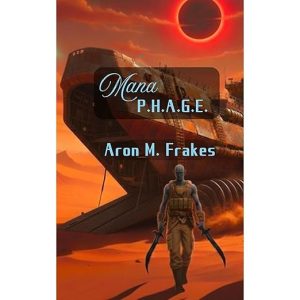
I picked up Mana P.H.A.G.E. on a slow weeknight when I was in the mood for something that felt genuinely strange. The concept drew me in immediately: a genetically enhanced assassin who wakes outside his own time, in a civilization built atop the ruins of a megacorporate empire that collapsed more than a millennium ago. It sits at the crossroads of post-apocalyptic science fiction and secondary-world fantasy, and Aron Frakes leans into that tension with clear intention.
The one listener review available calls it “Mad Max with Magic” and that description is more accurate than it might first appear. This is a world where orbital space stations and anti-gravity vehicles once existed, where genetic designers and elective cybernetics were consumer products for those with enough credits. All of that has crumbled. What remains are the bones of those megacities, the secrets left behind, and a survivor who remembers almost none of it.
Our Take on Mana P.H.A.G.E.
What Frakes gets right is the texture of the setting. The collapse here is not a clean catastrophe but a layered one, and you feel that in the way remnants of technological civilization coexist with a world that has moved on to something rawer. Bullets as currency. Mana as power. The one who accumulates the most of either makes the rules. It is a blunt economic logic that suits the brutality of the world, and it does not overstay its welcome as a framing device. The protagonist waking into this reality with fractured memories creates a discovery structure that works reasonably well for the genre.
The weakness here is the Virtual Voice narration. For a story that hinges on a lone survivor piecing together his identity, the narration needs to do significant emotional work in those quieter moments of self-reckoning. AI narration can handle plot momentum, but the interior texture of this particular character, someone genuinely lost in time and memory, would have benefited enormously from a human reader who could modulate the silences. As it stands, the production is functional rather than immersive.
Why Listen to Mana P.H.A.G.E.
The appeal here is the genre fusion itself. If you are a reader who grew up on cyberpunk and has migrated into progression fantasy or secondary-world fantasy over the last decade, Mana P.H.A.G.E. occupies an interesting middle space. Frakes draws on the megacorporation aesthetics of the cyberpunk tradition, the resource-scarce brutality of post-apocalyptic fiction, and the magic-system logic that readers of LitRPG and progression fantasy will recognize, even if this book does not rigidly adhere to those conventions. The blend is original enough to be worth the time investment.
The protagonist’s situation is genuinely compelling as a premise. A genetically enhanced assassin is already a character type with built-in kinetic energy, but stripping him of memory and dropping him thousands of years past his own era forces the kind of existential disorientation that good speculative fiction uses well. Watching him uncover clues about his past and the world he now inhabits gives the story a dual narrative function, both action and archaeology.
What to Watch For in Mana P.H.A.G.E.
The book is a debut release from Midnight Publishing, and some of the roughness that comes with that territory is present. The world-building is ambitious enough that it sometimes outpaces the character development. The protagonist’s emotional journey toward reconstructing his identity can feel secondary to the mechanics of the setting. At roughly thirteen hours, the story does not overstay its welcome, but readers hoping for a fully resolved arc should know this reads as the opening chapter of something larger. The series potential is evident; the standalone satisfaction is more modest.
Worth noting: with only a single listener rating at the time of writing, the reception data here is thin. The one review is enthusiastic, but a larger sample size would give a clearer picture. This is a book that may find its audience gradually, particularly among readers who discover it through the progression fantasy or post-apocalyptic pipelines rather than mainstream science fiction.
Who Should Listen to Mana P.H.A.G.E.
This is a strong pick for listeners who want their post-apocalyptic settings to carry some intellectual weight alongside the action, and who do not require polish in the narration. If you have a high tolerance for world-building-first pacing and enjoy watching a mystery unfold from the inside of a fractured mind, the premise delivers. Skip it if Virtual Voice narration breaks your immersion entirely, or if you need a standalone story with a fully resolved arc rather than a series opener.
Frequently Asked Questions
Is Mana P.H.A.G.E. the start of a series or a standalone?
Based on the scope of the world-building and the open-ended nature of the protagonist’s quest to recover his identity and history, this reads clearly as the first entry in a planned series rather than a self-contained story.
How does the magic system relate to the technology in the world?
The synopsis positions mana and bullets as parallel currencies of power in a post-collapse civilization where advanced technology once blurred the line between science and magic. The magic system appears to emerge from or alongside that collapsed technological order rather than existing independently of it.
Does the Virtual Voice narration significantly detract from the listening experience?
For action and plot-driven sequences it is adequate, but the story’s emotional core involves a protagonist with fragmented memories and a lost identity, which is exactly the kind of interior psychological territory where AI narration struggles most. Listeners who are sensitive to narration quality may find it limiting.
What other audiobooks is Mana P.H.A.G.E. comparable to?
The Mad Max meets magic description from the one available review is apt. Listeners who enjoyed the Cradle series by Will Wight for its progression-through-scarcity logic, or who liked the post-collapse world-building of Pierce Brown’s Red Rising, will find familiar pleasures here, though Mana P.H.A.G.E. operates at a smaller scale.