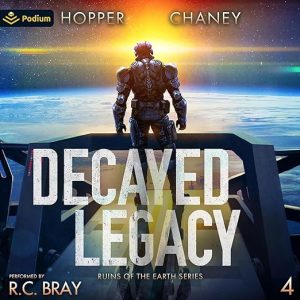
The craft question with a fourth volume in an action-heavy military SF series is always whether the momentum that sustained the earlier books has been maintained or whether the formula is beginning to show its seams. Christopher Hopper and J.N. Chaney have built a sustainable series architecture in Ruins of the Earth by investing heavily in two things: a team dynamic that keeps generating genuine surprise, and a humor register that never tips into self-parody. Decayed Legacy, the fourth audiobook in the series, demonstrates that the formula is holding with significant confidence and that the creative energy behind it has not been exhausted by the prior entries.
The setup for this entry does something structurally interesting. Following the events above Manhattan in the previous book, with Phantom Team defeating Gornath of the Ontishog and saving Earth from a devastating plague, the natural move would be a victory lap before the next threat emerges. Hopper and Chaney instead use that post-victory moment as a threshold. Major Insarka Kindesh's invitation back to Karkin Four becomes a reorientation of stakes: the mission is no longer defensive but humanitarian, the challenge of rescuing millions of humans stranded on a backwater planet introducing a moral weight the pure action beats of earlier entries did not carry quite as prominently.
First, the Big Picture
R.C. Bray is one of the few narrators whose name functions as a reliable quality signal for military SF regardless of which title he is attached to. His voice work here does what it does best: the tactical command scenes have a precise, clipped authority; the banter between Wic and the rest of Phantom Team has genuine comic timing; the moments of actual emotional weight are not overplayed. A reviewer describes the military tactics and communication as landing with particular resonance for those who have served, and Bray's delivery is a significant part of why that authenticity translates into audio with such consistency across the entire series run.
Sir Charles, referenced in the synopsis with the joke about the bucket of flounder, is the kind of secondary character this series handles better than most. The Ruins of the Earth books have built an ensemble where the secondary figures are not just functional presences but sources of comedic energy that never undercuts the tension of the action sequences. Bray understands the specific pitch that kind of character requires, and the audiobook is measurably better for that understanding throughout. Reviewers who highlight Chuck as a standout element are responding to something real in how Bray handles those scenes.
The comparison points offered by the authors, fans of Galaxy's Edge, Expeditionary Force, and District 9, are useful and reasonably accurate in identifying the target listener. This is military SF that takes its tactics seriously while maintaining the conviction that the genre does not need to choose between competence and humor. The Blood Guard's covert operations against an Androchidan Empire in the throes of war provide the geopolitical backdrop without demanding the close attention that harder SF worldbuilding often requires from its readers when it is less skillfully managed.
One reviewer notes that this is the kind of material where non-stop action, front-line humor, and imaginative weapons are the primary draws, and that the editorial and writing quality supports them without qualification. That is the honest framing for what this audiobook is. Decayed Legacy is not a book interested in quiet introspective moments or stylistic experimentation. It knows what it is doing and does it with considerable skill. The ten hours and forty minutes of runtime feel appropriately paced, enough material here to justify the length without the filler sections that sometimes inflate audiobook series entries into frustrating territory.
What to Watch For in Decayed Legacy
This is book four in a continuing series and it does not function as a standalone entry in any meaningful sense. Phantom Team's history, the relationships between characters, the prior missions, the specific nature of the origin ring technology and the galactic political landscape, all of these are assumed knowledge for this installment. Listeners who encounter this audiobook without the prior context will follow the action but lose significant texture from everything that makes the character dynamics resonant and earned. The recommendation is firm: start from the beginning of the Ruins of the Earth series before arriving here.
The marooning-in-enemy-territory structure of the central conflict has been a staple of the genre for decades, and Hopper and Chaney are not reinventing it here. What they are doing is executing it with enough character specificity and tactical creativity that the familiar framework feels inhabited rather than merely borrowed. Listeners who come expecting genre reinvention will be disappointed. Listeners who come for a well-executed version of exactly what the series has always offered will find considerable satisfaction across the full runtime of this fourth entry.
Is This One for You?
This audiobook is for committed fans of the Ruins of the Earth series who have followed Phantom Team from the beginning, and for readers already drawn to Galaxy's Edge, Expeditionary Force, and similar military SF series with strong ensemble casts and humor as a structural element alongside the action. R.C. Bray's narration is a significant part of the value proposition here. Listeners who have enjoyed his work on other SF titles will find him in characteristic form throughout. Skip this audiobook if military SF is not your category or if you are looking for a series entry point; book four is definitively not where to begin this particular journey.