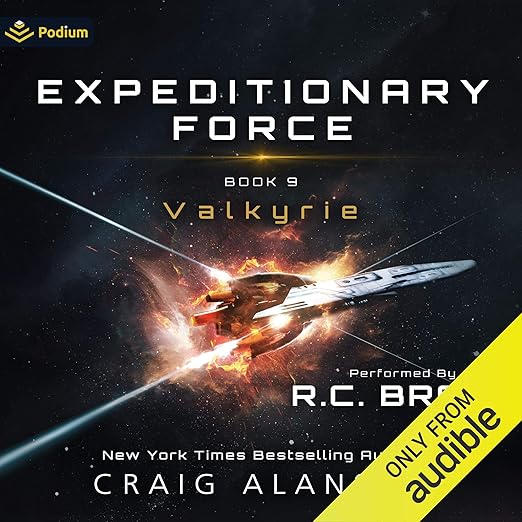
Quick Take
- Narrator: R.C. Bray is credited; nineteen hours of two-hander comic timing plus a darker turn is a heavy ask, and nobody has reviewed the result.
- Subjects: Military science fiction, doomed homeworld, human and artificial intelligence buddy comedy, reprisal over retreat.
- Tone: Funny, profane and unexpectedly bleak.
- Bottom line: A strong, divisive ninth installment for series veterans only.
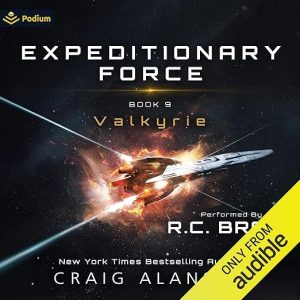
Book nine of Expeditionary Force arrives at the stage where a long series either consolidates or starts spinning its wheels, and Valkyrie does a little of both across an audiobook that runs nineteen hours and forty-five minutes. Craig Alanson has already given the Merry Band of Pirates a run of world-saving victories, and this installment opens with them accepting that the run is over: Earth is doomed, the best available outcome is evacuating a few thousand people before vicious aliens arrive, and the only remaining question is whether to go quietly. They decide not to. What follows is the most argued-about entry in the series so far, and the arguments are worth understanding before you commit twenty hours.
A Closer Look at Valkyrie
The premise is a real escalation rather than a cosmetic one. Eight books of narrowly averted catastrophe have trained this series' readers to expect the save, and Alanson opens by taking it off the table. Accepting that humanity's homeworld cannot be defended reframes everything the crew does afterwards as either logistics or revenge, and the book chooses revenge: hit the enemy hard enough that the aliens regret ever hearing of humans. That is a darker starting position than this series usually adopts, and it changes the emotional weather even while the jokes keep coming.
The jokes do keep coming, and the reviews confirm the machinery still runs. Sean Bai reports that the opening stretch “was some of the same old Joe and Skippy that we like”, which in this series is high praise and a promise kept. Viacheslav Vasiliev, four stars, describes an opening “at a decent pace, everything exploding and all, just what you'd expect from the Merry Band of Pirates”, then lists what the review came for: “Nice light-hearted jokes, killer bedsheets and my fav uncle Edgar.” If those words mean something to you, this is your book. If they do not, that is a signal in itself.
Where the three visible reviews diverge is the back half and the ending, and the split is unusually informative. Sean Bai calls the closing stretch a “side story” and reports that it “didn't feel detracted from the main story”, while titling the review around needing to process how it finished. Gavaronee, five stars, is emphatic in the other direction: “I thought Valkyrie was the best in the series yet”, and reports having “no idea where people are coming from when they say that the they hated the ending”. Vasiliev's title supplies the shape of the complaint without joining it: “Cliffhanger was inevitable at some point.”
The Joe and Skippy dynamic remains the reason this series has run to nine books, and Alanson has not let it curdle into routine. A frustrated human commander and an insufferably superior artificial intelligence is a comic pairing with a natural half-life, and the standard failure mode is for the banter to become a tic performed for returning readers. On the evidence of the reviews it has not happened yet; Sean Bai's phrase about “the same old Joe and Skippy” is affectionate rather than resigned, and the presence of running gags like the killer bedsheets suggests the series is still building its own private vocabulary rather than repeating it.
Nearly twenty hours is also the right shape for what this book attempts. A story that has to sell an evacuation, a reprisal operation and a substantial secondary thread needs room, and readers who came in expecting a tight one-mission structure are exactly the readers who found the middle slow. Approached instead as a long, discursive stretch of a much bigger campaign, the length reads as generosity. This is the ninth book; nobody arrives here wanting economy.
R.C. Bray is credited with the reading, and on a book like this the job description is unusually demanding. Nineteen hours of a two-hander built on comic timing means sustaining two voices whose entire relationship lives in the gaps between lines, keeping a synthetic intelligence's arrogance funny rather than grating, and doing it consistently enough to match eight prior installments in a returning listener's memory. Then the tone has to turn for the darker material about a doomed planet. The three reviews on file argue about plot, pacing and the ending, and not one of them about the audio, so the performance goes unassessed. What the material does is leave a reader nowhere to hide.
Things to Know Before Starting Valkyrie
The pacing complaint is specific and comes from the most enthusiastic reviewer in the sample. Sean Bai, who opens with “This book is amazing”, still records that “the middle 5-10% was very boring, with too much dialogue”. On a runtime this long, five to ten percent is somewhere around one to two hours of talk. If dialogue-heavy passages are where your attention goes, plan for a stretch in the middle where very little detonates and the crew works through its feelings instead.
Next, the structural choice. Sean Bai describes the last half of the story as a side story, and while the review is clear it did no damage to the main line, a reader hoping the final third would drive the doomed-Earth plot to a resolution should adjust. That expectation gap explains much of the divided reaction Gavaronee reports encountering, and it is worth knowing about in advance rather than discovering at hour fifteen.
Two more practical points. Vasiliev's title names a cliffhanger, so do not treat this as a stopping place if unresolved endings frustrate you; Gavaronee's plan to be first in line for book ten is the appropriate reflex. And the star average on this listing rests on a handful of ratings, which measures the edition's youth and not the series' standing. Judge it on the written reviews and on your own history with the previous eight.
Who Craig Alanson Is Writing For
This one is for the committed. Anybody who has already followed Joe and Skippy through eight books knows whether the formula still works on them, and Valkyrie delivers a bigger, darker, more argumentative version of it. Military science fiction readers who like their space opera funny, their artificial intelligences insufferable and their stakes planetary will find the series worth the entry cost, and this book is the one that finally cashes in the long-promised threat to Earth. Fans of long-running audio series, where a familiar reader and a familiar pair of voices become a habit, are the natural audience.
Newcomers should start at book one without exception. The synopsis assumes you know who the Merry Band of Pirates are and why an evacuation counts as a defeat, and reviewers casually invoke running gags that have accumulated across eight prior installments. Anyone who wants a self-contained story, dislikes cliffhangers, or has been losing patience with the banter as the series has gone on will find this the wrong place to test whether the itch has passed.
Questions Listeners Ask
Can I start the series with Valkyrie?
No. The description assumes you already know the Merry Band of Pirates and treats Earth's evacuation as a defeat only a returning reader can feel. Reviewers reference running jokes built up over eight prior books. Start at book one or the emotional logic here will pass you by entirely.
Does the audiobook end on a cliffhanger?
One four-star reviewer titles the write-up around a cliffhanger being inevitable at some point, and a five-star reviewer promises to be first in line for book ten. Expect the story to stop rather than to close, and expect the ending itself to be the thing people argue about.
Is the middle really as slow as reviewers say?
One reviewer who calls the book amazing still describes the middle five to ten percent as very boring with too much dialogue. On a nineteen-hour-forty-five-minute runtime that is roughly one to two hours of talk. Everyone else in the visible sample praises the pace of the opening.
Is nearly twenty hours a lot for this audiobook series?
It is on the long side and the shape is deliberate. The book carries an evacuation, a reprisal operation and a substantial secondary thread one reviewer calls a side story. Approached as a leg of a long campaign rather than a single mission, the length reads as generosity rather than padding.