Quick Take
- Narration: Hodgman's self-narration is essential; his timing, developed across years of The Daily Show and the Judge John Hodgman podcast, gives the dry literary humor a dimension that a studio narrator could not access.
- Themes: Middle age and self-reckoning, the comedy of class and geography in New England, the gap between the self we expected to become and the one we are
- Mood: Wry and melancholic, with the humor arriving sideways rather than head-on
- Verdict: Hodgman telling the truth turns out to be funnier and stranger than his invented persona, and the audiobook format is where his particular comedy finds its fullest expression.
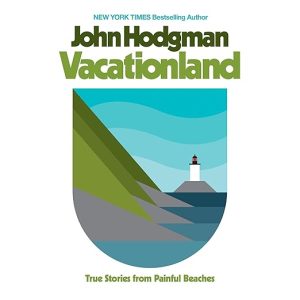
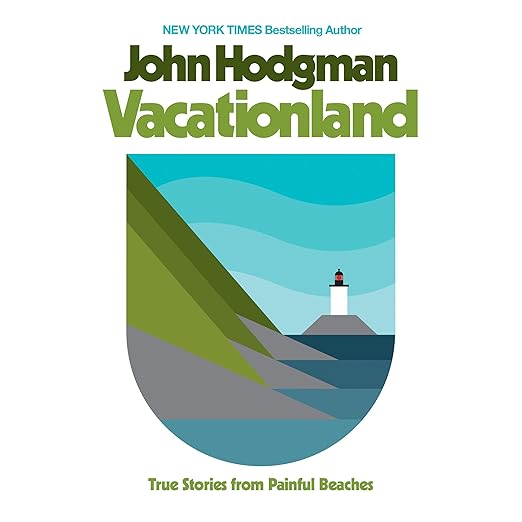
Vacationland's opening scenario arrives without ceremony in the audiobook: John Hodgman standing on a beach in Maine that wants to kill him, contemplating the evolutionary purpose of the mustache he has inexplicably grown, aware that he has become someone his younger self would not entirely recognize and is not entirely sure whether to grieve or accept that fact. The audiobook version of this collection is essentially mandatory for anyone who already knows Hodgman's work. He narrates himself, and the performance is doing something the prose alone cannot fully accomplish.
Hodgman built a career on invented facts, on persona, on the elaborate scaffolding of fabricated authority figures from his earlier books of fake trivia. By 2016, when he was assembling Vacationland, that routine had soured. His note in the book acknowledges it directly: when everyone is doing fake news, ironic falsehood stops being a pose and starts being a problem. What he does instead is what the audiobook spends five and a half hours documenting: tell the truth about who he actually is, which turns out to be funnier and stranger and more painful than the invented version.
The structure of the audiobook is essayistic rather than narrative. Hodgman wanders through three wildernesses in his own description: Western Massachusetts where he spent his youth, the coastal Maine that has replaced it as his primary geography, and what he calls the metaphoric haunted forest of middle age that connects them. The connections are real and the comedy that emerges from them is not the comedy of setup and punchline. It is the comedy of a person paying such careful attention to his own absurdity that the reader cannot help but recognize something of themselves in it.
His account of freshwater clams, the horror of encountering them in a Maine lake, is genuinely funny in the audiobook in a way that depends entirely on his delivery. The written version is funny too, but Hodgman's timing as a performer, honed across years of The Daily Show appearances and his Judge John Hodgman podcast, means that the audio format gives him additional tools. He knows when to let a sentence breathe and when to push through before the listener can decide they are in on the joke. Jon Stewart's blurb for the book, 'I love everything about this hilarious book except the font size,' captures something true about the humor: it is specific, dry, and arrives at you sideways.
The Strengths
The middle-age reckoning is sincere without becoming maudlin, which is a difficult balance to maintain over five-plus hours of autobiographical essay. Hodgman describes those years when men in particular must stop pretending to be 'the children of bright potential they were' and settle into 'the failing bodies of the wiser, weird dads that they are,' and the phrase is funny and sad simultaneously in the way that the best humor about aging manages to be. The audiobook works on that double register throughout.
One reviewer noted that prior familiarity with Hodgman's work from The Daily Show and the Judge John Hodgman podcast adds depth to the experience, which is accurate. But the same reviewer noted she had not encountered his earlier books of invented facts and found Vacationland compelling anyway, which confirms that the collection works as a standalone. Another listener who came to the book without prior Hodgman knowledge described him as 'very relatable, funny and clever,' which is the same response but without the comparative context. The book does not require its own backstory to deliver its goods.
Before You Commit to Vacationland
Listeners expecting consistent narrative thrust, a story moving forward toward resolution, will find the essayistic form disconcerting. Hodgman circles, returns, reconsiders. The book is not trying to arrive anywhere. It is trying to pay honest attention to where it already is, and that mode of attention can feel aimless if you are waiting for the next plot development. The five-and-a-half-hour runtime suits the material precisely because it is short enough that the circling never becomes actual wandering.
Listeners who are not familiar with Maine as a cultural concept, the specific class dynamics of coastal summer communities, the ritual suffering of swimming in genuinely cold ocean water, and the particular relationship that weekend residents have with year-round locals, may miss some of the texture in the Maine sections. Hodgman is working with a specific comedic geography that has its own rules, and while the humor lands even without deep knowledge of those rules, the resonance is deeper for listeners who have experienced any version of the things he describes.
Recommended For
This audiobook is for listeners who have found other practitioners of the self-deprecating literary humor essay, David Sedaris being the obvious touchstone, and want something with a distinctly American Eastern Seaboard register. It also works for existing Hodgman fans who want to hear what he sounds like when he is telling the truth rather than performing elaborate falsehood. And it works for anyone navigating their own version of the particular disorientation of middle age, the gap between the person you expected to become and the person you actually are.
Listeners who need their humor broad and their narrators energetic may find Hodgman's delivery too dry for sustained listening. His comedy is fundamentally literary, built on sentence construction and timing rather than performance in the theatrical sense. In audio format, that distinction matters. This is a book that rewards close attention to language, and the listener has to meet it at that level.
Do you need to have read John Hodgman's earlier books to appreciate this audiobook?
No. The audiobook works as a standalone. Prior familiarity with Hodgman's work on The Daily Show or his Judge John Hodgman podcast adds comparative depth, but first-time readers consistently find the collection compelling without that context.
How explicit is the self-examination in this audiobook, and does it become uncomfortably personal?
The self-reckoning is honest but not confessional in the way that requires the listener to manage secondhand discomfort. Hodgman's instinct is to frame pain through wit, which keeps the more vulnerable passages accessible rather than demanding.
Who is this audiobook for if you are not already a fan of John Hodgman?
Listeners who respond to literary humor essayists like David Sedaris or Sloane Crosley, or who enjoy self-deprecating memoir about middle age, will find the register immediately familiar. The humor is dry and requires attention to sentence-level construction rather than broad comedic performance.