- Performance: Jimmy Moreland handles eleven hours split between two battles happening a thousand light-years apart and cut against each other.
- What it covers: A species harvesting genetic material to survive, an old debt called in, a commander who cannot be in two places
- Feel: Brisk military space opera with a comic streak
- Our call: Precisely what volume sixteen of a self-published space opera should be, and a poor place to arrive new.
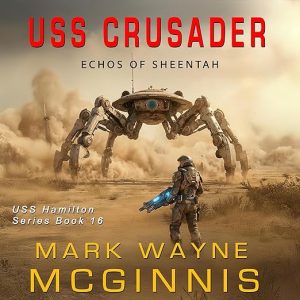
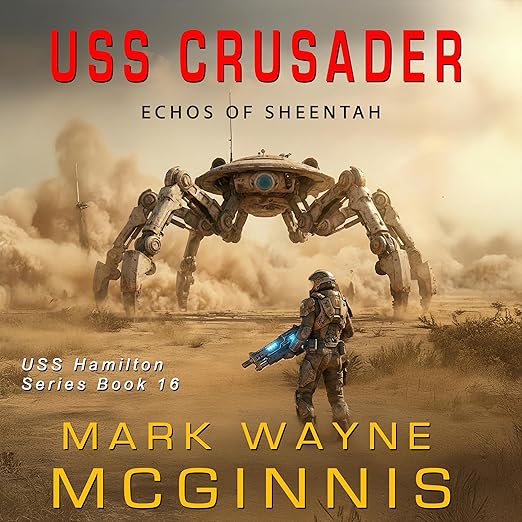
Where do you enter a series that has already run sixteen volumes? That is the practical question hanging over this audiobook, and the listing complicates it before you get anywhere near the plot: the title says USS Crusader, the series field says USS Hamilton, and the number attached to it is sixteen. Eleven hours and fourteen minutes of space opera sit behind those fields, with a retired officer pulled back into service, an alien species everybody believed had died out three centuries ago, and two separate emergencies unfolding a thousand light-years apart. It delivers exactly what it advertises. The advertising, in a couple of places, is incomplete.
Quintos is retired again, ranching, in love and thoroughly finished with fighting, which lasts until Admiral Gilbert calls in an old debt. The ship he returns to is both the joke and the premise: the USS Crusader, once the most powerful omninought in the fleet, has been stripped out and refitted as a glorified luxury liner for wealthy colonists. A five-star verdict from December 2025, from somebody reporting having read all sixteen books, adds detail the description withholds, describing an uppity governor, thirty-two hundred colonists, and a claim being staked on a planet called Topiaris in the Liberty Worlds System, all of it arriving with what that verdict calls the usual humor and drama.
Two fronts is the structural idea and it is the best thing in the design. At the wormhole exit sit twelve alien dreadnoughts belonging to a species presumed extinct for three hundred years, which has spent that time baiting traps across the galaxy and harvesting genetic material from colonists in search of a cure for the disease killing it. The search has now succeeded, and the answer is Lieutenant Akari James, one of Quintos's own crew. Then a message arrives from home: the ranch is under attack, and Pristy and his niece Sonya are fighting for their lives against a Pylor warlord everybody thought was dead. Two emergencies, one commander, no way to be in both places at once.
Why USS Crusader: Echoes of Sheentah Works as an Audiobook
McGinnis writes fast and the series reputation reflects it. A five-star verdict from February 2026 reports that the USS Hamilton books are always fast paced and that the reader in question finishes one inside a day or two of starting, which is an honest description of what a series like this is for. The running time fits that account: no doorstop, and a plot that moves in short scenes across the two fronts rather than settling into either. The alien biology gives the antagonists a motive beyond conquest, which is more than a great deal of military science fiction manages by its sixteenth outing.
Jimmy Moreland has the reading, and the cast list is the thing to weigh before buying. One voice has to carry a retired officer, an admiral calling in a favor, a governor written for comedy, an alien species negotiating across a species gap, a captive crew member and a ChronoBot the copy says is slowly losing his mind to enemy programming. That last one is the genuinely interesting problem, since the voice has to read as artificial from the start and then audibly come apart. Eleven hours across that spread of registers, with two battle sequences running in parallel, is a heavier assignment than a mid-series space opera usually suggests.
Weak Spots in USS Crusader: Echoes of Sheentah
Continuity is where the only substantive criticism on this page lands, and it earns attention because it is the only checkable claim anybody has made. A four-star verdict from January 2026, from somebody who says they have read and enjoyed every book in the series, reports repeated instances of characters knowing things they have no way of knowing. The example given is specific: Quintos is cut off from his ship and crew while a rescue is being planned, then asks about the operation on first contact as though he had already been briefed on it. That verdict says several more of the same kind occur. Continuity slips in a sixteenth volume are not fatal, but a reader that invested noticing them is worth taking seriously.
Self-publication is written into the record, since the publisher field carries the author's own name, which explains both the release cadence and the absence of the editorial layer that might have caught the problem above. The dates deserve a look too. The audio edition is dated 23 February 2026, and all five graded responses were written between 27 December 2025 and 6 February 2026, every one ahead of it, so the 4.6 across five hundred and twenty-five ratings is measuring a text rather than a recording. A five-star verdict from 20 January 2026 also supplies series payoff the description skips, tying the Sheentah to the origin of Harvey, a ChronoBot these books have been carrying for a while.
The Right Listener for USS Crusader: Echoes of Sheentah
Space opera readers already inside this series have nothing to decide; volume sixteen is volume sixteen and it behaves like one. For everyone else the appeal is a particular kind of comfort reading executed competently: a returning cast, a clear antagonist with a comprehensible motive, battles at a scale you can actually picture, and a running time short enough to finish inside a week of ordinary listening. A five-star verdict from 25 January 2026 puts the pitch about as economically as anybody could, calling it good action, good character development and good science fiction, and adding that it would make a decent film.
Latecomers should be honest with themselves about the arithmetic. Sixteen volumes of accumulated cast, running jokes and unpaid debts are the actual product on offer, and a first-time listener gets the plot without the payoff attached to it. Anyone sensitive to continuity slips should read the review column before buying rather than afterward, because the column is where the specifics live. And anyone shopping by title should register that the ship on the cover is not the ship in the series name, which stops mattering the moment you start and matters a great deal while you are still searching. Sixteen volumes in, that is the deal on offer.
Questions Listeners Ask
Is book sixteen a reasonable place to join this series?
Not really. The description assumes you already know Quintos, Captain Pristy, the ChronoBots and the Pylor, and the whole plot turns on an old debt incurred in an earlier volume. You will follow the battles perfectly well and miss entirely why any of it is supposed to cost him something.
Why does the title say USS Crusader when the series is USS Hamilton?
The plot explains it. Quintos is called out of retirement and posted to a different vessel, the Crusader, once the fleet's most powerful ship and now refitted as a liner for paying colonists. The series field still tracks the original name, so the mismatch is a fact about the page rather than the book.
Does this audiobook cut back and forth between the two battle fronts?
That is the structure the copy promises: twelve alien dreadnoughts at one end, an attack on the ranch at the other, and a commander who cannot reach both. Expect short alternating scenes rather than one sustained siege, which is a sensible shape for eleven hours and suits the pace the series is known for.
Does this audiobook finish its own story?
The copy sets up two emergencies and a ticking clock without indicating how either one resolves. What it does establish is a debt structure, closing on a line about debts costing more than you agreed to pay, which reads like a book that settles its own crisis and leaves an account open.