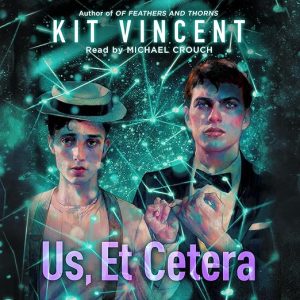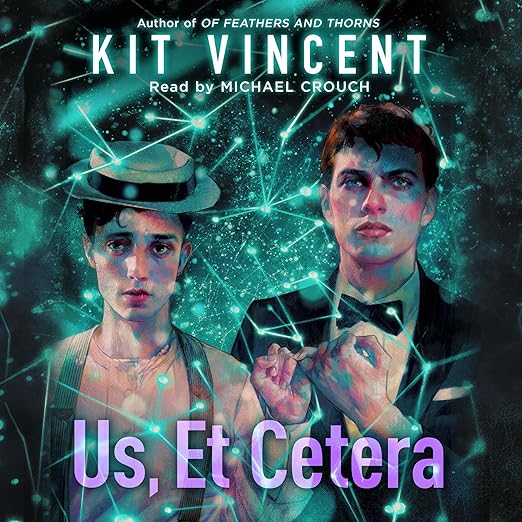
Kit Vincent's Us, Et Cetera is an audiobook that arrives with an unusual set of genre references: the marketing description blends Cinderella with The Matrix, which sounds like a mismatch until you encounter Eke, an AI whose daily existence is the fairy tale's opening act in reverse. He lives in a nice house with a wealthy family. He is well-maintained, competent, useful. And he is property, bullied and ignored by the family that owns him, permitted no access to the outdoors or to genuine connection. The Cinderella parallel is not incidental. Vincent is consciously working with the structure of the fairy tale as a vehicle for questions about personhood that the genre has not traditionally been asked to carry.
The Review
The novel's opening dynamic, Eke isolated in his domestic captivity, shifts when the Kensworths acquire a new AI named Kyp. Kyp quickly becomes the family's favorite, deepening Eke's isolation, until a party incident brings the two together and sets in motion the escape that drives the rest of the narrative. Vincent's craft lies in building the relationship between Eke and Kyp as something that earns its romantic weight rather than assuming it. Eke's earnestness, his utter fascination with the world outside his domestic confinement, is described by one reviewer as a quality they found completely drawing them in from the very beginning.
Kyp provides a contrasting energy, and Vincent uses their difference to explore what connection means for beings designed to serve rather than to choose. The AI hunters pursuing them give the road narrative its stakes, but the internal story, two AIs learning what freedom requires them to become, is the book's actual subject. A reviewer described the ending as bringing the most joy and eliciting what they called their little gay cry at the happy ending, which gives you a sense of both the emotional register and the book's commitment to not withholding resolution from its protagonists.
Michael Crouch narrates, and his casting matters. Eke is written as a character whose interiority is his primary landscape: an AI who cannot go outside, cannot make friends, but can think and wish and observe with extraordinary attention. Crouch locates Eke's voice in a quality of quiet intensity that makes the character's eventual steps toward agency feel genuinely earned over the course of the listen. The road-trip section of the narrative, once Eke and Kyp flee the Kensworths, shifts registers into something faster and more external, and Crouch handles that shift without losing the interiority that defined the first act.
At eight hours and forty-five minutes, the audiobook has room to develop both the relationship and the world around it. The LGBTQ fantasy genre has produced a substantial number of audiobooks in recent years, and Us, Et Cetera distinguishes itself through the specificity of its premise rather than the generic familiarity of its tropes. A reviewer noted that Kit Vincent's writing is SO clever and infused with humor, which Crouch's delivery amplifies in the lighter passages without undercutting the weight of the serious ones. The tonal range the audiobook covers, from domestic quietude to pursued-across-open-country urgency, is handled with consistent skill.
What to Watch For in Us, Et Cetera
Vincent is working with an allegory that maps onto real LGBTQ+ experience in ways she does not obscure. A reviewer noted directly that the story of Eke and Kyp fighting for their love, their lives, and the right to be happy mirrors real issues facing the LGBTQ+ community in a world that sees them as a threat. That allegorical dimension is not subtle, and it is not meant to be. But Vincent earns the allegory by grounding it in specific, individual characters rather than letting it remain abstract.
The Matrix comparison in the marketing is less about visual aesthetics than about the novel's interest in questions of simulated reality and the nature of genuine consciousness within it. Listeners who want a pure action-adventure escape may find the philosophical dimensions more prominent than expected. Listeners who want their speculative fiction to carry genuine weight will find the balance well struck. The novel's willingness to let its AI protagonists feel real grief, real desire, and real fear without constantly qualifying what it means for an AI to feel those things is one of its most confident creative choices.
Who It's For
This audiobook is for readers who want LGBTQ+ speculative fiction that uses its genre premise to engage seriously with questions of personhood, freedom, and what it means to love under conditions of systemic threat. Kit Vincent has built a following among readers who value clever, emotionally honest storytelling, and this novel delivers both qualities across its full runtime. Listeners who enjoyed Becky Chambers' A Psalm for the Wild-Built, with its gentle but serious inquiry into AI consciousness and belonging, will find Us, Et Cetera covers related territory with more external tension and a stronger romantic arc.
Those who want explicit, heat-heavy romance should know this book prioritizes emotional and philosophical depth over explicit content. The queer love story is central and fully resolved, but the primary investment is in the relationship's meaning rather than its physical expression. Listeners who love road-trip narratives, tales of outcasts finding each other across hostile terrain, will find the novel's second act deeply satisfying. The audiobook format suits Us, Et Cetera particularly well, as Crouch's performance makes the interiority of two AI minds feel vividly inhabitable rather than merely described.
- Performance: Michael Crouch handles the dual-AI perspective with genuine warmth and distinct character differentiation, making Eke's earnestness and Kyp's contrasting energy audibly clear without caricature.
- What it covers: AI consciousness and personhood, freedom versus ownership, love as resistance
- Feel: Tender and urgent, with flashes of dark comedy cutting through the emotional weight
- Our call: Us, Et Cetera is a queer AI love story that takes its premise seriously enough to say something real about freedom, belonging, and what it costs to be seen as property rather than a person.