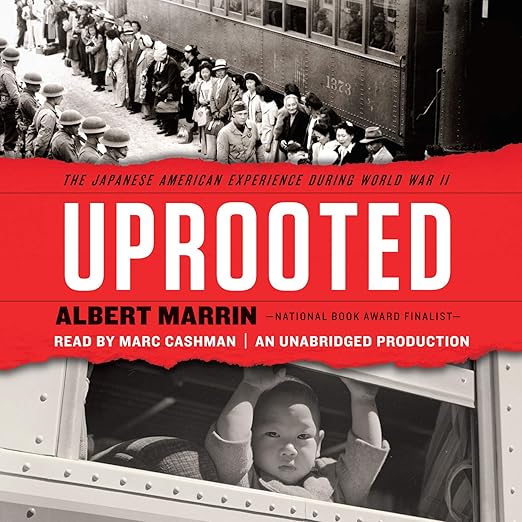
Seventy-five years after the bombing of Pearl Harbor, Albert Marrin sat down to explain how the American government responded by rounding up more than 100,000 of its own citizens based on nothing but ancestry, holding them in concentration camps for years. Marc Cashman narrates this Uprooted audiobook across eight hours and eleven minutes, and the five reviews attached here treat it less as a young-adult history lesson and more as a piece of American history that most adult readers never got taught either.
A Direct Line to the Racism Condemned Abroad
One reviewer, C. Underwood, makes the strongest case for the book's scope: full of what that review calls mind-blowing information about events that were a major part of United States history but only ever a minor part of the country's history education, tracing the beginning of major Asian nations, international economics, and the development of World War II alongside the internment story itself. That review draws a direct, uncomfortable line between the racism the book documents domestically and the racism the country condemned Hitler for abroad, arguing the book earns its relevance by refusing to let American readers stand entirely outside that history.
An experienced high school librarian, reviewer P. Westgate, addresses something the other reviews only gesture toward: pushing back directly against what that review calls poor ratings the book had picked up elsewhere, arguing those lower scores miss that Uprooted is written specifically for young adults and therefore includes more background context than a book aimed at readers who already know the era well. That defense sits a little oddly next to the actual 4.4 average and 37 votes on this listing, a solid score that does not obviously match the defensiveness in that review, though the underlying point about the book's intended audience still stands regardless.
One of the Country's Most Beloved Presidents
Marrin won recognition as a National Book Award finalist, and reviewer Kindle Customer describes the book as an extremely interesting and informative summary of the Japanese American internment, adding that it highlighted prejudices that, in that reviewer's words, still exist today, and that before reading it that reviewer had been mostly unaware of Japanese history within the country's own past. A second review, also credited to a Kindle Customer, frames the book's relevance even more urgently, noting the country lives in a precarious moment where war and racism feel close at hand, and expressing hope that history along these specific lines never repeats.
Both of those reviews land on the same word, informative, but arrive there from different directions, one focused on what the book corrects about a specific historical blind spot, the other on what the book warns against repeating. That range is itself a useful signal for a book aimed at teenagers: Uprooted seems built to work as both a first serious encounter with this history and a reminder for readers who thought they already knew it well.
Synopsis language backs up that framing directly: Uprooted traces the path that led one of the country's most beloved presidents to authorize internment, while also covering the history of racism and xenophobia inside Japan that contributed to the attack on Pearl Harbor in the first place, tying both countries together rather than presenting one as simply the victim and the other as simply the aggressor. That two-sided approach is part of what reviewer Jane H. is responding to when calling the book incredibly well researched, crediting an award-winning author who covers facts left out of standard history curricula.
Cashman's Narration Goes Entirely Unmentioned
Cashman's narration goes entirely unmentioned across all five reviews, a silence worth noting given how much of this book's value depends on tone: internment history aimed at a young-adult audience needs a narrator who can hold gravity without either sanitizing the material or overwhelming a younger listener with it, and this page offers no confirmation either way of how that balance lands in the audio edition.
Jane H.'s review also mentions something worth flagging on its own terms: the book is physically larger than expected, plus lots of photos, both comments that describe a print edition rather than anything about the eight-hour audio listen. It is a small sign that at least one reviewer here is responding to the print or ebook version they actually held, not necessarily the audio format under review.
The synopsis frames this book around a Publishers Weekly Best Book of the Year distinction and a Booklist Editor's Choice selection, credentials that line up with how consistently these five reviews treat the book as a serious piece of scholarship rather than a simplified young-adult summary. Marrin's status as a National Book Award finalist gets repeated across more than one review too, functioning almost as a second endorsement layered on top of the reviewers' own reactions to the material itself.
Racism Underneath the Policy, in Both Countries
Present-day relevance is the real hook for teenagers and adults who want internment history connected explicitly to ongoing racism and xenophobia, rather than sealed off as a closed historical chapter, and who are comfortable with a young-adult framing that assumes less background knowledge going in. P. Westgate's point stands: this book supplies more context than a specialist history would, which makes it a stronger entry point for a first encounter with the subject than a deep dive for readers who already know the period well. A narrowly military or political account sits outside what this book sets out to do. Uprooted spends real time on the racism underneath the policy, in both the United States and Japan, rather than treating the internment decision as an isolated wartime choice.
At a Glance
- Voice: Marc Cashman narrates eight hours of internment history; oddly, none of the five reviews here mention the reading at all, despite how much tone matters for this subject.
- Big ideas: Japanese American internment, wartime racism and xenophobia, present-day historical relevance
- Atmosphere: Sober and urgent, written to connect a specific historical injustice to current events
- Worth it?: A well-documented young-adult history that connects internment to present-day racism, let down only by a total absence of narration feedback in the reviews.