The Short Version
- Read by: Paige Reisenfeld carries two leads whose relationship has been slow-burning across two previous volumes, plus the villain the copy hands most of the plot to.
- At its heart: A sapphic enemies-to-lovers slow burn, forbidden magic and the cost of using it, an alliance with the people who wanted you dead
- Vibe: High-stakes and emotionally loud, on a semi-modern backdrop
- Short version: Excellent for anyone already two books deep, sold on a page that cannot tell you whether the story ends here.
Sapphic enemies-to-lovers slow burn is how the copy positions this, and for once the positioning is accurate rather than aspirational. What the copy does not tell you, and what this audiobook's own page cannot settle, is whether Unyielding ends the story. It runs twenty-one hours and ten minutes, it is the third entry in The Blacksea Odyssey, and nothing in the series data indicates whether a fourth is coming. Its readers, as it turns out, do not agree either, which is a genuinely useful thing to know before committing three days of listening to it.
How Unyielding Holds Up
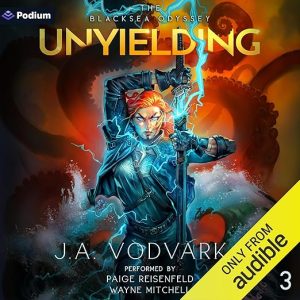
Nyssa Blacksea is tired of running, and the copy opens at the moment she stops. She has a royal bargaining chip, a desperate plan, and freedom for herself and Quinn apparently within reach; the description calls hope a dangerous weapon, which is the kind of line that either sets your teeth on edge or tells you precisely what register you have signed up for. This is epic fantasy on a semi-modern backdrop, an unusual combination, and the reason the comparisons reach for Arcane and The Legend of Korra rather than for the standard shelf of secondary-world doorstops. The Empire wants Nyssa dead and has wanted it for two books.
Ceril Anelos is the engine of the third volume, and the plot he sets going is why the alliances rearrange themselves. His stated goal is mastering forbidden magick that has been locked away for centuries, and the attack he launches pushes Nyssa and Quinn into partnership with powers that previously wanted them destroyed. From there the copy promises a treacherous web of Imperial politics, power struggles and old rivals, with Nyssa's stated priority unchanged throughout: protecting the people she loves. Both women have painful pasts to confront while they hunt Anelos, who intends to claim Quinn and kill Nyssa, and the race is to stop him making a god of himself first. It is a great deal of plot for one volume, and the description does not pretend otherwise.
Epic fantasy with two women at its center and no coming-out plot is rarer than it ought to be, and a five-star report from May 2025 names that as the appeal in plain language: a fantasy series with two female leads, humor woven through the personalities, and LGBTQ relationships treated as ordinary rather than as a point of contention. That is the book's actual proposition, and it deserves stating, because this listing files a twenty-one-hour epic fantasy under a single LGBTQ category with no tags whatsoever, framing the romance as the subject when the copy frames it as one thread among Imperial politics, old rivals and a man trying to make himself a god.
Marta's five-star report from July 2025 is the single entry here that postdates the recording, arriving a month behind it, and it concerns emotional weight rather than plot: a journey for Nyssa and Quinn that works separately and together, a heart equally aching and rejoicing, and a great deal of fun across the sequence. It is a response about feeling rather than machinery. Twenty-one hours is a considerable amount of room, and this entry apparently spends it on both, which is the harder pair to hold in balance and the reason the series has held an audience this size.
Weak Spots in Unyielding
Whether this is the end of the story is the one thing the page genuinely cannot tell you. A four-star report from December 2024 opens by calling it the conclusion to this trilogy, and fills in mechanics the description omits along the way: the Marked Gods hold enormous ancient power and stay mortal regardless, at the mercy of their own bodies and of something the series calls void collars, and the book picks up exactly where the previous one closed, on the bargaining chip. A five-star report filed twelve days later says the opposite in almost as many words, expressing relief that it is not ending and describing the book as obviously set up for a fourth. The series field reads volume three of The Blacksea Odyssey and gives no total. If you have ever been burned by a series that stopped mid-arc, or by one that stretched a finished story into another installment, you are entitled to know which risk you are taking, and this page will not tell you.
Nava's five-star from April 2025 is a rating with no words attached to it at all, just a title, which seems trivial until you notice what the rest of the column also lacks. Five hundred and eighty-one ratings sit on this page and not one of the responses shown says anything about the recording. Paige Reisenfeld is credited with twenty-one hours and ten minutes of it, on a book whose own copy addresses itself to listeners rather than to readers, and a buyer has nothing to go on except the sample. At this running time, that absence is the most consequential gap anywhere on the listing.
Should You Listen to Unyielding?
Fans of the first two Blacksea books have the easiest decision here and can stop reading now. For everybody else the audience is fairly precise: listeners who want epic fantasy without a medieval frame, who like a slow burn that has already been burning for two volumes, and who are not put off by ancient magic systems arriving with their own vocabulary. Of the three comparisons in the copy, Gideon the Ninth is by far the most informative, because it signals prose with a sense of humor and a plot that expects you to keep up rather than waiting for you.
Everyone else should weigh the length before anything else, because twenty-one hours is a substantial commitment to a series whose own readers cannot agree on whether it is finished. Newcomers should start at volume one, since the third book opens on the previous volume's closing situation and never once pauses to explain the collars, the Marked Gods, or the Empire's grudge. Buyers browsing by category should also know that filing a twenty-one-hour epic fantasy under LGBTQ and nothing else does the book no favors, hiding a fantasy reader's entry point behind a label that describes one element of it. And whether more is coming remains, on this evidence, an open question.
A Few Questions About Unyielding
Can I start The Blacksea Odyssey at book three?
Not sensibly. The book opens on the situation the second volume left behind and never stops to explain the void collars, the Marked Gods, or why the Imperial regime wants Nyssa dead in the first place. Twenty-one hours assumes two volumes of groundwork already done. Start at the beginning.
How explicit is the romance in this audiobook?
The copy calls it a slow-burn sapphic enemies-to-lovers romance and gives no heat rating, and the page posts nothing by way of a warning either. Two volumes of buildup point toward payoff rather than restraint in this one, but nothing on the page states how far it goes. Sample before buying.
What makes this audiobook twenty-one hours long?
Three things the copy names outright: Imperial politics with several competing factions, a magic system old enough to have been sealed away for centuries, and two leads whose separate pasts both have to be confronted. It reads as plot-heavy rather than padded, but plan for several sessions instead of a weekend.
Why is this filed under LGBTQ with no fantasy category?
It is a shelving choice the book itself does not support. The copy describes epic fantasy on a semi-modern backdrop, forbidden magick and an Imperial regime, and names Arcane, The Legend of Korra and Gideon the Ninth as its comparisons. Filed this way, fantasy readers browsing by genre will simply never meet it.