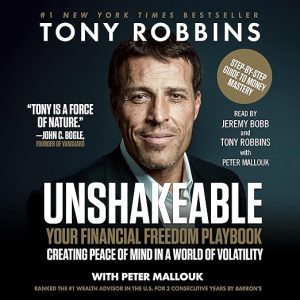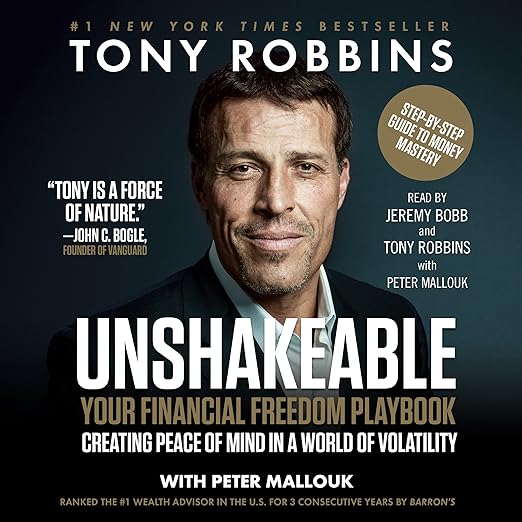
Peter Mallouk's track record as the only financial advisor to be ranked number one in the United States for three consecutive years by Barron's is the kind of credential that gets buried in a dust jacket blurb and quickly forgotten. Listening to this audiobook, narrated by Tony Robbins himself, I kept coming back to that detail , because the collaboration it represents is the engine behind everything Unshakeable attempts to do. Robbins brings the reach and the storytelling instinct; Mallouk brings the precision. Together they've built something that functions less as a motivational listen and more as a workable financial primer for people who have spent too long intimidated by markets they don't understand.
Our Take on Unshakeable
Following Money: Master the Game, which ran to nearly seven hundred pages, Unshakeable is deliberately compact. At just over seven hours, it strips the earlier book's framework down to its most actionable core. The argument is straightforward: market crashes are not catastrophes to be feared but predictable cycles to be positioned for. Robbins walked through fifty conversations with the world's most successful investors to distill what they have in common, and the patterns are surprisingly consistent: they diversify intelligently, they minimize fees aggressively, they don't try to time markets, and they remain calm when everyone else is panicking. The title refers to a specific psychological and financial state , one where volatility stops being a source of dread and becomes, with the right preparation, an opportunity. One listener described the book as 'a tremendous resource for anyone just starting out, and a valuable back-to-basics for even the most seasoned investor.' That dual-audience positioning is intentional, and it largely works.
The hidden fee chapter is worth the entire runtime on its own. Robbins explains in plain, plain language how the financial services industry has constructed a system where the people managing your money often profit from keeping you uninformed. The math on how fees compound over decades is genuinely alarming, and the book presents it with enough clarity that you'll want to audit your own accounts by the time the chapter ends. This isn't abstract: Robbins and Mallouk give you the vocabulary to ask the right questions and the framework to evaluate the answers.
Robbins narrating his own work is the best possible version of this material in audio form. His voice has an urgency that matches the content , he genuinely believes the information he's delivering will change how you live, and that conviction comes through without tipping into the evangelical excess that occasionally marks his live appearances. The pacing is brisk. He doesn't linger on any single concept long enough to lose you, which serves the audiobook format well, though it can feel thin in sections where more depth would be welcome.
Why Listen to Unshakeable
The book's central value proposition is emotional as much as financial. Robbins understands that most people's relationship with money is shaped by fear rather than by understanding, and Unshakeable addresses both levels simultaneously. The 'core four principles' section, drawn from patterns across the world's most successful long-term investors, distills decades of financial research into a framework a non-specialist can actually apply. The four principles, articulated clearly and repeated throughout, give the book the quality of a well-designed course rather than a one-time read. Three listeners have noted that the book changed something significant before they had even finished it , that's the response you get when content meets a listener at exactly the right moment of readiness.
The 401(k) chapter, in particular, is essential listening for anyone participating in employer-sponsored retirement plans in the United States. The information about what plan providers often omit from their pitch materials is not new , it has been covered in financial journalism for years , but Robbins and Mallouk present it at exactly the right altitude: specific enough to be actionable, accessible enough to be understood by someone with no background in investment theory.
What to Watch For in Unshakeable
Listeners who have already consumed Money: Master the Game will find significant overlap. Unshakeable is designed as a companion and distillation, not an independent sequel, and some passages feel like they've been transplanted almost directly from the longer book. If you're coming to this fresh, that's not a problem , the material stands alone. But if you're hoping for substantial new ground beyond what Money covered, you may find Unshakeable underwhelming in scope. The book also tilts heavily toward the American financial system: the 401(k) discussion, the references to specific regulatory frameworks, and the tax strategy sections are largely US-centric. International listeners will need to translate the principles to their own markets, which the book doesn't assist with.
The book's treatment of market crashes as cyclical rather than catastrophic is particularly useful for listeners who built their investing habits around panic-driven responses. Robbins traces several historical downturns and shows, consistently, that the investors who stayed the course and used volatility as a buying opportunity outperformed those who exited. That's not a novel observation in financial theory, but Robbins and Mallouk present it with enough concrete historical data that it functions as genuine reassurance rather than empty optimism. The examples are drawn from real downturns, named with specific dates, and the outcomes are measured. That specificity is what separates the argument from motivational platitude.
Who Should Listen to Unshakeable
Ideal for listeners who found Money: Master the Game too dense, or who want a financially focused entry point to Tony Robbins's broader wealth philosophy. The audiobook format suits the material exceptionally well , Robbins's live-wire delivery keeps even the more technical passages from dragging. Skip it if you are an experienced investor already conversant with index fund strategy and fee minimization: you won't find much that challenges your existing framework. Come to it if you're somewhere between confused and motivated and need a system that will hold up under pressure.
Quick Take
- Voice: Tony Robbins self-narrates; his urgency and conviction are inseparable from the material and make this the ideal format for this content
- Big ideas: Financial freedom, market psychology, fee transparency and long-term wealth building
- Atmosphere: Energized and practical, with real-world urgency underneath the motivational register
- Worth it?: A focused financial primer that earns its concision by stripping Money: Master the Game down to its most immediately actionable core.