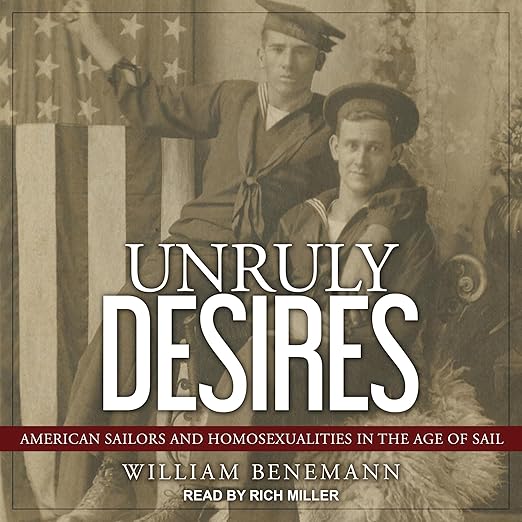
Quick Take
- Narration: Rich Miller reads with appropriate academic gravity and sufficient range to carry the documentary material – a solid match for serious historical nonfiction.
- Themes: LGBTQ history in nineteenth-century maritime culture, primary source research and historical method, invisibility and community on the margins
- Mood: Scholarly and absorbing, dense with primary documentation, quietly revelatory
- Verdict: A serious and carefully researched work of queer history that fills a genuine gap in how the nineteenth-century American naval world has been documented.
I came to Unruly Desires the way I come to most serious historical nonfiction: with a mix of genuine curiosity and mild dread about the ratio of scholarship to readability. William Benemann’s book about LGBTQ culture in nineteenth-century American maritime life had been recommended to me by two different people in the same week, which in my experience is not coincidence. I started it on a Tuesday evening and finished it over the following two days, which for nearly eleven hours of scholarly history is as close to a sprint as my reading schedule allows.
The book’s premise is, when you state it plainly, both straightforward and overdue. The nineteenth-century American Navy and commercial maritime industry, hungry for bodies to fill their ships, welcomed exactly the kinds of men that polite society rejected – eccentrics, criminals, outcasts, misfits. That community, with its different values and expectations, created conditions in which men attracted to other men could find something approaching refuge. Benemann documents what that looked like, using an extraordinary range of primary sources: diaries, personal letters, court-martial reports, ships’ logs, government records, Congressional hearings, medical treatises, maritime fiction, pornography, and newspaper accounts.
Our Take on Unruly Desires
The methodological rigor here is the book’s defining quality and its most important contribution. One reviewer noted that the documentation is extensive, the deductions are logical rather than speculative, and the primary source material includes the sailors’ own testimony about their identities and actions – a point that the reviewer found some critical readers bizarrely resistant to. Benemann neither projects contemporary identity frameworks backward onto his subjects nor erases the specificity of how those men understood themselves. That balance is difficult to maintain and he maintains it throughout.
The scope is also broader than the title suggests. The maritime world that Benemann examines extends from the War of 1812 through World War II, and the contextual material he provides – on the Barbary pirates, the whaling industry, British prison practices, and how America’s port cities developed their own distinct cultures – enriches the central subject rather than distracting from it. One reviewer called it queer history we never learned in school, which is accurate and also slightly undersells how deeply embedded this history is in well-documented American naval and legal records that have simply not been aggregated and interpreted in this way before.
Why Listen to Unruly Desires
Rich Miller is a capable narrator for serious nonfiction, and the material asks for exactly what he brings: steadiness, clarity, and the ability to move through dense archival material without flattening it. The court-martial accounts and personal diary extracts require a reader who can modulate between analytical summary and direct quotation, and Miller handles both registers without confusion. At just under eleven hours, the audiobook does not rush through the subject, which is appropriate – this is not material that benefits from compression.
The publisher Tantor Media has a strong record with serious nonfiction audio, and the production quality here matches that reputation. The documentation-heavy sections are navigable in audio format because the book is organized thematically rather than purely chronologically, which means the listener can follow the argument rather than keeping a running dynasty chart.
What to Watch For in Unruly Desires
One reviewer offered a fair observation that the book occasionally strays from its central subject into contextual material that extends beyond what is strictly necessary. This is an academic tendency rather than a structural flaw – the richness of the context Benemann provides is generally a strength, but there are passages where the maritime history crowds out the LGBTQ history that brought most readers to the book in the first place.
This is not casual listening. It is serious historical scholarship, and it asks for the kind of sustained attention that rewards patience. Listeners looking for a narrative-driven account of individual lives will find the book more analytical than personal, though the primary source quotations provide genuine human texture throughout.
Who Should Listen to Unruly Desires
Essential for anyone interested in American LGBTQ history who wants serious scholarly documentation rather than popular narrative. It sits naturally alongside works like George Chauncey’s Gay New York or Leila Rupp’s A Desired Past, and extends the historical record into a maritime context that those landmark works do not cover. Listeners drawn to American naval history who have not previously considered the LGBTQ dimensions of that world will find it genuinely revelatory. Not recommended for listeners seeking light or narrative-driven historical audio.
Frequently Asked Questions
What time period does Unruly Desires cover?
Primarily the nineteenth century, but the historical arc runs from the War of 1812 through World War II. Benemann’s focus is on how maritime culture created conditions for LGBTQ community formation across that span.
Is this book based primarily on secondary sources or original primary research?
Extensively primary. Benemann draws from diaries, personal letters, court-martial reports, ships’ logs, Congressional hearings, newspaper accounts, medical treatises, and maritime fiction – a breadth of documentation that reviewers consistently cited as one of the book’s major strengths.
Does Rich Miller’s narration handle the archival and quotation material well?
Yes. He navigates between analytical summary and direct primary source quotation clearly, which matters for a book that alternates frequently between the two registers. The narration does not flatten the distinction between Benemann’s voice and the historical voices he quotes.
How does this compare to other works of American LGBTQ history like Gay New York?
It covers different terrain – maritime and naval culture rather than urban civilian life – and extends further back historically. The two works complement each other well. Unruly Desires is more densely documentary and less narrative-driven than Chauncey’s book, but the primary source depth is comparable.