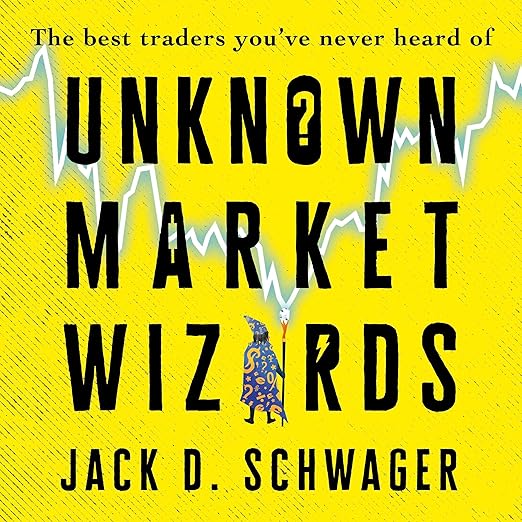
Who are the best traders most investors have never heard of, and what can their track records tell us about whether exceptional performance is reproducible? That question sits at the center of Unknown Market Wizards, and Jack D. Schwager pursues it with the same methodical, interview-driven format that made the original Market Wizards series one of the most durable franchises in financial literature. I listened to this audiobook over the course of a week during morning commutes, which turned out to be nearly ideal: the interview structure meant that I could pause and resume without losing narrative thread, and DJ Holte's narration kept the pace moving even through the more technically demanding passages about trading methodology.
The conceit here is specific and worth understanding before you begin. Schwager's earlier Market Wizards volumes featured legends: Paul Tudor Jones, Ed Seykota, Michael Marcus. This installment deliberately shifts to traders who are not famous, who manage their own accounts rather than institutional money, and who have nonetheless produced performance records that rival or surpass many of the professionals who appear in investment industry rankings. A trader who turned $2,500 into $50 million. A former advertising executive who used classical chart analysis to generate a 58 percent average annual return over a 27-year span. A junior tennis player who abandoned a sporting career for markets and achieved a nine-year average annual return close to 300 percent. These are extraordinary numbers, and Schwager is careful throughout to acknowledge what that arithmetic implies without overclaiming what it proves about replicability.
The series title has carried through three decades of publishing and multiple market cycles, and this volume continues the tradition with a particular emphasis on what trading looks like outside the institutional context. The anonymous traders featured here operate without the infrastructure of major hedge funds, without compliance departments or investor relations obligations, and their freedom from institutional constraint is both an advantage and a complexity when Schwager tries to extract universally applicable lessons from their individual experience.
What Makes Unknown Market Wizards Worth Hearing
DJ Holte is a competent and efficient narrator for this kind of material. Financial interview content is technically demanding: it requires clear enunciation of numbers, terms, and proper nouns, the ability to switch register between Schwager's analytical voice and the traders' more personal recollections, and enough pace variation to keep 12 hours from feeling monotonous. Holte delivers on all three. He is not a narrator who brings significant dramatic interpretation to the text, but for Schwager's methodical, evidence-focused prose style, restrained delivery is the right call. The emotional moments, and some chapters have them, including personal setbacks and the psychological dimensions of extended losing streaks, land without being overstated.
Schwager's interview style is genuinely its own thing. He is not a confrontational interviewer, but he asks follow-up questions that push traders past surface-level reflection into the actual mechanics of what they do and why. The recurring themes that emerge across multiple interviews, the importance of position sizing, the distinction between a trader's method and their psychology, the role of loss tolerance in long-term performance, feel organic rather than manufactured because they arise from the subjects themselves rather than from Schwager's editorializing. The accompanying PDF, which includes charts referenced in some of the more technical discussions, is a useful supplement for listeners who want the visual data rather than only the verbal narrative.
Things to Know Before Starting Unknown Market Wizards
One reviewer noted that the book can feel repetitive to listeners who read extensively in finance, and this is a fair observation. The patterns that Schwager surfaces across interviews, risk management above all else, the psychological component of performance, the danger of abandoning a method during drawdowns, are consistent themes in trading literature. Listeners who have already absorbed Schwager's earlier volumes or books like Trading in the Zone will recognize these patterns quickly. The value here is less in the novelty of the insights than in the specificity of the individual traders' experiences, which illustrate familiar principles through unfamiliar contexts that make them feel fresh.
The anonymity of the featured traders is both the book's strength and its limitation. Because these are private individuals rather than public figures, Schwager cannot provide the kind of verification that comes with institutional records. He is clear about this, and he explains his process for assessing the credibility of performance claims, but listeners should approach the stated track records as reported rather than audited. The extraordinary returns described are compelling precisely because they come from private accounts, and that privacy cuts both ways when it comes to assessing what they mean.
One of the less discussed elements of Schwager's format is how the interview structure reveals character as much as strategy. The traders in Unknown Market Wizards are not identical in temperament or approach: some arrived at their methods through systematic study, others through intuition refined by painful losses, and the variance in their personal histories is as instructive as the commonalities in their risk management philosophy. DJ Holte's narration handles these personality differences with enough light touch to let the individuality of each subject come through, which is no small feat across a 12-hour collection of interviews.
Who Jack D. Schwager Is Writing For
Listeners who have read and enjoyed earlier Market Wizards volumes will find a natural continuation here, with the added interest of the private trader context. Those new to Schwager's work can start here without prior context; each volume is structurally self-contained. Finance enthusiasts and active traders looking for psychological and methodological insights from practitioners rather than theorists will find substantial material. Listeners hoping for a how-to trading guide should manage expectations; this audiobook is about how specific people think and act, not a system to replicate. Those who find 12 hours of interview-driven financial content insufficiently varied in format may want to sample before committing to the full runtime.
Quick Take
- Narration: DJ Holte delivers efficient, clear narration suited to interview-driven financial content; restrained rather than interpretive, which fits Schwager's analytical prose well.
- Themes: Private trading excellence, psychology of performance, risk management discipline
- Mood: Methodical and illuminating, with moments of genuine human interest amid the market analysis
- Verdict: A solid addition to the Market Wizards audiobook series, most rewarding for active traders and those who want practitioner insight over theoretical frameworks.