At a Glance
- Performance: Edward Herrmann's measured, documentary-weight delivery remains one of his defining performances, even trimmed for a younger audience.
- What it covers: Survival, endurance, forgiveness, wartime resilience
- Feel: Harrowing but ultimately hopeful
- Our call: An excellent entry point for teen listeners, though readers wanting the full scope should seek the original adult edition.
A Delinquent Kid Who Became an Olympic Runner
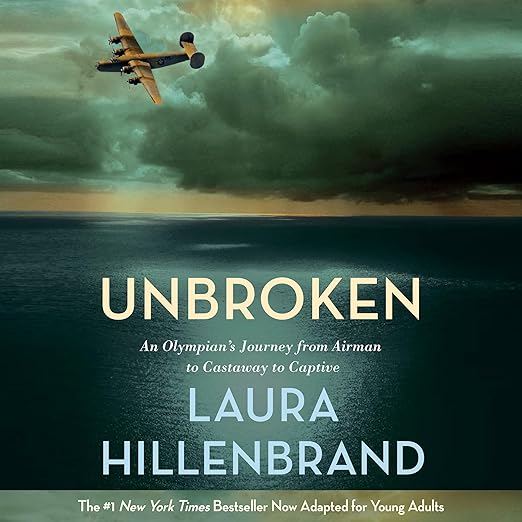
Louis Zamperini's story earns every bit of its reputation as one of the most extraordinary survival accounts of the Second World War, and this young adult adaptation of Laura Hillenbrand's audiobook trims the material for younger listeners without softening what actually happened to him.
On a May afternoon in 1943, a B-24 Liberator bomber crashed into the Pacific, and a young lieutenant named Louis Zamperini pulled himself onto a life raft to begin one of the war's most harrowing ordeals. He'd been a delinquent kid who broke into houses and brawled before channeling that same defiance into running fast enough to reach the Berlin Olympics, and that same stubborn will carried him through weeks adrift, sharks, starvation, and, eventually, enemy capture.
Kirkus Calls It a Fine Adaptation
This edition adds real value beyond a trimmed word count: more than one hundred photographs and an exclusive interview with Zamperini himself, features the original adult bestseller doesn't include in the same form. The book's connection to Angelina Jolie's film adaptation only deepens the cultural footprint of a story that keeps finding new audiences.
The critical reception backs up the instinct to adapt this for teens at all. Booklist gave it a starred review calling it 'highly dramatic and exciting,' School Library Journal praised it as 'a strong, well-written work,' and Kirkus called it simply 'a fine adaptation' that 'ably brings an inspiring tale to young readers.'
The Trial Even Greater Than the Raft
The 'trial even greater' the synopsis references isn't just the raft and the POW camps; Zamperini's hardest fight came after the war, in years of nightmares and drinking before a Billy Graham crusade became the turning point toward the forgiveness that defines the book's final act.
Zamperini's Olympic credential is real and specific: he competed as a distance runner in the 5,000 meters at the 1936 Berlin Olympics, running a finishing lap fast enough to draw international attention years before the war turned him into a very different kind of survivor, and long before anyone in that stadium could have guessed what he'd eventually endure over the Pacific.
The raft ordeal itself lasted 47 days, during which Zamperini and his surviving crewmate fought off circling sharks, endured strafing runs from a Japanese aircraft, and watched their meager rations run out entirely, specific details that make the survival stakes here concrete rather than abstract.
Herrmann Died in 2014, a Fixed Performance
Edward Herrmann's measured baritone carries an inherent, documentary-weight authority that never tips into theatrical performance, and this recording is widely considered one of his defining audiobook performances. He trusts Hillenbrand's cinematic, fact-driven prose to do its own work rather than pushing listeners toward a manufactured emotional response, and his controlled restraint during the darkest passages, the POW camps and violence, is a deliberate strength rather than a limitation. Herrmann died in 2014, so this recording is part of a fixed, finished catalog.
Reviewer Diana calls the book's power-of-forgiveness theme central to why it lingers, and reviewer schoolmom's response makes the emotional case plainly: the story left her wanting to personally thank Hillenbrand for writing something that builds real gratitude for freedom in its listeners. That's the kind of reaction a well-narrated survival story is built to produce.
Herrmann's own career adds real weight to the casting: an Emmy winner for playing FDR in Eleanor and Franklin, and familiar to television audiences as Richard Gilmore on Gilmore Girls, he brought a documentary-trained authority to nonfiction narration that few narrators fully replicate.
Hillenbrand was already a bestselling author before this book, having written Seabiscuit: An American Legend, and that same gift for turning a real, well-documented life into a page-turning narrative arc is exactly what carries over into Unbroken and, by extension, into this adapted edition.
A Hundred Photographs That Don't Translate to Audio
The more than one hundred photographs and the exclusive Zamperini interview that make this print and ebook edition special don't translate to an audio-only listen. Anyone drawn specifically to those visual extras should treat the audiobook as a companion to the illustrated edition rather than a full substitute for it. Few true stories offer teachers that combination of accessibility and genuine historical weight in one package.
Herrmann's delivery may read slightly older than the intended teen audience, though it never condescends to it, and the source material itself doesn't shy away from real wartime brutality even in adapted form. This is an honest, unsanitized YA edition, not a softened one, and parents or younger listeners should know that going in.
Placed alongside other WWII survival accounts for younger readers, this adaptation earns its spot for the same reason the adult edition became a phenomenon: it treats a teenage audience as capable of handling real horror without needing it softened into something safer than what Zamperini actually endured.
This edition's classroom-ready format, with historical photographs and a genuine interview subject, makes it a natural fit for middle and high school WWII units, giving teachers a survival narrative that connects abstract history to one fully realized human life.
A Four-Part Transformation, From Rule-Breaker to Forgiveness
Teen listeners, classrooms studying WWII history, adults wanting a tighter version of Zamperini's story, and fans of the film will all get real value from this specific edition, which earns its place as an adaptation rather than a mere abridgment.
Listeners wanting the full scope of Hillenbrand's original adult bestseller, including its longer runtime and fuller context, should seek out that separate, unabridged edition instead; this one is purpose-built for a younger readership first.
The book's real structure is a four-part transformation: a troubled, rule-breaking kid, an Olympic-caliber runner who channeled that same defiance into competition, a war hero who survived weeks at sea and years of captivity, and finally a man who found forgiveness on the other side of trauma most people never recover from at all.
Listeners who finish this edition curious for more have a clear next step already available: the full adult bestseller and Jolie's film adaptation both extend the same story further for anyone ready to go deeper.