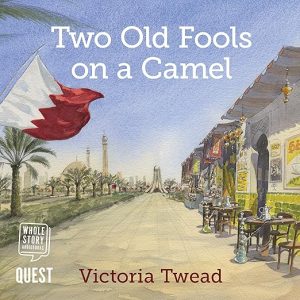
Retirement expat memoirs have a reliable formula: couple leaves familiar life, encounters cultural friction, finds community, returns changed. Victoria Twead's Two Old Fools on a Camel follows that arc in spirit, but the setting has a way of upending even the coziest expat narrative. This audiobook, narrated by Jilly Bond, covers the year Vicky and Joe Twead spent teaching in Bahrain, and it does not let the comfortable comic memoir tone go unchallenged for long. The Arab Spring was not background noise to their year abroad. It was the year.
I picked this one up on a long commute and found myself recalibrating expectations within the first half hour. This is the third installment in the Old Fools series, so Twead and Bond arrive with an established rhythm. Listeners who have followed the couple from their Spanish village through the earlier books will recognize the tone instantly. Those arriving fresh, as I did, will find enough context woven into the early chapters to follow the characters without feeling lost, though some of the shorthand affection the author has for her recurring cast works best if you have met them before.
A Closer Look at Two Old Fools on a Camel
Jilly Bond has been the consistent voice of this series, and that continuity matters here. Bond captures Twead's self-deprecating humor without letting it tip into farce, and she handles the tonal gear shifts, from comedy to house arrest, with enough grounding that neither register feels manipulated. The classroom scenes, which one reviewer singled out as particularly strong, benefit from Bond's ability to distinguish between characters without relying on exaggerated accents. These are real children, and Bond treats them that way.
Twead is writing in the tradition of light British expat comedy, and she knows the tradition well. The humor in the teaching sequences, the bureaucratic absurdities of working in a private Gulf school, the portraits of her sixth-grade students reaching for a second language they resent being made to learn, all of this lands with affection rather than condescension. Reviewer Lynn M. described the book as "a continual laugh-out-loud" read for anyone who has taught, and the specific texture of classroom chaos that Twead captures is recognizable across cultures and continents.
The more surprising element of this audiobook is what happens when the comedy is forced aside by history. The Arab Spring arrived in Bahrain in 2011 with real violence and political consequence, and Twead does not pretend it did not. The house arrest section of the book is genuinely tense, and it gives the memoir a weight that a purely comedic expat story would lack. This is not a political analysis of what happened in Bahrain. Twead is not that kind of writer, and she does not pretend to be. But she is a witness to a specific moment in a specific place, and that witness counts for something.
At seven hours and nineteen minutes, the audiobook has room to develop both the comic and the serious registers without feeling rushed. The pacing is comfortable rather than slack, which is characteristic of the series. Twead structures her year chronologically, and the accumulation of small moments, the friendships formed with colleagues from several countries, the cultural negotiations of daily life in a Gulf state, the logistics of teaching in a system built on entirely different assumptions about authority, builds into something more substantial than any individual chapter promises. The individual vignettes from her classroom, the students who charmed her, the ones who exhausted her, the colleagues she came to love, accumulate with the weight of real time spent in a real place.
Things to Know Before Starting Two Old Fools on a Camel
Listeners arriving from outside the expat memoir genre should be prepared for its conventions. The cultural observations stay on the surface more than a deeper literary travel account would allow. Twead is writing to entertain first and illuminate second, and some of the complexity of Bahrain's social and political landscape gets flattened in service of the comic arc. The political events are present but not analyzed, which is honest about the limits of the narrator's perspective but may frustrate readers who want more than witness testimony.
The series position also matters. Reviewer Vmp specifically noted finishing the second book before seeking out this third installment, and that trajectory feels right. Twead's world is populated with recurring characters whose histories inform the present book. The book works as a standalone listen, but the emotional investment deepens if you arrive already knowing the couple and their particular brand of cheerful stubbornness in the face of complicated circumstances.
One of the audiobook's quieter pleasures is its portrait of the other foreign teachers Vicky and Joe worked alongside: educators from a dozen countries, each navigating the same institutional absurdities with different cultural frameworks for what counts as acceptable frustration. Those relationships give the book a warmth that extends beyond the couple's own story.
Who Victoria Twead Is Writing For
This audiobook is an easy fit for fans of light British travel memoir, particularly listeners who appreciated Bill Bryson's earlier travel books or Peter Mayle's Provence writing, though Twead's register is warmer and less witty than either. Teachers will recognize themselves in the classroom sequences. Listeners who want a first-person account of the Bahrain uprising from a civilian perspective will find something genuine here, even if the political context is not the book's primary interest. Those who want rigorous cultural analysis or literary travel writing in the Patrick Leigh Fermor tradition should look elsewhere.
Questions Listeners Ask
Do I need to have listened to the first two Old Fools audiobooks to follow this one?
Not strictly, but the experience is richer with prior context. Twead provides enough background to orient new listeners, though the affection for recurring characters works best if you have traveled with them before.
How does this audiobook handle the political events of the Arab Spring in Bahrain?
Twead writes as a witness rather than an analyst. The house arrest sequences are treated with genuine gravity, but the broader political context is not deeply examined. The book is memoir, not political journalism.
Is the audiobook narration consistent with earlier entries in the Old Fools series?
Yes. Jilly Bond narrates this installment as she has throughout the series, which gives long-term listeners a consistent tonal anchor and makes the emotional shifts of this particular book land more effectively.
How explicit or intense is the content around the political unrest?
Mild by the standards of conflict memoir. The house arrest section conveys genuine fear and uncertainty, but Twead does not dwell on graphic violence. The book remains accessible and would not be distressing for sensitive listeners.