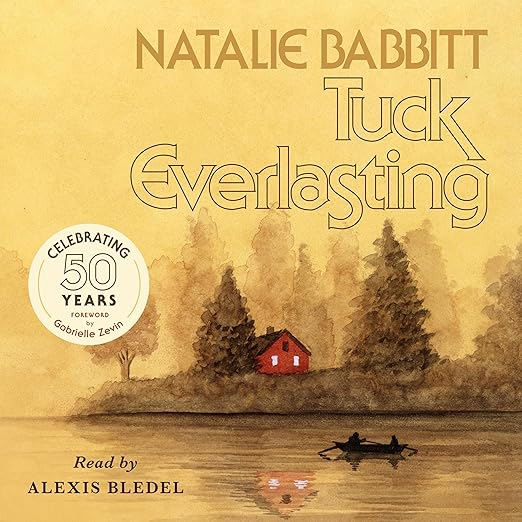
- Read by: Alexis Bledel brings Winnie Foster's quiet gravity to life with a warmth earned through decades of playing literary women; AudioFile's Earphones Award confirms this is narration that genuinely serves the text.
- At its heart: Mortality and the nature of a well-lived life, the burden of secret knowledge, the ethics of immortality.
- Vibe: Luminous and gently melancholic, like late summer light on a very old forest.
- Short version: A 50th Anniversary edition that treats a children's classic with the reverence and production care it deserves.
Winnie Foster wants to run away into the woods. That impulse, so specific to the particular claustrophobia of being ten years old inside a proper household, is where Natalie Babbitt grounds her entire moral fable, and it is the impulse Alexis Bledel channels from the audiobook's opening minutes with a clarity that makes the novel's deeper themes feel lived rather than constructed. Tuck Everlasting has been in print for fifty years, read by generations of children and their parents in school assignments, quiet bedrooms, and library afternoons. This 50th Anniversary Edition, featuring a foreword by Gabrielle Zevin and bonus material that includes an afterword from Babbitt's daughter, arrives as something more than a reissue. It arrives as a document of how some children's literature crosses into something that has no usable expiration date.
The premise is one of the most elegant in American children's fiction. A spring in a nearby wood grants immortality to those who drink from it. The Tuck family has been living with that immortality, and its ramifications, for nearly a century by the time ten-year-old Winnie discovers them. A suspicious stranger is tracking the Tucks. Winnie must decide what to do with her knowledge. That is the entire scaffold, and Babbitt builds the whole of the book's moral architecture on it.
Our Take on Tuck Everlasting, 50th Anniversary Edition
What the anniversary edition adds is genuine rather than merely supplementary. Zevin's foreword, written and recorded by the author of Tomorrow, and Tomorrow, and Tomorrow, brings a novelist's specific intelligence to the question of why this book matters and what it is actually arguing beneath its surface magic. Babbitt's daughter's afterword provides biographical context for the novel's composition that sheds light on why the moral question it raises, whether immortality is a gift or a trap, sits at the center of the work rather than its margins. These additions give the audiobook a critical framework that enriches rather than interrupts the main text.
Bledel's narration earned AudioFile's Earphones Award, and the recognition is warranted. Her voice carries a quality of attentiveness, a sense of really looking at the world she is describing, that is exactly right for Winnie's narrative perspective. Winnie is not a passive protagonist. She is a child making an extraordinarily adult moral decision, and Bledel communicates both the weight of that decision and the innocence from which it is made simultaneously. That is not a simple vocal balance to achieve.
The language Babbitt uses is formal in the way that the best mid-twentieth-century children's literature was formal: precise, unhurried, respectful of the reader's intelligence without overwhelming it. The prose sounds better aloud than it reads silently, which is a feature of writing that originally understood itself as something to be shared between parent and child rather than consumed privately. Bledel honors that quality of the text.
Why Listen to Tuck Everlasting, 50th Anniversary Edition
One reviewer described listening to this audiobook with her daughter over a summer, and noting that both of them were left talking and thinking long after the story ended. That is the proper effect of this novel. The central question, would you want to live forever, is simple enough for a ten-year-old to grasp and complex enough for an adult to sit with seriously. Babbitt does not provide easy answers, and the audiobook format, with Bledel's carefully calibrated ambiguity in the novel's final passages, honors that refusal.
At three hours and ten minutes, this is an ideal shared listening experience for parents and children. The length is appropriate for a single afternoon or two evening sessions, short enough to maintain narrative momentum across a younger listener's attention span but long enough to develop the Tuck family with genuine emotional texture. Angus Tuck's speech to Winnie about the wheel of life, which comes roughly at the novel's midpoint, is the most philosophically dense passage in the book and the one most deserving of a pause and conversation.
The production by Macmillan Audio ensures clean, consistent audio quality throughout, which matters for a text this carefully written. Every word Babbitt chose deserves to be heard clearly, and the production does not let the recording obscure that precision.
What to Watch For in Tuck Everlasting, 50th Anniversary Edition
Pay particular attention to how Babbitt stages the suspicious stranger's story in parallel with Winnie's. The stranger never becomes a fully humanized figure in the way the Tucks do, and that asymmetry is deliberate. He represents a different relationship to the secret of the spring, one defined by exploitation rather than stewardship, and Babbitt uses him to frame the moral choice Winnie faces without making it feel schematic.
The toad, which appears in the novel's opening and closing passages, has accumulated decades of critical attention as a symbol, and listening rather than reading allows you to hear how naturally Babbitt introduces and returns to the image without the reader's eye triggering the symbolic loading prematurely. Bledel's treatment of the toad scenes is light rather than portentous, which is exactly the right calibration for material that carries symbolic weight but should not announce it loudly.
The Zevin foreword is worth listening to before the main text rather than after, as she orients listeners to the novel's moral concerns in ways that enrich the first hearing rather than only deepening a rereading.
The Right Listener for Tuck Everlasting, 50th Anniversary Edition
This audiobook is ideal for shared family listening with children aged eight and up. Tuck Everlasting is frequently assigned in middle school English classes, and this edition is an excellent companion to that curriculum. Adults who read the novel as children and want to return to it will find Bledel's narration and the anniversary additions make this a genuinely fresh experience. Literary fiction listeners who appreciate children's classics that engage seriously with mortality and moral philosophy will find Babbitt's work rewards adult attention. The bonus material, including Zevin's foreword and Babbitt's daughter's afterword, makes this the definitive audiobook version of the text.
Common Questions
Does Alexis Bledel's narration work for this classic audiobook, even though the story is told through a child's perspective?
Bledel's performance earned AudioFile's Earphones Award, and the recognition is apt. She captures Winnie's attentive, wondering quality without condescension, and handles the novel's more philosophically weighted passages with restraint rather than dramatic emphasis.
What bonus material does the 50th Anniversary Edition audiobook include?
A foreword written and read by Gabrielle Zevin (author of Tomorrow, and Tomorrow, and Tomorrow), an afterword from Natalie Babbitt's daughter providing biographical context for the novel's composition, and additional bonus material not included in earlier editions.
Is this audiobook appropriate for young children or is it better suited to older readers?
The text is appropriate from about age eight upward. Younger children may find the moral philosophy abstract, but the story itself, Winnie's adventure in the woods and her encounter with the Tuck family, is engaging from early elementary age. Shared listening with a parent who can facilitate discussion of the central themes works well for younger listeners.