Quick Take
- Narration: Virtual Voice AI narration, functional but emotionally flat, which is a significant drawback for a romance built on the heat between two leads and the vulnerability of a trauma-survivor protagonist.
- Themes: found family, healing after abuse, omegaverse power dynamics rewritten through tenderness
- Mood: Angsty and sweet in turns, with flashes of genuine warmth
- Verdict: The story itself has real emotional pull, but readers who care about narration quality should be aware this is AI-voiced, the performance does not do justice to Ashe Moon’s character work.
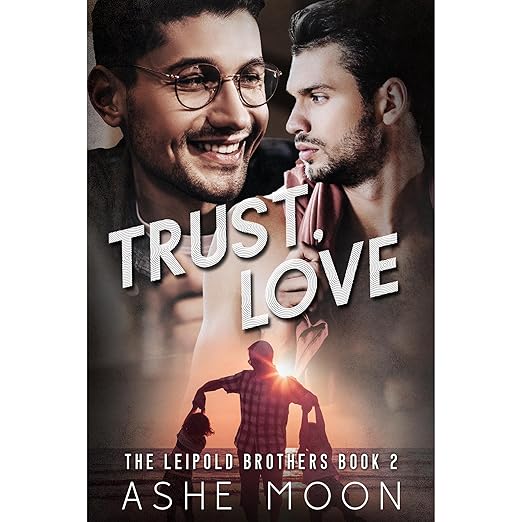
I want to be upfront about something before I get into the story itself: Trust, Love is narrated by Virtual Voice, which is Amazon’s AI text-to-speech system. That matters for an audiobook review in a way it would not matter for a print review, and I will address it directly in a moment. What I can say first is that the underlying novel by Ashe Moon has enough genuine emotional substance to survive even a narration that cannot quite carry its weight.
Trust, Love is the second book in Moon’s Leipold Brothers series, following My Next Door Omega. It is fully readable as a standalone, the synopsis makes this explicit, and Moon does the structural work to ensure readers who haven’t met William Leipold before understand who he is and what he has survived. He is an omega who escaped an abusive relationship and has spent years rebuilding a careful, protected life for himself and his young son Nate. Dakota Cloud is an alpha restaurateur who has sworn off relationships and funnels his energy into his ramen restaurant, Send Noods, a name that drew a laugh from me despite myself.
Our Take on Trust, Love
Moon writes the central dynamic between William and Dakota with a thoughtfulness that distinguishes this from the broader omegaverse genre. The power imbalance baked into alpha-omega dynamics is not ignored or glossed over, it is precisely the thing William is most afraid of. His wariness of Dakota is not generic romantic resistance; it is the specific, earned wariness of someone who trusted an alpha before and paid for it. That psychological texture gives the romance its stakes, and Moon is careful to develop Dakota as a figure who must consistently prove himself worthy of that trust rather than simply being presumed good by authorial fiat.
The inclusion of Nate, William’s son, adds a layer that many romance readers will find particularly affecting. Dakota’s relationship with the child develops organically alongside his relationship with William, and the family-building dimension of the story, the idea that Dakota is choosing not just William but the whole shape of a life he never planned for, gives the HEA genuine emotional weight.
Why Listen to Trust, Love
The book’s pacing is brisk without being rushed. At just over four hours, it moves quickly from the initial encounter at the restaurant through the escalating connection and into the conflict introduced by William’s toxic ex, whose reappearance provides the external pressure that forces both characters to commit to what they are building together. Reviewers consistently praise the authenticity of the character development and the flow of the writing, and those qualities are real. Moon has a light touch with the humor, the restaurant setting gives her material to work with, and the tension sequences land with genuine urgency.
As an audiobook experience, the caveat is significant. Virtual Voice narration renders dialogue and action without the emotional modulation a human narrator brings to the material. Romance, more than almost any other genre, depends on a narrator’s ability to differentiate characters, shade emotional shifts, and convey intimacy. AI narration can handle plot delivery; it struggles with chemistry. Listeners who are primarily story-driven and less focused on the listening experience itself will find more to enjoy here than those who need narration to do active work.
What to Watch For in Trust, Love
The external conflict, the reappearance of William’s abusive ex, arrives late and resolves quickly. Some readers have noted that the resolution feels somewhat compressed relative to the threat level established. For a story that does nuanced work on trauma and trust in its first two thirds, the final act moves fast. This is not a dealbreaker, but it is worth knowing: Moon is stronger on the slow build than on dramatic confrontation.
Listeners new to the omegaverse subgenre should also note that this is a nonshifter entry with mpreg themes. The world-building is not extensive, Moon assumes a baseline familiarity with alpha-beta-omega dynamics, so readers entirely new to the genre may find a few early passages slightly disorienting.
Who Should Listen to Trust, Love
Omegaverse romance readers who prioritize found family narratives and trauma-informed relationship dynamics over action plots will find this worth their time. Those who read My Next Door Omega will want this without much deliberation. New listeners who are sensitive to AI narration quality, or who are new to the omegaverse genre and need more context-setting, may be better served by the print edition.
Frequently Asked Questions
Can Trust, Love be listened to without reading My Next Door Omega first?
Yes, Ashe Moon writes it as a fully self-contained story. There are references to characters from the first book, but Moon provides enough context that new readers will not feel lost. The emotional arc is complete on its own.
How explicit is the content in Trust, Love?
The synopsis describes it as steamy, and that is accurate. There are sexual scenes, and the mpreg element is part of the narrative. The book is clearly labeled for adult readers. It is not graphically gratuitous, but it is not a clean romance either.
What is Virtual Voice narration and how does it affect the listening experience?
Virtual Voice is Amazon’s AI text-to-speech system. It reads the text accurately but without the emotional nuance a human narrator provides, character voices are not differentiated, and tonal shifts in emotional scenes are flattened. For a romance novel, this is a meaningful limitation. Listeners who prioritize narration performance may prefer the ebook version.
Is the omegaverse world-building explained for readers new to the genre?
Only minimally. Moon assumes a baseline familiarity with alpha-beta-omega dynamics and does not spend time on exposition. Readers who have never encountered the omegaverse genre before may want to do a quick read of the genre conventions before starting.