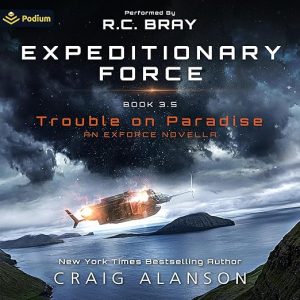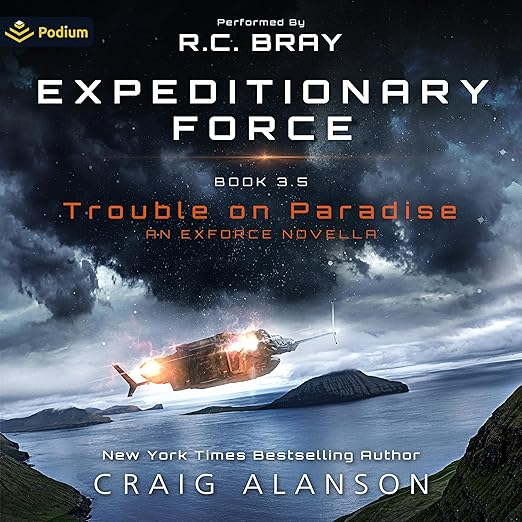
Podium Audio released this five-hour detour in July 2017, and the audiobook has collected exactly two ratings in the years since. Five people wrote about it anyway, which is the first sign that the page is not keeping accurate books on itself. Craig Alanson wrote a side story here, and side stories attract a particular kind of reader: the one already deep enough in a series to want the gaps filled, and honest enough afterward to say whether filling them was worth the time.
Major Emily Perkins gets the assignment the flagship crew does not. While the UN Expeditionary Force's pirate starship Flying Dutchman is off enjoying what the description calls a luxury vacation cruise, UNEF troops remain stranded on an alien-controlled planet, and Perkins and her team are left picking up the pieces on the ground. Swapping a starship for a garrison is a real change of altitude, and the book commits to it rather than cutting back to the more famous half of the story.
Charles F. Kartman, filing the earliest of the written responses in November 2017, names the trade-off exactly: a shorter book, set only on Paradise, with no Colonel Joe and no Skippy, which makes it a relatively more straightforward story. The plot, Kartman adds, covers events described much more briefly elsewhere in the sequence, and puts its weight on relations between UNEF and the Ruhar. That is a precise account of both the appeal and the limitation, offered by someone who plainly likes the wider series.
Side material has to justify itself twice over, once as a story and once as a purchase, and this one leans on the second justification more comfortably than the first. Ground-level occupation politics, supply problems and the slow negotiation between two species sharing a planet make for a quieter book than a starship caper. Alanson knows it, keeps the runtime short, and prices the whole thing as a supplement rather than pretending it carries the weight of a main entry.
Why Listen to Trouble on Paradise
R.C. Bray returns as the reader, which is the continuity that matters most to anyone following the series in audio. Consistency of voice across a long sequence does real work: it keeps a side story feeling like part of the same world rather than a spin-off produced by a different team. For a supplement of this size, that continuity is arguably the strongest argument for taking this in audio at all rather than reading around it.
Completism drives the pool. The longest of the five responses, posted in January 2020, lays out a genuinely funny economy: the first two entries read on an e-reader, the third borrowed from a local library that had stocked the series, and then this one bought because the library had not stocked it. That reader also measures Alanson's progress by how much of the prose gets skipped, and concludes he is getting better, which is a backhanded compliment with real information inside it.
Ground-level material is the strongest writing here. The friction between the two groups sharing the planet gives Alanson something the flagship plot rarely allows: two groups who have to actually live with each other, negotiating rather than shooting. Readers who came to the series for hardware and banter may find that a downshift, but the inter-species dynamics are the most textured writing here, and they explain events the main sequence covers in a paragraph and moves past.
What to Watch For in Trouble on Paradise
Counting is broken on this page, and in a way worth understanding. The listing reports two ratings behind a 4.5 average, which two integer votes can indeed produce, since a five and a four average out exactly there. What two votes cannot produce is five signed written responses, all of them visible, carrying grades of five, four, five, five and four. Those five grades average 4.6, so the counter and the displayed score cannot both be describing the same pool of readers.
Series data is missing entirely, which compounds it. Nothing on the listing names a series or gives a number, yet two separate responses treat this as an installment in a numbered sequence, one of them referring to it plainly as 3.5 and naming the wider run as ExForce. A book explicitly written to sit between two others should say so on its own page. Anyone arriving here first will have no way to know they have walked into the middle.
Dissent is polite but clear. The most recent of the written responses, from February 2026, compares the book to a prequel film, allows that the backstory is good to have, and then says it was not too captivating and that the reader could have done without it. That response still carries five stars, which tells you something about how series readers grade supplements: generously, and without much relation to how much they enjoyed the hours.
Who Should Listen to Trouble on Paradise
Completists working through the sequence in order are the entire natural audience, and they should treat this as optional rather than essential. B Gilson, in February 2025, offers the only remark on the page that touches the recording itself, calling the story line enjoyable while the live action voices did not do much, and then noting that the series purchases continue regardless. That is the honest position of most listeners here: mild about the individual book, committed to the run.
Newcomers should start elsewhere, and the page will not tell you where. Beginning a long-running military science fiction series with its half-numbered side story means meeting a garrison you have no reason to care about yet, in a conflict whose stakes were established earlier in the sequence. The description assumes that knowledge from its first sentence onward, which makes this a poor first impression of what Alanson actually does well.
At five hours this asks little and returns proportionally. The Ruhar material is genuinely more interesting than a filler episode has any obligation to be, Bray's continuity keeps it anchored to the larger series, and the brevity is a mercy rather than a shortfall. Series readers should place it where the numbering says it belongs, once they work out where that is. Anyone else should meet the Flying Dutchman properly before signing on for a tour of the ground.
Do Joe and Skippy appear in this audiobook?
The description places the Flying Dutchman crew elsewhere, off on what it drily calls a luxury vacation cruise, while the action stays on Paradise with Major Emily Perkins and the stranded UNEF troops. Listeners who come to this series specifically for that double act should expect to spend the whole recording without them.
Does the audiobook stand on its own without the earlier books?
Not comfortably. The stakes on Paradise were set up earlier in the sequence, and the tension between UNEF and the Ruhar assumes you know how the two ended up sharing ground. Alanson does not re-explain any of it. Starting here means meeting a garrison with no reason yet to care what happens to it.