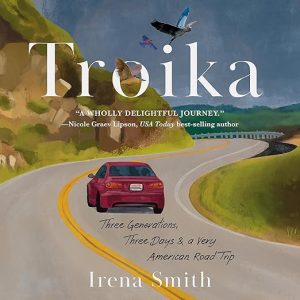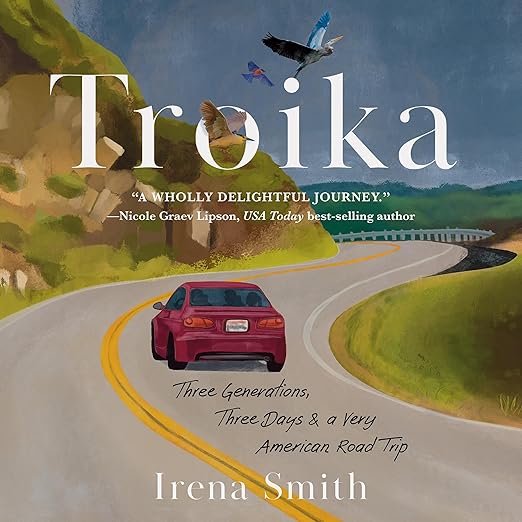
The strongest argument for choosing this memoir in audio sits on the credit line: the person who lived the three days is the person reading them. Five hours and forty-three minutes covers a drive to California's Central Coast taken by three generations of one family, and the audiobook is credited to Irena Smith, who also holds the byline and the publisher line. A book carried by voice and timing gains something from that arrangement, and this one is built out of bickering, reconciliation and stories told inside a moving car.
Is Troika Worth Your Time?
Two clocks run at once. The first covers three days, a severe winter storm, a set of alarming ostriches, an enchanted light exhibit, a hunt for coffee with plant-based milk and a shared binge of White Lotus. The second runs from the horrors of the second world war and an escape from Soviet Russia through adolescence and motherhood in the suburbs of Silicon Valley. The copy calls the result a braid, which is the right word: the trip supplies the present tense while the longer strands keep interrupting it, exactly the way family history interrupts an actual car journey.
This title needs its subtitle and knows it. Troika on its own tells a browsing listener nothing; the seven words after the colon do all the work, and unusually for this catalog the title field carries every one of them. What the copy never does is gloss that first word, which is left standing on its own while everything else gets explained. The description is otherwise generous with specifics. It names the coast, the storm, the ostriches and the streaming show, and it puts Homeric detours and internet memes in the same sentence without apologizing for either.
The Best Parts of Troika
An author-read memoir is a different product from a performed one, and the difference is settled long before anyone reaches a microphone. A hired reader interprets. A writer reading a memoir is repeating something that was already said aloud once, often to the people described in the book. Nothing on this page reports how the recording turned out, so the case rests on the arrangement rather than the result: the material is a family argument conducted in a car, and the person who had the argument and then wrote it down is the one credited with speaking it.
The length is well judged for the design. Three days of trip time works out at under two hours per day, so the compression is severe and the book puts it to use: the drive is a frame rather than an itinerary, and the digressions are the whole point. Travel memoirs that run long usually get there by describing places. This one describes people, in a moving vehicle, over a stretch of road where nobody can leave, which is the harder job and the one that suits listening.
The register swerves deliberately, and the copy is honest about it in advance. Heartbreak to hilarity, Homeric detours to internet memes, Russian proverbs alongside a search for oat milk. Anyone who has driven any distance with a parent and a grown child will recognize that tonal instability as accurate reporting rather than as a stylistic decision. The seventy-seven-year-old and the twenty-two-year-old are the two poles of the book, and the middle generation, the one doing the driving, holds the argument between them and gets no vote.
Before You Commit to Troika
Four months after the April 2026 release, the rating column on this page is still empty and no written response has appeared beneath it. For a self-published memoir that costs more than it would for a house release, because the usual substitutes are missing as well: no press quotes, no series to inherit an audience from, no imprint whose other titles hint at the editing standard. The publisher field carries the author's own name, matching both the author line and the reader line, so every assurance on this page traces back to a single source.
Filing is the second issue. The record sits under travel and tourism with a travel writing and commentary tag, while the copy's own opening phrase is lyrical and unconventional memoir. Anyone browsing travel for a destination book arrives at a family history in which the Central Coast functions mostly as a corridor. Anyone browsing memoir never reaches the page at all. The trip is real and the places get named, but the book is about migration, memory and motherhood, and it says as much in its second paragraph.
One small oddity sits inside the description. The copy introduces its central figure as a middle-aged narrator rather than as the author, a convention borrowed from fiction, then attaches a seventy-seven-year-old mother and a twenty-two-year-old daughter to that figure. On a memoir where the byline and the reading credit are the same person, the third-person distance is a strange note to open on, and it leaves a buyer briefly unsure whether this is autobiography or something merely shaped like it. The rest of the copy settles the question, though not before the first sentence has muddied it.
Should You Listen to Troika?
Listeners who want their travel writing to be about the passengers rather than the destinations are the natural audience, and they get an unusually well-stocked version of it. Anyone drawn to books about mothers and daughters, particularly across three generations instead of the usual two, has a specific reason to try this. Immigrant family stories that keep hold of their humor are rarer than they ought to be, and the copy promises a darkly funny meditation rather than a solemn one. Anyone fond of the Odyssey will find the framing playful instead of pretentious.
Buyers who choose travel audio for the places should look elsewhere, since the Central Coast is the setting rather than the subject and the book keeps leaving it for Russia and for Silicon Valley. Listeners who need a rating before committing have nothing at all to work from here. And a listener who prefers memoirs read by professionals should spend a few minutes with the sample first, because on a record where one person holds all three credits, that sample is the only independent evidence available anywhere on the page.
In Brief
- Voice: One name carries the byline, the reading credit and the publisher line, so nothing here was interpreted by an outside voice.
- Big ideas: Migration and memory, mothers and daughters, the Odyssey as a family map, generational distance.
- Atmosphere: Warm, digressive, funny in a way that keeps circling back toward loss.
- Worth it?: A memoir worth the five hours, filed under a category that will keep its readers from finding it.
Before You Listen
How long does the Troika audiobook run, and who is credited?
Five hours and forty-three minutes, released on 7 April 2026, with Irena Smith holding the byline, the reading credit and the publisher line. That length covers a three-day trip plus several decades of family history, so the pace stays brisk rather than descriptive throughout.
Does the audiobook have any ratings yet?
None. The April 2026 release date has been and gone, and the rating column stands empty with no written response posted against it. On a self-published title with no imprint and no series behind it, the sample is the only evidence a buyer can weigh before deciding either way.