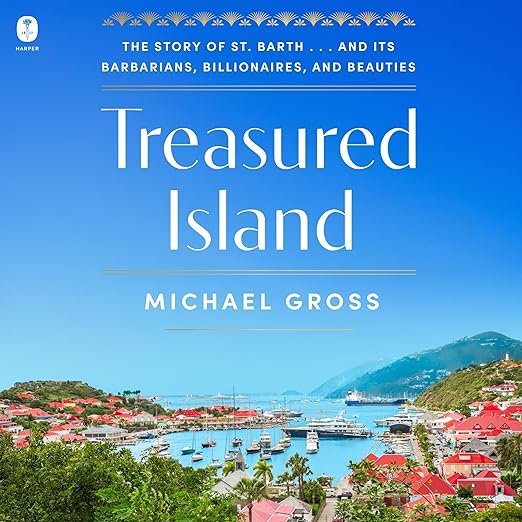
St. Barthélemy materializes most dramatically from the air, the runway too short for anything but a sharp banking approach over the hills, the harbor opening up below in turquoise layers that somehow look expensive even from altitude. Michael Gross has spent over three decades trying to understand how a volcanic island that spent centuries as a resource-poor backwater became the preferred address for celebrities, oligarchs, and the kind of inherited European money that does not need to announce itself. This audiobook, narrated by Stephen Mendel and running nearly thirteen hours, is the result of that inquiry, and it is a richer and more rigorous piece of work than the phrase 'social history of a Caribbean island' might initially suggest.
Where This One Lands
Gross is best known for Model and 740 Park, both of which applied the same method: extended access to a closed world, meticulous sourcing, and a prose style that makes the sociology of extreme wealth readable without becoming either sycophantic or hostile. He brings that method to St. Bart's with characteristic thoroughness. The book begins with the island's actual origins, a volcanic outcrop so inhospitable and resource-poor that it spent centuries as a marginal community, and traces its transformation into a playground for entertainment, tech, and fashion celebrities alongside old European money and international oligarchs.
The transformation is not simply a story of tourism dollars or savvy marketing. Gross traces the specific decisions, the particular families, the individual moments that shifted the island's trajectory: the arrival of certain hotels at the right moment, the establishment of restaurants that created social codes, the word-of-mouth networks of wealthy Europeans that made St. Bart's 'the place' for a specific class of traveler rather than its neighboring islands. The social history is genuinely illuminating even for readers who have no particular interest in visiting and no patience for the ultra-rich as a subject in themselves.
Gay Talese's description of Gross as the 'premier chronicler of the rich' is earned here. The book is neither envious nor admiring, which is the correct register for this subject matter. Gross is interested in how social geography is constructed, how places acquire and maintain their reputations, and what those processes cost the places and people involved. Those questions are interesting regardless of how one feels about St. Bart's or the people who holiday on the island.
Stephen Mendel narrates with a register that suits social history well: measured, clearly articulated, and without the performed enthusiasm that can make travel content sound like promotional copy. At nearly thirteen hours, the audiobook has the scope to develop its subjects properly. Gross is not summarizing the island's story but building it through specific people and specific moments, and Mendel gives that material the room it needs without rushing through the connective tissue.
The audiobook works on two levels simultaneously. As a companion for listeners who have visited or plan to visit St. Bart's, it provides rich historical context that transforms what might otherwise be a beautiful but somewhat opaque destination into something legible. As a piece of social history about how extreme wealth shapes places and communities over decades, it is engaging and well constructed regardless of any travel plans. The depth of Gross's reporting over thirty years of extended visits gives the book an insider texture that shorter engagements with the subject could not produce.
What to Watch For in Treasured Island
Listeners whose primary interest is practical travel guidance, where to stay, what to eat, which beaches to prioritize, will not find that here. This is social and cultural history, not a travel guide. The book assumes the reader is already interested in St. Bart's as a subject and does not spend much time establishing why the island merits thirteen hours of attention. For listeners who share Gross's fascination with the mechanics of elite social world-building, that assumption is entirely reasonable. Listeners who came in through a travel interest and expected a different kind of book should clarify their expectations of the scope before committing to the full runtime.
The book is also necessarily focused on the island's recent transformation, the past several decades during which its current character was formed, rather than its deeper colonial past. The earlier history of the island's original residents and its periods under Swedish and French administration are present but not the central focus. Listeners interested in Caribbean history more broadly will find the recent social transformation the primary subject rather than a comprehensive historical account of the islands across centuries.
Without substantial published reader reviews at the time of this assessment, it is difficult to gauge how the audiobook experience specifically compares to the print edition for general readers. Based on Gross's track record and Mendel's steady narration, the audio version appears well executed, though listeners who prefer to absorb dense social history with the ability to annotate or navigate back may find the print edition more practical for reference purposes during and after reading.
Gross also pays attention to what the transformation of St. Bart's has meant for the islanders themselves, the families who have lived on the island for generations and who have navigated the shift from poverty to proximity to extreme wealth with varying results. Some have prospered from the service economy the wealthy visitors created. Others have found the island increasingly difficult to afford as a place to actually live. That tension between the destination and the community it is built on is a thread Gross follows throughout, and it gives the social history a dimension that pure celebrity chronicle would lack.
Recommended For
This audiobook is best suited for listeners with a genuine interest in how elite social geography is created and maintained: how a place becomes 'the place' for a particular class of traveler, and what that transformation costs the place itself and its original inhabitants. Fans of Gross's earlier work will find this a natural continuation of his preoccupations. Listeners who have spent time on St. Bart's and want to understand the history they experienced will find it richly contextualizing. The thirteen-hour runtime is appropriate for the material, and listeners committed to the subject will find the depth consistently rewarding throughout.
The Short Version
- Voice: Stephen Mendel's measured, articulate delivery suits the social history register well, providing clear and consistent presentation without performed enthusiasm.
- Big ideas: The transformation of St. Barthélemy from impoverished Caribbean backwater to ultra-wealthy elite playground, and the social mechanics that created and sustain that shift.
- Atmosphere: Analytically cool and richly detailed, social chronicle rather than travel narrative, best suited for listeners already curious about the subject.
- Worth it?: A thoroughly researched social history of an extraordinary Caribbean island, rewarding for listeners interested in elite cultural geography, but not a substitute for a practical travel guide.
A Few Questions About Treasured Island
Is the Treasured Island audiobook a travel guide or a history book?
It is a social history rather than a travel guide. The book traces how St. Barthélemy transformed from a marginal volcanic island into a playground for the ultra-wealthy, covering the specific people and decisions that shaped its current character. Practical travel guidance is not within its scope.
Do I need to have visited St. Bart's to get value from this audiobook?
No prior visit is required. The book functions as a self-contained social chronicle and works well for listeners interested in elite cultural geography even without direct experience of the island. Listeners who have visited will find it enriches and contextualizes what they observed there.