The Short Version
- Narrator: Steven Brand carries a solo reading with no cast and no editorial apparatus, so the whole book rests on one voice holding an eighteenth-century register.
- Subjects: The search for the Niger, dependence on local hospitality, slavery and trade in West Africa, the beginnings of colonial enterprise
- Tone: Plain, forward-moving and frequently precarious, an account written on the move
- Bottom line: A founding travel document that still works as a story, though the audio edition strips away the maps and notes a text this old genuinely wants.
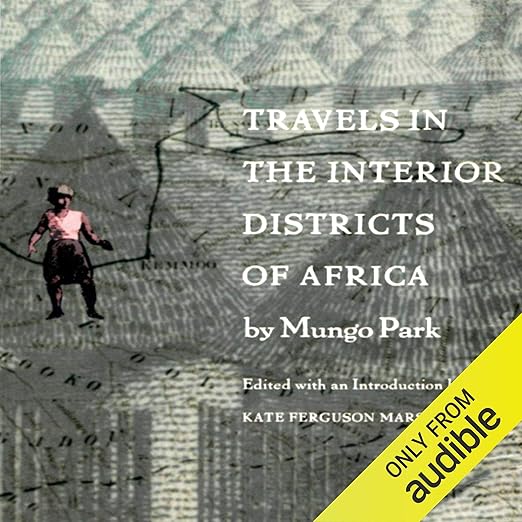
Published in 1799 and never really out of circulation since, Travels in the Interior Districts of Africa arrives with its own historiography attached. The audiobook gives it twelve hours and sixteen minutes with Steven Brand reading, and the publisher describes this as the full edition, which on a text of that age is a claim worth registering. Mungo Park set out to find the Niger River. What he wrote down along the way became a founding document of African travel literature and, unavoidably, of the European enterprise that followed him.
Only three ratings sit behind this listing, and the 4.8 they supposedly produce is a figure three whole-star votes cannot reach. Fourteen divided by three works out at 4.67 and displays as 4.7. Fifteen divided by three is a clean 5.0. Nothing exists between them, because votes arrive in whole stars and thirds of a star do not land on eight-tenths. The one visible grade is a four, which caps the achievable total at fourteen in any case, so even the best reachable figure sits below what the page shows.
Strip the reputation off and what remains is a walking narrative. Park traveled for eighteen months, with local guides or entirely alone, without much idea where he was going, dependent on the people he met for food, shelter and directions. That dependency is the book's structure and also its moral texture: a man with no power and no expedition behind him, fed by strangers whose societies he is simultaneously describing for an audience that would later put the description to use.
Chronology is where the page's single written verdict slips. A four-star response from December 2018 calls this a thrilling read that plays like a film being watched, praises the way events are sequenced to keep you wanting the next one, and then places West Africa in the late seventeenth to early eighteenth century. The description puts first publication in 1799 and the material squarely in the eighteenth. The enthusiasm is well founded. The dating is a century adrift, which matters if you are using that summary to orient yourself.
Why Listen to Travels in the Interior Districts of Africa
Worth a credit for two reasons, and they are different in kind. The first is that the book is genuinely a story, with a destination, a mounting sense of danger, and an account assembled from inside the experience rather than at a desk long afterward. The second is the material nobody else was recording. The description states the claim carefully: a rare written record of the lives of ordinary people in West Africa before European intervention, which is a different and considerably more valuable thing than an adventure.
Innocent is not a word this listing uses, and a listener should not supply it. It says outright that Park was significant in opening Africa to European economic interests, and that his modest, low-key heroism let the British public imagine themselves as a welcomed force there. His accounts of war, politics, the spread of Islam and his repeated confrontations with slavery as it was practiced in eighteenth-century West Africa are exactly why historians still work with him. Take it as evidence rather than as testimony.
Literary afterlife is part of the sell, and for once the claim is checkable. The description names Wordsworth, Melville, Conrad and Hemingway among the writers who acknowledged Park's influence on their own work. Whether or not the lineage interests you, it tells you what sort of prose to expect: a plainly written traveler's report from the end of the eighteenth century, which later novelists mined for atmosphere and for the shape of a journey into somewhere unmapped.
What to Watch For in Travels in the Interior Districts of Africa
Twelve hours of prose written in 1799 is the genuine question mark hanging over this edition. Sentences from that period run long and subordinate and were built for the eye, and Steven Brand has to keep them navigable at speaking pace across what amounts to a full working day of listening. The text also carries place names and personal names transliterated as one traveler heard them two centuries ago. Play the sample on a passage of description rather than a passage of incident.
A scholarly edition normally arrives with apparatus, and audio strips all of it away. Maps most of all: this is a book about a river its first readers could not have placed, and following a route through unfamiliar country without one is a real loss rather than a small inconvenience. Nothing on the listing mentions a companion document. If the geography matters to you, keep something open beside you, because the account names places continuously and never stops to orient anybody.
Content rather than craft drives the last caution here. This is a first-hand account of a region where slavery was being practiced and traded, written by somebody who kept encountering it and set down what he saw. The description says as much without flinching. Nothing here is sensationalized and nothing is softened, and a listener looking for travel writing as escape has arrived at precisely the wrong title.
Who Should Listen to Travels in the Interior Districts of Africa
Travel writing readers who want the origins of the form are the obvious audience, since this sits very close to a source text for the whole genre. Anybody studying the history of West Africa, the history of slavery, or the machinery of colonial enterprise will find the description's framing accurate rather than promotional: the book functions as a crucial document inside that scholarship, not as a comfortable narrative about a long walk.
Long single-voice nonfiction is exactly what this is, and the pace suits anybody who likes the form. No cast, no interviews, no interleaved analysis, just one continuous account moving forward, which has become a rarer proposition in audio than it once was. Anyone who has worked through modern histories of the same region and wants the document sitting underneath them has an obvious next step waiting here.
Approach with care if you want a modern voice on this history, because the perspective is the eighteenth century's and the book offers no apology for it. Pass if you need maps, footnotes and a scholarly introduction, none of which survive the move into audio. Nothing else on the travel shelf offers quite this thing: a first-hand account of West Africa written before the machinery arrived, read straight through, with every one of its blind spots left intact.