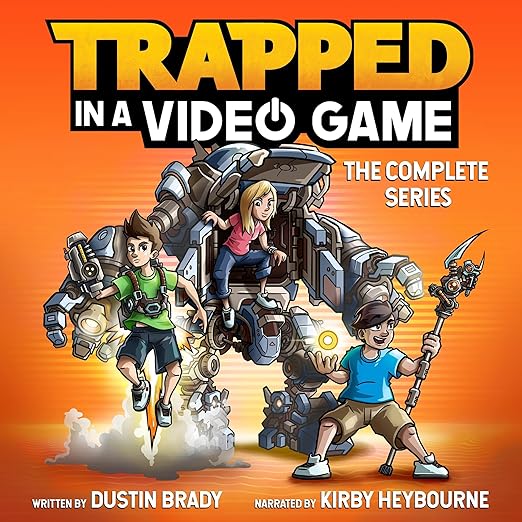
Not one of the five people who wrote about this audiobook appears to have heard it. They describe reading with a grandson, a son getting through the series quickly, a set ordered for an eleven year old, and one of them praises the graphics, which a recording does not have. That is no criticism of the responses, which are warm, specific and clearly earned. It does mean anyone looking for guidance on what Kirby Heyborne does across thirteen and a half hours has to look somewhere other than the column sitting directly beneath the listing.
What Dustin Brady Delivers
Jesse Rigsby hates video games, a solid joke to build five books on, and the reason he hates them is that a video game character is trying to kill him. The first volume drops him and his best friend Eric into a game called Full Blast, where a mysterious figure trails him and the exit refuses to announce itself. Everything afterward escalates: a Pokemon Go-style mobile game hiding invisible monsters, robot villains from Super Bot World 3 loose in the real world where no extra lives exist, a retro island holding an android, a drone and an 8-bit shark, and finally ten minutes to save everything.
Kirby Heyborne carries all five books, and that is the single strongest argument for taking the bundle in this format instead of piecemeal. A series read by one voice keeps Jesse and Eric sounding like themselves from the first game to the last, and continuity of voice matters more to a seven year old than to anyone else in the house. The record names no second reader and no full cast, so the entire span of five games belongs to one performer, uninterrupted. Andrews McMeel Publishing gathered the whole run into a single recording, which also spares a young listener the business of hunting down the next volume between installments.
What Dustin Brady Gets Right
Thirteen hours split across five novels means short books, which is exactly what this audience wants. The copy names that audience without hedging: a seven to twelve year old video game fan, promised non-stop action, huge plot twists and tons of humor. Chapters run short enough that the description jokes about a kid begging for one more, and in audio that becomes a natural stopping point every few minutes, and that is the difference between a car trip that works and one that ends in negotiation.
Book by book the stakes move from inside the game to outside it, and that escalation is the structural idea holding the collection together. The first two volumes trap Jesse in software. The third turns the software loose in the world, where the copy makes the point that lands hardest with a twelve year old: in the real world, no extra lives. Two responses confirm the comedy works. A nine year old, quoted by a parent, reports that it is really funny, and an eight year old is described tearing through the whole set.
Sheila supplies the account most likely to sell this in other households. A set ordered for an eleven year old grandson who had been, in that telling, more of a screen person with his eyes glued to one game or another, who got talked into checking out the first book and has been diving into them since. A series about a boy trapped inside a video game turned out to be the thing that pulled a kid out of one. No line the publisher wrote comes close to that as a recommendation.
Where Dustin Brady Loses Some Ground
Graphics get named outright in one entry, and that single word settles where this column came from. A parent reports that an eight year old likes the graphics and, being a strong reader, is moving through the series with ease. Another says a grandson loved these books. A third read the first one alongside a grandchild and regrets not managing the rest, since the family lives two days away. Every one of those sentences belongs to a printed set, and none can tell you what the recording does with a hover tank or an 8-bit shark.
Nowhere on this listing does a series field get filled in. The title announces The Complete Series, the description numbers five books and hands each one a title and a premise, and the field that would tell a buyer this is a collected edition sits blank. For the bundle itself that is a minor irritation. For anyone searching by series name, hoping to locate the individual volumes or a sixth installment, it becomes a genuine obstacle, and the description ends up being the only place the structure is written down at all.
Missing alongside it is any statement about what the full thirteen hours actually covers. Five novels for a seven to twelve year old audience is plausible at that length, yet nothing confirms the recordings are complete rather than condensed, and nothing indicates whether the audio keeps the order the description sets out. Buyers of a collected edition usually want that confirmed in writing, and here it has to be inferred from a runtime and a title. The audio date reads June 27, 2023, while the earliest written response lands in November 2025, so this column arrived more than two years behind the recording it sits under.
Who Should Pick Up Trapped in a Video Game: The Complete Series
Families with a gamer between seven and twelve are the obvious buyers, and the age band in the copy matches the children described in these responses, who are eight, nine and eleven. It suits car trips, shared listening at home, and one specific case a reviewer describes and cannot solve: a grandparent living two days away from a grandchild. A printed book cannot be read together across that distance. A recording can be playing at both ends of it.
Reluctant readers are the group this format serves best, worth saying because the column celebrates the opposite, a strong reader moving through the print set at speed. Older listeners will find the humor pitched young, and adults who want the illustrations those responses enjoyed will not find them here. Parents hoping to trade screen time for listening time already have one precedent in this column, and it involves a boy who was talked into the first book and stayed for the other four.