In Brief
- Narrator: Cheryl May's steady, unshowy delivery keeps the tension earned rather than performed.
- Subjects: EMP survival, small-circle trust over crowds, mountain isolation
- Tone: Tense and grounded
- Bottom line: A solid, self-contained entry into a massive franchise, best for genre fans who don't need series-wide continuity.
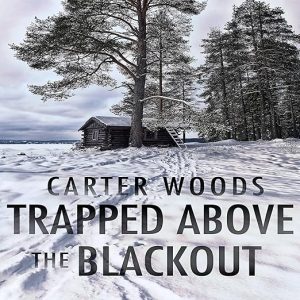
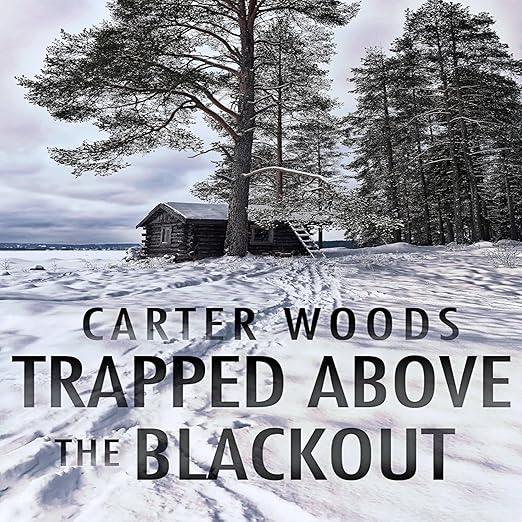
Cheryl May's voice carries wildlife biologist Lisa through this audiobook's opening pulse strike with the kind of grounded calm that survival fiction depends on, since panic narrated at full volume for eight straight hours would exhaust a listener long before the plot does. Trapped Above the Blackout marks entry number one hundred forty-three in the long-running EMP Survival in a Powerless World series from Carter Woods, and that number alone signals something worth understanding before pressing play: this is a serialized, multi-entry survival franchise rather than a single trilogy, closer in structure to a shared-universe anthology than one continuous author-driven arc.
What We Made of It
What distinguishes this specific entry from the generic post-EMP premise the series title promises is its narrowing of scope down to three women, Lisa, Natasha, and Natasha's daughter Regan, isolated in the mountains rather than following a sprawling ensemble cast across a collapsing city. Reviewer Poeseewi singled out Regan specifically as a favorite character who experienced real growth across the book, which suggests the character work holds up even within a franchise built more for episodic consumption than for deep individual-book literary ambition. Keeping the cast small lets the mountain setting itself, described by that same reviewer as beautiful, do real atmospheric work rather than getting lost behind constant new-character introductions.
The central premise, electronics failing, roads turning violent, safety found in staying hidden rather than seeking out other survivors, plays against the more common post-apocalyptic instinct to band together in numbers. That inversion, trust a small known circle and avoid the crowds entirely, gives the book a specific, coherent survival philosophy rather than a vague backdrop of general chaos. Reviewer Amazon Customer's comment that 'the chaos of such an event is hard to imagine' suggests the book succeeds at making the disaster's practical texture, not just its danger, feel plausible rather than abstract.
For a franchise this large, the audio format solves a real practical problem: entry one hundred forty-three is a genuinely intimidating number to approach in print, where the visual weight of a series list can discourage a new reader before they start. Audio strips that anxiety away almost entirely, since a listener downloading this specific title experiences it as a self-contained eight-hour survival story about three specific women in a specific mountain setting, without needing to reckon visually with everything else the series numbering implies exists around it.
Cheryl May's steadiness matters especially in a genre where lesser narrators lean into breathless, over-dramatized delivery for every tense scene, flattening the difference between a genuinely dangerous moment and an ordinary one. Reviewer Kindle Customer's framing of the book as almost a wakeup call about digital dependence and the inability of most people to survive a real power outage suggests the material is doing thematic, not just plot-mechanical, work, and a narrator who trusts that theme to land without constant vocal underlining is the right choice for a story more interested in earned unease than jump-scare pacing.
Long-numbered survivalist series like this one are a recognizable convention within post-apocalyptic prepper fiction specifically, a subgenre built around rapid-release, standalone-adjacent entries rather than a single author's carefully plotted trilogy. Readers already familiar with this corner of the genre will recognize the format immediately: a shared premise, EMP-triggered societal collapse, reused across many entries with different characters and settings each time, functioning less like sequential chapters and more like variations on a theme, worth understanding as a genre convention rather than a publishing oddity specific to this one title.
What to Watch For in Trapped Above the Blackout
A series number in the hundreds means this entry almost certainly was not written with a single, tightly serialized narrative in mind connecting book one to book one hundred forty-three. Listeners expecting to need the full backlist to understand this specific story should be reassured that the synopsis reads as self-contained, three women, one mountain, one blackout, but anyone hoping for deep series-wide continuity and callbacks to earlier entries may find that expectation does not match how a franchise at this scale typically operates, where individual entries function more like standalone chapters in a shared premise than sequential installments of one plot.
The three attached reviews are uniformly five-star with one four-star exception, and all speak to character and setting rather than flagging any specific narration weaknesses, a reasonably strong signal for Cheryl May's performance even without a review dedicated purely to her delivery. Worth noting for genre purists: this sits closer to survivalist thriller than hard science fiction despite its science-fiction-fantasy genre tag, the EMP premise is the inciting event rather than a fully explored speculative mechanism, and readers wanting rigorous technical explanation of the pulse itself may find the book more interested in its human aftermath.
Eight hours is a substantial runtime for a story centered on just three characters in one isolated setting, and listeners should expect a slower, more atmospheric pace than a plot-dense thriller might deliver in the same runtime. That pacing choice suits the mountain isolation premise, dwelling in a place rather than rushing through it mirrors the characters' own situation, trapped and waiting rather than actively fleeing toward a destination, but readers wanting constant forward plot momentum across all eight hours should know the book spends real time on atmosphere and relationship-building between the three women rather than nonstop incident.
Best Suited For
This suits listeners who enjoy grounded survivalist fiction over hard science fiction, readers drawn to small-cast, character-focused danger rather than large ensemble disaster narratives, and anyone already invested in the EMP Survival in a Powerless World franchise looking for a self-contained entry that does not demand the other hundred-plus books first. The mountain isolation setting and the trust-a-small-circle survival philosophy give this a distinct identity within a crowded post-apocalyptic genre, and Regan's arc specifically offers an emotional hook beyond pure survival mechanics for listeners wanting more than just escape-the-danger plotting.
This also suits readers who enjoy the crossover between survivalist fiction and genuine prepper-adjacent nonfiction, the kind of reader who follows disaster-preparedness content alongside apocalyptic novels because the practical detail interests them as much as the drama. The book's attention to specific survival choices, staying hidden rather than seeking help, trusting a small known circle, gives it a grounded, almost instructional texture underneath the fiction that this particular crossover audience tends to appreciate more than readers looking purely for escapist adventure.
Skip this if series numbering in the triple digits is a genuine deterrent, or if hard science-fiction rigor around the EMP mechanism itself matters more than character-driven survival drama. Readers wanting a tightly plotted single arc with a clear beginning and end across one author's unified vision, rather than one entry in a sprawling multi-author-adjacent franchise, should approach the series structure here with realistic expectations before committing eight hours to what functions as one chapter in a much larger, ongoing premise.
Good to Know
Do I need to listen to earlier books in the EMP Survival series before this audiobook?
No. Despite being entry one hundred forty-three, the synopsis and story are self-contained around three specific women in one mountain setting, functioning more like a standalone chapter in a shared premise than a sequential series installment.
Is Trapped Above the Blackout audiobook hard science fiction or survival thriller?
It reads as survivalist thriller rather than hard science fiction. The EMP event is the inciting incident rather than a deeply explained technical mechanism, with the story's focus on human aftermath and small-group trust instead.
Who is the main character in this audiobook, and whose perspective does it follow?
Wildlife biologist Lisa anchors the story, trapped in the mountains alongside Natasha and Natasha's daughter Regan after the power grid fails, with Regan specifically praised by a listener as a standout character.
Does this audiobook work as a standalone listen despite being book one hundred forty-three?
Yes. The high series number reflects a long-running, multi-entry franchise structure rather than a single continuous plot, and this specific entry is built to be understood without the rest of the backlist.