
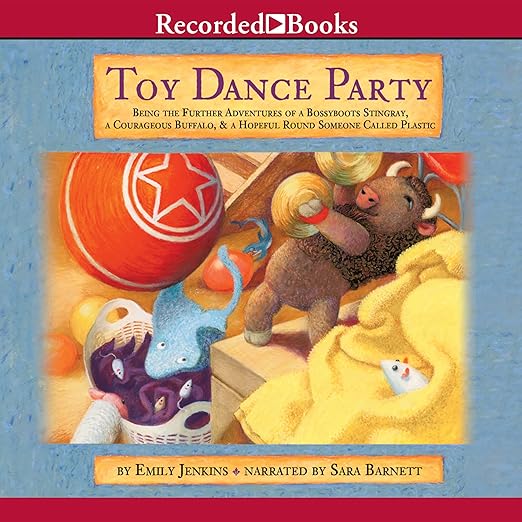
Lumphy, Stingray and Plastic have been left behind. Their little girl has gone away for winter vacation and forgotten to pack them, which is the whole premise of this audiobook, and across not quite three hours that premise produces a blizzard, a rescue operation involving the vacuum cleaner, and a dance party held with the washing machine. Emily Jenkins is not writing about adventures. She is writing about being forgotten, and the adventures are what that feeling looks like from a toy's height.
Our Take on Toy Dance Party
Emily Jenkins is doing something more careful than the setup suggests. These are toys with anxieties rather than quests, and being left behind is the actual subject the blizzard and the vacuum are dressing up. An April 2010 five-star response gets at why adults keep buying these books, describing characters who reflect the reader's own shortcomings, bossiness and fear and loneliness among them, while showing what it looks like to love one another anyway.
Sara Barnett is the credited reader for a book that spends most of its life being read aloud by somebody else. Four of the five written responses describe exactly that scene: a parent doing the voices at bedtime, children arranged on the bed reacting. That is not a criticism of the recording. It is a description of the competition, because a professional reading has to beat the parent it replaces or it will not get played a second time.
Three toys, three temperaments, and the book keeps them distinct without ever labeling them. That matters more in audio than in print, where a young listener has pictures to anchor who is who, and it is the single hardest thing a solo reader has to manage in a chapter book this short. The comedy depends on the listener knowing who is speaking before the sentence finishes.
Why Listen to Toy Dance Party
Every chapter is a self-contained episode, which is the structural gift here. Surviving the blizzard, rescuing the toy mice from the vacuum and the dance party are separate stories sharing a cast, so nothing breaks if you stop after one of them. For bedtime that is close to ideal, and for a car containing a five-year-old it is the difference between a book that works and a book that gets switched off. Episode structure also protects the jokes, since each one gets a clean setup instead of arriving on top of a plot the listener half remembers from yesterday.
Squealing is apparently the correct response. A September 2014 five-star account describes children laughing, pounding pillows, throwing themselves backward and shrieking outright at the antics of their favorite characters, and rates the sequel above the first book. That is a physical description of how this material plays in a room, and it is easily the most useful thing on the page for anyone wondering whether a four-year-old will sit still for it.
Kids are not the only audience this was built for, which is the reason it keeps getting bought two decades on. The vocabulary is not sanded down into mush, the emotional situations are genuinely uncomfortable at points, and the jokes are constructed so adults land on a different beat than children do. That is the classic dual-audience trick, and the written record here suggests it works on both halves of the room. The washing machine is a character. So is the vacuum, in a manner of speaking, and a book willing to build a threat out of household appliances has already understood how small a toy's world is and how enormous everything in it looks from down there.
What to Watch For in Toy Dance Party
Serial killers come up, which is not a phrase you expect in a review of a book about a stuffed buffalo. A November 2018 four-star response raises it directly: something in these books may frighten some children, and the example offered is a reference to serial killers hiding in the basement. That account is openly unsure whether the passage belongs to this volume or to the first one, having read both.
Illustrations get praised in the written record, which tells you exactly where these responses came from. Four of the five explicitly describe reading the printed book aloud rather than playing a recording, and one of them closes by noting how good the pictures are. That is a print pool sitting underneath an audio listing. It does not make the responses worthless, it makes them evidence about the writing rather than about this edition.
Recorded in 2012, this edition inherits a reception assembled almost entirely around the hardcover. The oldest of the five responses dates from April 2010, two years before the recording existed at all. What that record documents is the book, and on material whose comedy runs on timing and on three voices staying separate, the distinction between the book and the performance of it is not a small one.
Who Should Listen to Toy Dance Party
Bedtime is the obvious slot and a car is the other one. Just under three hours divides cleanly into episodes, nothing carries over, and a child who falls asleep partway through the vacuum rescue has not lost a plot thread. Parents who have run out of energy for doing the voices themselves are the specific buyer this recording exists for, and the genre rarely admits how many of them exist.
Households already invested in these characters are the surest bet. A November 2014 five-star response describes a daughter asking for this one as a birthday present after the family had borrowed it from a library, praises it for not being foolish drivel in the way of many children's books, and calls the content appropriate across ages. That same account puts one chapter at roughly twenty minutes of reading aloud, which is a useful unit to plan around.
Press play expecting a small, funny, quietly melancholy book about being left behind rather than an adventure story with toys in it. Newcomers can start here without confusion, though the first book supplies the friendships that make the bickering land. One caution travels with the recommendation: the written record flags an unsettling image somewhere in this series without pinning down which volume carries it, so preview before bedtime if your listener is easily spooked.
At a Glance
- Narrator: Sara Barnett is credited on a chapter book whose written record is dominated by parents reading it aloud themselves, which sets the bar the recording has to clear.
- Subjects: Being forgotten and left behind, three temperaments learning to share a shelf, small domestic disasters
- Tone: Funny and gentle, with real melancholy under the slapstick
- Bottom line: A near-ideal bedtime listen in self-contained episodes, with one flagged image worth previewing first.







