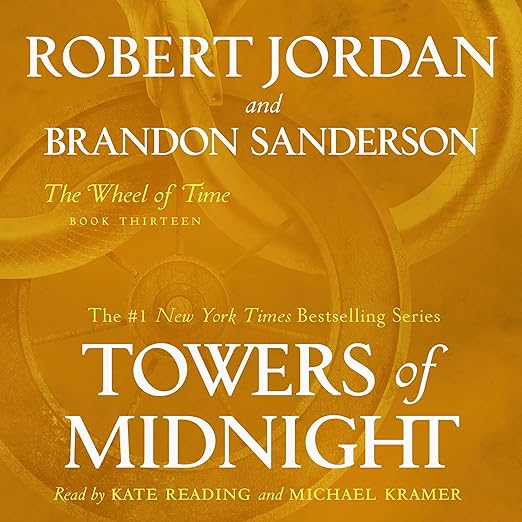
Quick Take
- Narration: Kate Reading handles the female-perspective chapters with characteristic precision, she and Michael Kramer’s division of narration duties across the Wheel of Time series has become one of the more celebrated partnerships in epic fantasy audio.
- Themes: the cost of accepting responsibility for the world’s fate, the wolf as internal identity crisis, the geometry of endings in long-form epic fantasy
- Mood: Dense and escalating, with the particular tension of a story that can see the finish line from where it stands
- Verdict: A near-essential penultimate volume for committed Wheel of Time listeners, Sanderson’s handling of Perrin and Mat here is the series’ high-water mark for those two characters.
I came to Towers of Midnight having spent the better part of three months working through the preceding twelve volumes of the Wheel of Time, and when I finally started Book 13, I was aware of something I hadn’t quite felt in any of the earlier installments: the specific, strange feeling of a story that knows it is almost over. There’s a quality to the pacing in this book, a forward pressure that the earlier volumes didn’t have, because the Pattern is unraveling and everyone in the story knows it and the story itself seems to know it too. That self-awareness about its own position in the arc gives Towers of Midnight an energy that some of the middle books lacked.
This is Book 13 in Robert Jordan’s Wheel of Time series, the second of the three volumes completed by Brandon Sanderson after Jordan’s death in 2007. Released in November 2010 and narrated by Kate Reading and Michael Kramer, it is widely considered the stronger of Sanderson’s two contributions before the concluding A Memory of Light. The seals on the Dark One’s prison are crumbling. Tarmon Gai’don, the Last Battle, is no longer a distant prophecy but an immediate event horizon. What Sanderson does in this volume is give three of the series’ principal characters the room to complete their most important internal arcs before everything converges.
Our Take on Towers of Midnight
Perrin Aybara’s storyline is the book’s center of gravity. His relationship with the wolf within him has been one of the series’ most interesting ongoing tensions, not because wolves are threatening, but because Perrin’s identity hangs in the balance between what he is and what he is afraid of becoming. Sanderson resolves this with genuine conviction. The Tel’aran’rhiod sequences, the Dream World sequences, are the visual and emotional peak of Perrin’s arc, and reviewer Efrem Y. Huang describes the overall plot development as “torrential”, there’s hardly a lull, and even the quieter scenes carry the weight of inevitability.
Mat’s storyline, his navigation of the Tower of Ghenjei and what he finds there, is the other major achievement of this volume. Sanderson has spoken publicly about Mat being the most difficult of Jordan’s characters to capture, and the earlier post-Jordan volumes showed that difficulty. By Towers of Midnight, he has found the character’s voice, and the Tower of Ghenjei sequence is among the most entertaining setpieces in the entire series. It takes everything that was established about the Aelfinn and Eelfinn across thirteen books and delivers a payoff that is inventive, funny, and heartbreaking almost simultaneously.
Why Listen to Towers of Midnight
Kate Reading’s narration has been a constant of the female-perspective chapters across the series, and her handling of Egwene’s political maneuvering in the White Tower, one of the book’s ongoing threads as she positions the rulers of the Borderlands against Rand, has the precision that character requires. Egwene works because she is competent in ways that are specifically institutional rather than magical or martial, and Reading understands how to convey institutional authority without making the character feel cold.
Reviewer Jenny, who has been reading the series since 1997, describes it as “a true epic fantasy” that she attributes to the relationship it has created with readers across decades. Reviewer Josh Mauthe notes the near-impossible structural challenge: this is the middle book of a three-part volume that represents the final book of a twenty-year series, and it has to satisfy on its own terms while setting up the finale and paying off events established long before Jordan’s death. That it largely succeeds at all three tasks simultaneously is the most meaningful endorsement of Sanderson’s achievement here.
What to Watch For in Towers of Midnight
The stylistic seams between Jordan’s original material and Sanderson’s completion are present, and readers who are sensitive to voice shifts will notice them. Sanderson’s prose has different rhythms than Jordan’s, more direct, more plot-efficient, occasionally less atmospheric. Whether this registers as a feature or a flaw will depend on what you valued most in the earlier volumes. Reviewer Efrem Y. Huang acknowledges “shortcomings in consistency or stylistic hiccups” while arguing the book succeeds as a whole, which is an honest assessment of the tension.
There is also a thread involving Elayne that multiple reviewers single out as less consistently handled than the Perrin and Mat storylines. The coordination of her political consolidation in Andor alongside the larger Tarmon Gai’don buildup requires some maintenance plotting, and the Elayne sequences can feel obligatory in ways that Perrin’s and Mat’s don’t. This is not Sanderson’s failure specifically, Elayne was always the most politically complex of the principal characters to integrate into the series’ mythic escalation, but it’s the book’s most visible structural inequality.
Who Should Listen to Towers of Midnight
Wheel of Time listeners who have committed through the first twelve books should not hesitate. This is a strong installment and the penultimate volume of an arc that deserves to be completed. Listeners who struggled with the mid-series pacing of Books 8 through 11, the period often described as the series’ most demanding, will find Towers of Midnight returns to the propulsive energy of the earlier volumes, and then escalates beyond it. Anyone who hasn’t started the series and is considering this as an entry point should understand that this is twelve volumes of context compressed into a book that will feel entirely opaque without them. Start at The Eye of the World, commit to the full scope of what Jordan built, and Towers of Midnight will read as the near-payoff it is.
Frequently Asked Questions
Do you need to read The Gathering Storm before Towers of Midnight?
Yes, absolutely. Towers of Midnight is Book 13 and The Gathering Storm is Book 12. Both are part of the concluding trilogy that was originally intended as a single volume, and they share the same narrative timeline with different character focuses. Reading Towers of Midnight without the preceding book would leave multiple major character states unexplained.
How does Sanderson’s handling of Perrin and Mat in this volume compare to The Gathering Storm?
Significantly better, according to the critical consensus. The Gathering Storm focused heavily on Rand and Egwene while Mat and Perrin received less attention. Towers of Midnight reverses that balance and gives both characters their most substantial arcs of the entire post-Jordan run. The Tower of Ghenjei sequence for Mat and the Tel’aran’rhiod resolution for Perrin are widely considered Sanderson’s best work in the series.
Is Kate Reading the sole narrator for Towers of Midnight, or does Michael Kramer share narration duties?
Both narrators appear, as with the full Wheel of Time series. Kate Reading handles the female-perspective chapters and Michael Kramer handles the male-perspective chapters. This division has been maintained throughout the series and continues through Sanderson’s volumes. Reading is listed as the primary narrator on this listing but Kramer’s contribution is substantial.
Is there a notable cliffhanger at the end of Towers of Midnight, or does it resolve enough to feel satisfying before A Memory of Light?
It sits in a satisfying middle position. The internal arcs for Perrin and Mat reach genuine resolution points, which gives the book its own completeness. However, the larger Last Battle arc is explicitly left open, Tarmon Gai’don begins but does not conclude here. Reviewer JRC Salter describes the book as delivering on character work with endings “worth the wait,” which suggests the balance between resolution and forward momentum lands correctly.