Key Details
- Read by: Andrew Wincott takes it solo for Penguin Audio, the right call for a story trapped inside a single consciousness.
- At its heart: Survival against the odds, the ethics of cutting the rope, friendship tested past its limit
- Vibe: Airless and relentless, with almost no relief offered
- Short version: A permanent survival classic sitting on one of the untidier product pages I have looked at this year.
One of the five entries filed under this mountaineering memoir is reviewing something else. It awards five stars, runs to a couple of lines, and describes objects that are sturdy, thick, chunky and strong, in the plural, which no audiobook has ever been. That leaves four usable responses beneath a survival classic, and it is worth saying plainly before anybody weighs the average at the top: six ratings, one contaminated entry, and a book that deserves considerably better housekeeping than this listing has given it.
The Verdict, Briefly
Joe Simpson and Simon Yates went at the unclimbed West Face of Siula Grande, twenty-one thousand feet up in the Peruvian Andes, with no support team and no expedition around them. Disaster arrived before they reached the summit. What makes the book permanent is not the accident itself but the decision that follows it, and the fact that the man who made that decision spent three days believing he had killed his friend.
Simon staggered into Base Camp frostbitten and exhausted and told their non-climbing companion that Joe was dead. Three days of guilt followed, and then a cry in the night sent them out with torches to find Joe crawling through a snowstorm in a delirium. Writing on May 5, 2020 at five stars, one buyer describes having to keep reminding themselves that Simpson lived, which is precisely the effect the book produces: you know the outcome and it still refuses to let you feel safe.
Cutting the rope is the moral center, and Simpson's own handling of it is what raises this above the ordinary survival shelf. A decision that looked like abandonment turns out to have saved both of them, which is the sort of reversal fiction would not dare. That same May 2020 response frames it as survival on an entirely different level from a television show, survival when nobody expects you to live, and marks the distance between this and a yarn spun by an author whose only experience came from research.
The Best Parts of Touching The Void
Survival writing carries a structural problem that cannot be designed away: the reader knows the narrator survived, because the narrator wrote the book. Simpson beats it by making the question not whether but how much, and by being unsparing about the condition of his own mind while it was failing him. The description's own phrase for what the search party found is a man crawling through a snowstorm in a delirium, and that is the register the whole thing works in.
Helplessness is the word the four-star entry reaches for, and it is well chosen. Writing on December 4, 2017, that buyer had already read several mountaineering tragedy books and found this a far more acute recounting of a personal survival story, set in a place difficult enough to survive without a broken leg. No team, no expedition, two people alone on a mountain, and then the accident. That reader admits to racing through it while knowing exactly what was coming.
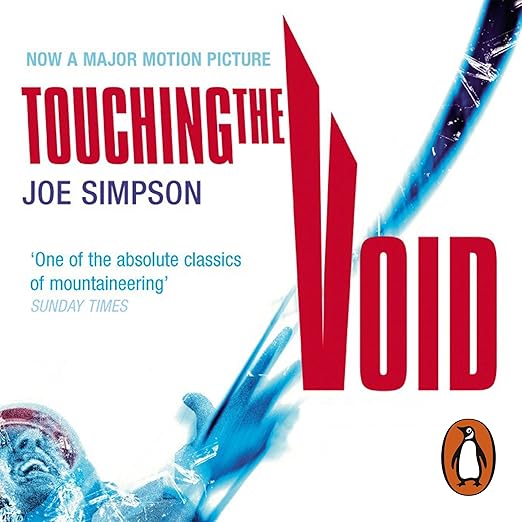
Penguin Audio released this recording in March 2012 with Andrew Wincott as the credited reader, at six hours and fifty-two minutes, a sensible length for a book that moves in one direction and never pauses. Pairing a first-person climbing memoir with a single-voice reading is the conventional decision and the right one here. A full cast would fracture a narrative whose entire power comes from one consciousness being trapped inside the situation with no way out.
Points to Consider
Sturdy, thick and chunky is how the February 2026 five-star entry describes whatever it actually bought, in the plural, alongside a remark that the things look old world. Nothing in it refers to a climb, a mountain, a book or a recording. That entry is sitting inside a pool of six ratings and dragging the average around, and a buyer looking at 4.6 has no way of knowing that a fifth of the written evidence concerns a different product altogether.
Dog-eared is how the March 2026 five-star entry describes the copy it lost, before explaining that the book got bought a second time because it was still available. The same response mentions being on the edge of a seat while reading. Three of the four usable entries use print vocabulary about this book outright and the fourth compares it against other books it has read, on a recording that has been on sale since 2012. Those grades are real. They belong to a different object.
Six ratings produce a displayed 4.6, and no combination of six whole-star votes actually reaches that figure. The nearest achievable values fall on either side of it. On a pool this small that is a rounding artifact rather than a scandal, and the practical consequence is simply that the number carries close to no information. Four usable opinions and one contaminated entry is the entire evidence base you are working from here.
The Right Listener for Touching The Void
Armchair adventurers are the natural audience, and no climbing experience whatsoever is required to follow any of it. Writing on December 31, 2025 at five stars, one buyer recommends it specifically to anyone who has been through a near-death experience or has had to focus on surviving against long odds, which widens the target well beyond people who own crampons. The mountain is the setting rather than the subject.
Avoid it if you want technical mountaineering, route description or equipment talk, because this is a book about one decision and its aftermath rather than about climbing as a craft. Avoid it too if graphic accounts of injury are a genuine problem for you: the broken leg is not a plot device, and the crawl back down is described at length and without mercy. And if you need a recording vetted by other listeners first, four usable opinions will not get you there.
Wincott reads it, Penguin Audio produced it, and six hours and fifty-two minutes is the right container for a story with no subplot and no relief anywhere in it. My advice is to ignore the numbers at the top of this page altogether, since they describe a pool of six that includes at least one person reviewing hardware, and to judge the thing on its sample instead. The book has survived a great deal worse than an untidy listing.
Questions Listeners Ask
How long is the audiobook, and does it need to be heard in one sitting?
Just under seven hours, and no, though it does resist interruption. The narrative moves in one direction with no subplots, so returning after several days costs you momentum rather than comprehension. Most listeners report it going faster than the runtime suggests, largely because the book offers nowhere obvious to stop.
Does knowing the outcome spoil the audiobook?
Not at all, and the book assumes you do know. The description gives the survival away in its own summary and the thing still works, because the tension comes from the mechanics of getting a wrecked body down a mountain rather than from any doubt about whether it happens. Suspense was never the mechanism here.