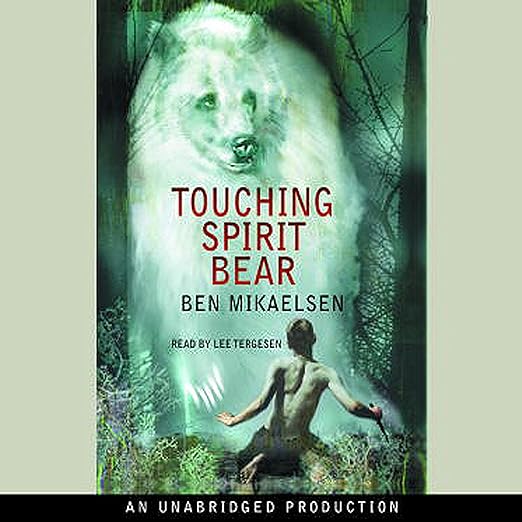
- Narration: Lee Tergesen gives Cole's rage and slow transformation genuine physicality, this is not a comfortable listen, and it is not trying to be.
- Themes: Restorative justice, anger and accountability, the natural world as mirror and teacher
- Mood: Stark and elemental, with hard-won moments of stillness
- Verdict: A book that holds up across decades and reading ages, the anger it describes is rendered honestly enough that adult listeners often find it more affecting than they did as students.
I first encountered Touching Spirit Bear as a name on a classroom reading list, the kind of book that gets assigned and then either forgotten or carried forward for life. Several reviewers who listened to this audiobook described exactly that split: some who read it in school and found it a chore, others who came back to it as adults and were struck by how much more it contained than they remembered. I listened to it on a long drive through countryside that felt appropriately remote, and the Alaskan island setting Ben Mikaelsen builds, cold, detailed, entirely indifferent to Cole's suffering, landed with real force.
Cole Matthews is one of the more unsparing portraits of adolescent violence in young adult literature. Mikaelsen does not soften him for accessibility. Cole has hurt people, seriously, and the book's first act makes clear that the restorative justice program sending him to the island is a last chance rather than a generous gift. When the Spirit Bear mauls him and he lies near death waiting for rescuers who may not come in time, the book earns its pivot toward transformation rather than asserting it.
How Touching Spirit Bear Holds Up
The novel's engagement with Circle Justice, a restorative practice drawn from Indigenous traditions, is handled with more seriousness than young adult fiction typically brings to justice-system alternatives. Garvey the parole officer and Edwin the Tlingit elder function as genuine mentors rather than adult-wisdom dispensers, and their patient willingness to give Cole another chance after he behaves monstrously is the book's moral center. Mikaelsen does not pretend rehabilitation is easy or fast.
The Spirit Bear itself is used with restraint, it is not explained, not domesticated into symbol, not given an agenda. It exists in the wild and Cole encounters it. That is all. The weight of what that encounter means is left entirely to Cole's interior reckoning, which Mikaelsen trusts his readers of any age to follow.
Why Touching Spirit Bear Works as an Audiobook
Lee Tergesen's narration is the difference between this being a book you understand and one you inhabit. He gives Cole's anger physical texture, the kind of rage that has calcified into habit and does not know how to be anything else, and then gradually, carefully, allows that texture to change. The Alaskan landscape sequences, which could easily become monotonous in the wrong hands, acquire a meditative quality under Tergesen's pacing that serves the book's core argument: that stillness, not activity, is what Cole needs to learn first.
At under six hours, this is one of the shorter listens in the catalog, which makes it ideal for a single long session. The brevity is not a weakness, Mikaelsen's prose is dense with observation, and Tergesen does not rush through it.
Weak Spots in Touching Spirit Bear
The book's pacing is deliberately slow in its middle section, when Cole is injured and alone and forced to simply survive. Some younger listeners find this section difficult. Adult readers who have returned to the book consistently describe it as the section that did not register fully the first time and hit hardest on return. Patience here is rewarded.
There is also Peter, the classmate Cole nearly killed, who exists in the first book primarily as the consequence Cole must face rather than as a fully developed character. His story continues in the sequel Ghost of Spirit Bear, and listeners who want resolution for him specifically may find this first book's handling of his perspective incomplete.
The Right Listener for Touching Spirit Bear
Appropriate for middle schoolers and up, and genuinely affecting for adults, the multiple reviewers who encountered this book decades ago and came back to it as parents, or as people still working through their own anger, suggest it operates on more levels than its classroom reputation implies. Not appropriate for listeners who need their coming-of-age narratives to be gentle or reassuring. The book earns its resolution, but the path there is deliberately uncomfortable.
Common Questions
Is Touching Spirit Bear appropriate for middle school classroom use as an audiobook?
Yes, it is consistently assigned at middle school level and the content, while confronting violence and its consequences seriously, does not include language or material inappropriate for that age group. Lee Tergesen's narration is restrained and does not amplify the violent scenes beyond what the text requires.
Does the Spirit Bear have a supernatural or spiritual significance that is explained in the story?
It is not explained. Mikaelsen treats the bear with deliberate ambiguity, it exists as a real animal that Cole encounters, but also carries weight as something beyond that encounter. The book leaves the interpretation open rather than resolving it into allegory.
Is this audiobook as effective for adult listeners as for the middle-grade audience it was written for?
Multiple adult reviewers, including some who first read it as students, report it is more affecting as an adult. The anger Cole describes, and the difficulty of genuine accountability, lands differently for people who have spent years either experiencing or managing those dynamics. Several describe it as significantly more powerful on return.
Does Lee Tergesen's narration handle the Tlingit cultural elements respectfully?
Yes, Tergesen approaches Edwin and the Circle Justice elements with the same seriousness Mikaelsen brings to the text. He does not exoticize the cultural material, letting it function as it does in the book: as practical wisdom rather than spiritual decoration.