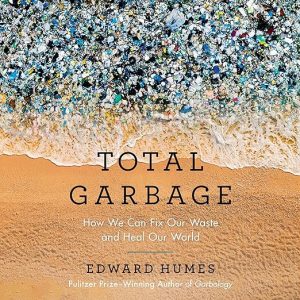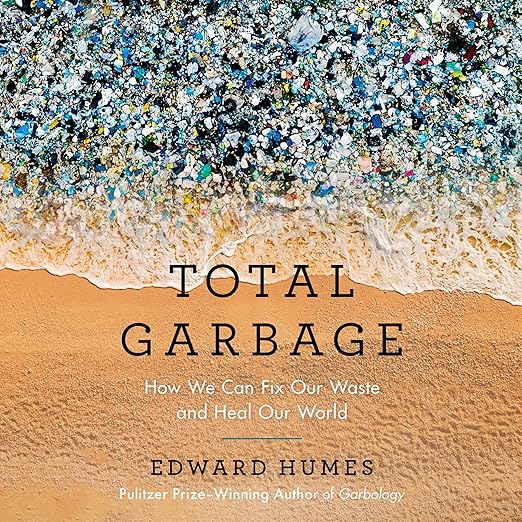
- Read by: Edward Humes narrates his own work with the quiet conviction of a journalist who has lived inside this research for years; his pacing is measured and authoritative, though the self-narrator's occasional flatness in anecdotal passages won't suit every listener.
- At its heart: Systemic wastefulness, consumer culture illusion, grassroots environmental action
- Vibe: Alarming but ultimately galvanizing
- Short version: A Pulitzer Prize-winning journalist dismantles the myth that individual waste doesn't matter, then hands you a roadmap for what to do about it.
Edward Humes opens this audiobook with a statistic that is hard to shake: Americans consume the equivalent of a credit card in microplastics every single week through the food we eat, the water we drink, and the air we breathe. That detail, delivered in Humes's own measured journalistic voice, sets the tone for everything that follows in Total Garbage, a book that does not let you look away, but also refuses to leave you paralyzed.
Humes is the author of several previous environmental investigations, and his prose has the distinctive shape of a writer who has spent decades interviewing scientists, activists, and ordinary people caught inside systems that were never designed with their well-being in mind. At just under ten hours, the audiobook gives him room to build his argument properly rather than rushing to the moral.
Waste as the Master Variable Behind Everything
What distinguishes Total Garbage from the familiar genre of environmental alarm books is its structural choice to treat waste not as one problem among many but as the master variable behind virtually all of them. Climate change, plastic pollution, deforestation, toxic emissions, Humes argues these are symptoms of a single upstream cause: the epic, normalized levels of trash and waste that industrial society generates daily and that most of us have been conditioned to accept as inevitable. That reframing is genuinely useful. It converts an abstract portfolio of existential threats into something a person can actually grip and work on.
The book is story-driven in the best sense. Humes does not lecture; he follows people. A community redesigning its entire waste infrastructure. Entrepreneurs turning food waste into productive raw material. Municipalities that discovered their recycling programs were shipping material to overseas markets with no intention of processing it. Each case study arrives with enough detail to feel real rather than illustrative. The cumulative effect is something that reviewers have called life-changing, and in this context that description is earned rather than reflexive. Reviewer Jo describes being struck by the opening microplastics figure alone as a credit card consumed weekly through food, water, and air, a visceral entry point that the rest of the book sustains rather than retreats from.
The structural argument extends to what Humes calls the pervasive yet hard-to-see wastefulness embedded in daily life, not just landfill content but the 40 percent of food and 65 percent of energy that the synopsis identifies as wasted through systems most of us participate in without recognizing. The book is meticulous about distinguishing personal behavior from institutional design, which matters for a subject where the standard response is either paralysis or individual guilt, both of which serve the status quo better than action.
Humes Narrates Himself, for Better and Worse
Humes narrating his own work is both an asset and a mild liability. The asset is obvious: no interpreter stands between the research and the listener. When Humes describes the food waste figures, the outrage in his voice is not performed. It is the outrage of someone who spent years accumulating evidence of institutional absurdity. That authenticity anchors the more alarming passages and prevents them from tipping into catastrophism.
The liability is that self-narrators trained in print sometimes produce a delivery that feels like a careful read rather than a performance. Humes has a good radio-journalist voice and handles the material's tonal shifts competently, moving from contempt for corporate waste theater to genuine admiration for the communities who have found their way back from excess. But listeners accustomed to professional narrators may notice a slightly constrained energy in some of the more personal anecdotal sections. It does not undermine the content; it just means the format rewards attentive listening rather than passive background play.
The audiobook also includes a downloadable PDF containing tables, charts, and what the book calls the What You Can Do Right Now About Waste Master List, a practical document that extends the listening experience into something tangible. That resource is worth downloading before you finish, because Humes earns his prescriptive final chapters honestly, and the master list gives those chapters a concrete form to work with after the audio ends.
How China's National Sword Policy Broke Recycling
The book's most effective rhetorical move is the repeated demonstration of the gap between what waste-management systems claim to do and what they actually accomplish. Humes is methodical about sourcing this. He does not simply assert that recycling is largely theater in its current form; he traces the supply chains, identifies the moment when China's 2018 National Sword policy collapsed the American recycling market, and shows what municipal governments chose to hide from the public in the aftermath. That investigative discipline makes the argument durable in a way that more impressionistic environmental writing often is not.
Watch also for the sequence on food waste. The 40 percent figure is not a rounding error but a structural feature of how food moves through distribution chains, how retailers manage spoilage risk, and how household behavior has been shaped by marketing into a particular relationship with freshness. Humes threads the personal and the systemic in these passages better than anywhere else in the book. The emotional register shifts from outrage to something closer to grief, and then, carefully, to practical possibility. Reviewer Gytis summarizes it well: frightening how wasteful we are as a society, but ultimately there is hope if we act. That dual register, honest about the scale, serious about the solutions, is the book's lasting contribution.
For Listeners Ready to Stress-Test Their Assumptions
This audiobook will work best for listeners who already sense that the scale of the problem exceeds what individual recycling bins can fix, but who want that intuition confirmed with evidence and then pointed toward something actionable. It is not a comfort listen, Humes is too rigorous for that, but it is not a catastrophe narrative either. The final third is explicitly about what works, delivered with the credibility that only follows from having spent the first two-thirds documenting what does not.
Listeners looking for purely technical environmental policy analysis will find Humes too narrative. Listeners who want emotional sustainability content without uncomfortable data will find him too relentless. The sweet spot is the engaged general reader who wants their assumptions about waste, recycling, and personal responsibility genuinely stress-tested over the course of a long walk or a cross-country drive.
Frequently Asked Questions
Is the Total Garbage audiobook suitable for someone with no prior background in environmental science?
Yes. Humes writes as an investigative journalist, not an academic, so the book is deliberately accessible. Technical concepts are introduced through concrete stories rather than terminology, and the cumulative argument builds in a way that rewards listeners arriving with nothing more than general awareness.
Does the audiobook version of Total Garbage include the PDF resources mentioned in the synopsis?
Yes. The accompanying PDF containing charts, tables, and the Waste Master List is available for download from your Audible library after purchase. Humes references it explicitly, and it is most useful to have on hand toward the end of the audiobook when the prescriptive recommendations begin.
How does Edward Humes's self-narration compare to his previous audiobooks?
Humes has narrated his own work before, and his delivery here is consistent with his earlier titles, offering calm factual authority with occasional warmth when describing individuals making meaningful changes. Listeners familiar with him will recognize the style; newcomers should know it is measured journalism-voice rather than dramatic performance.