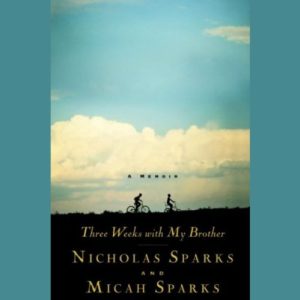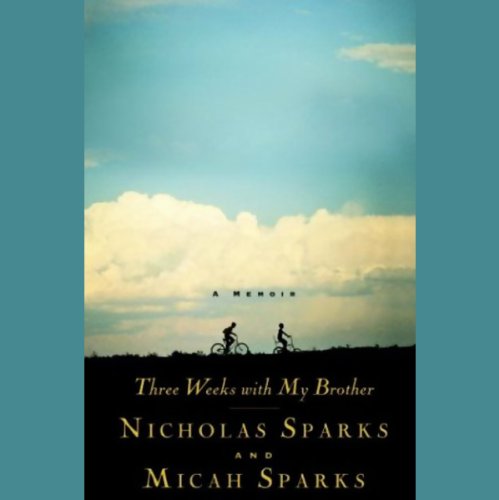
Three Weeks with My Brother is the audiobook Nicholas Sparks fans do not always know to reach for, and the one I find myself recommending when people ask me which of his books shows the man behind the novels. Co-written with his brother Micah, this memoir unfolds around a three-week round-the-world trip the two brothers took in January 2003, shortly after the deaths of their parents and their sister left them the only surviving members of their immediate family. It is the backstory to every Nicholas Sparks novel written in his adult career, and listening to it with Henry Leyva narrating, I kept thinking how strange and clarifying it is to hear the source of all that romantic grief finally laid plain.
What makes this audiobook particularly valuable as a listening experience is the double structure of the narrative itself. The globe-spanning travel, Machu Picchu, Petra, the Taj Mahal, Easter Island, unfolds alongside a parallel story of the Sparks family history told in flashback. The physical journey and the emotional excavation run concurrently, which is a structure that works especially well in audio form, where a narrator can signal tonal shifts through voice alone rather than chapter breaks and white space.
Our Take on Three Weeks with My Brother
Nicholas Sparks is famous enough that his name carries baggage, and I want to set it aside here for a moment. This memoir does not read like his novels. The sentimentality is present, but it is earned rather than designed. The humor, particularly in passages involving young Micah's various catastrophic adventures, is genuinely funny in the way that family mythology becomes funny when enough time and enough loss has passed. And the grief, when it arrives, arrives without orchestration.
Leyva's narration supports this tonal balance better than I initially expected. He does not reach for emotional effects or signal to the listener how to feel. His reading of the passages describing the death of Sparks's sister Dana, who died following a car accident, and the earlier death of their mother from a riding accident, is measured to the point of being almost clinical. That restraint is exactly correct. The facts are sufficiently devastating without performance layered on top of them.
The co-authorship with Micah also contributes something specific. This is not a solo memoir where one person has organized their memories into meaning. It is two brothers comparing notes in public, which produces a texture that is messier and more honest than the polished Sparks narrative voice in his fiction. Moments where they disagree about events, or where their interpretations of the same childhood memory diverge, are some of the most affecting passages in the book.
Why Listen to Three Weeks with My Brother
The audiobook format suits this memoir particularly well for a few reasons. First, the travel sections, which move through more than a dozen countries across three weeks of narrative time, benefit from a narrator who can pace the geography without letting it become a catalog. Leyva threads through the international stops briskly enough that momentum never flags, but lingers at the moments where Sparks and Micah are clearly processing something larger than the monument in front of them.
Second, the memoir's structure as a conversation between two brothers is one that audio captures better than the page. Reading the book, you are always aware that this is a printed artifact. Listening to it, you feel closer to the experience of being a third person in the room while two people work through something real together. The candor Sparks and Micah bring to their family history, including an honest reckoning with their father's particular brand of intellectual severity, benefits from that intimacy.
A reviewer who lost both parents suddenly and then lost a husband to cancer describes reading this book as a way of learning to live again with what remains. That response reflects what the memoir does at its best: it does not offer comfort in the abstract, but rather the specific evidence of two people who lost nearly everyone and found, between them, a reason to keep going. The world tour becomes a container for that evidence, and the audio format lets it land without the reader having to manage the delivery.
What to Watch For in Three Weeks with My Brother
The nine-hour and twenty-four-minute runtime is well paced across the travel narrative, but listeners should know that the memoir does not shy away from accumulative grief. By the time the reader has been introduced to all the losses, including both parents and a sister, all in a compressed period of years, the emotional load is considerable. This is not a light travel memoir or a pleasant companion for an easy commute. It asks something of you.
The travel backdrop also functions somewhat differently than a standard travel memoir. If you are coming to this audiobook looking for rich destination reporting or cultural immersion, you will find it in fragments rather than as a sustained focus. The wonders of the world, as the synopsis notes, are backdrops against which the brothers' inner lives play out. Listeners who want the travel to be the point rather than the frame should adjust expectations accordingly.
The personal photos referenced in the print edition are naturally absent in audio, which is a real loss for a book where family images carry specific emotional weight. The audiobook stands complete on its own, but this is a case where pairing the audio with access to the print or e-book version would add meaningful texture.
Who Should Listen to Three Weeks with My Brother
Readers who know Sparks only through his novels will find this audiobook genuinely surprising. It is less controlled, more personal, and far more willing to sit with uncertainty than his fiction typically is. If that sounds like a more interesting version of the author, this memoir is exactly where to start.
Listeners navigating their own loss, particularly the loss of siblings or parents, will find specific resonance here. The reviews bear this out, with multiple listeners describing the book in terms of their own family grief rather than in terms of Sparks's celebrity. That is a meaningful signal about what the book actually accomplishes. Henry Leyva's narration makes the nine-hour listen feel intimate rather than long, and the memoir's humor prevents the emotional weight from becoming relentless. For listeners prepared to feel something real, this audiobook rewards the time.
- Read by: Henry Leyva handles the dual emotional registers of this memoir, its comedy and its grief, with restraint and genuine feeling, never pushing the audience toward a reaction.
- At its heart: Sibling bonds, grief and survival, faith tested by loss
- Vibe: Tender and reflective, with genuine bursts of levity
- Short version: A memoir that earns its emotional weight honestly, and one of Nicholas Sparks's most candid and affecting works across any format.