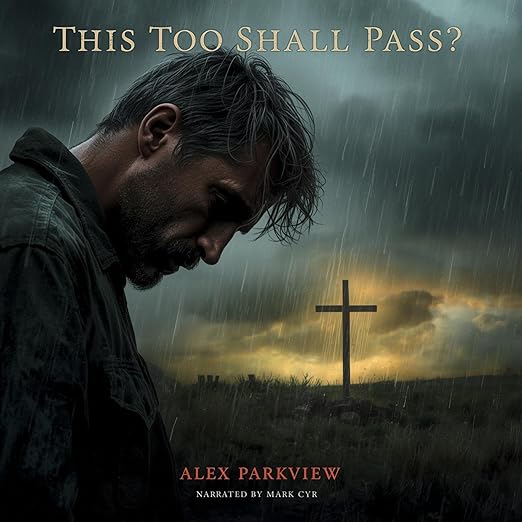
Quick Take
- Narration: Mark Cyr reads with the tone of someone who has sat with the material and means it; quiet and direct, which is exactly right for content addressed to people carrying invisible wounds.
- Themes: Moral injury, faith under duress, conscience and survival
- Mood: Honest, unflinching, and unexpectedly gentle
- Verdict: A short but serious resource for veterans, first responders, and those who companion them, one of the more honest treatments of moral injury available in audio form.
I almost passed over this one because of its length, one hour and forty-two minutes is barely a long-form essay in audiobook terms, but the subject pulled me in. Moral injury is a term that has moved from military psychology into broader usage over the past decade, and it remains poorly understood outside clinical contexts. Alex Parkview’s opening move is to define it precisely, and that act of naming, performed clearly in the first few minutes of the listen, is itself a kind of relief for the audience this book is designed to reach.
The distinction Parkview draws between PTSD and moral injury is the conceptual foundation of everything that follows. PTSD, as he explains it, is the trauma of what happened to you. Moral injury is the wound of what you did, what you failed to prevent, or what you were complicit in, the rupture between your actions and your core values, a rupture that the paperwork can clear but the conscience cannot. For veterans, first responders, medics, and survivors who have lived in that gap, the naming of it is not academic. It is a form of recognition that the clinical system frequently fails to offer.
Our Take on This Too Shall Pass
Parkview refuses the easy resolution. The title is a question, not a consolation, this too shall pass?, and the book honors that ambiguity at every turn. He does not promise that moral injury heals or that faith will return unchanged or that there is a practice that will quiet the mirror. What he offers instead is a map of the wound: its specific texture, the ways it differs from grief or PTSD, the reason it attacks faith at its roots rather than merely shaking it. One reviewer quoted a phrase that captures Parkview’s method exactly: the tone feels like a conversation with someone who has walked the same dark road. That quality of hard-earned authority is present throughout, and it is what makes this a resource rather than a lecture.
Why Listen to This Too Shall Pass
Mark Cyr narrates the book in a register that matches its content: quiet, direct, not performatively solemn. He reads the practical sections, structured lament, trigger grounding, journaling with mercy, as tools rather than prescriptions, which is the right emphasis. Parkview’s material on scripture is handled with a similar ground-level honesty: no cheap answers, as one reviewer noted, just lament, presence, and grace that does not demand forgetting. Cyr’s reading sustains that register across the full ninety-two minutes without pushing into either clinical distance or pastoral warmth. The chapter on Tools for the Long Haul, which reviewers single out as particularly actionable, benefits from Cyr’s unhurried pace, these are things to sit with, not to get through.
What to Watch For in This Too Shall Pass
The book is explicitly rooted in Christian faith, drawing on scripture and the language of grace throughout. Secular listeners or those from non-Christian traditions will find some of the framework harder to inhabit directly, though Parkview’s practical tools, structured lament, grounding techniques, boundary-setting, are not exclusively religious in their application. The book is also notably short: ninety-two minutes covers the subject with care but without the depth that a longer work might provide. Parkview acknowledges the limitation implicitly, this is a companion for a long road, not a resolution of it, and he includes a dedicated section for spouses, pastors, and friends who want to support without rushing or fixing. That section is worth the listen for companions as much as for those carrying the injury directly.
Who Should Listen to This Too Shall Pass
Veterans and first responders who have felt that the clinical system saw their wounds but not their conscience, and who have not found adequate language for what they are carrying, will find Parkview’s framework useful in ways that more general trauma resources often are not. Chaplains, therapists, and pastoral counselors working with this population will find the diagnostic clarity of the moral injury framework clearly articulated in accessible language. The companion section makes this a genuinely useful listen for spouses and close friends as well. At ninety-two minutes, the time commitment is minimal relative to what it offers the right listener.
Frequently Asked Questions
How does Parkview define moral injury differently from PTSD, and is the distinction clearly explained for lay listeners?
Yes. The distinction is one of the first things Parkview addresses, and he explains it in plain language: PTSD concerns what was done to you, while moral injury concerns the breach between your actions and your core values. He draws on real stories and research to ground the distinction concretely rather than relying purely on clinical definition.
Is this book useful for someone who is not religious, given its Christian framing?
The practical tools Parkview offers, structured lament, trigger grounding, journaling with mercy, are not exclusively religious in their application. The scriptural content is present throughout and is central to Parkview’s approach, however, so secular listeners should expect to translate some of the language rather than finding a purely secular resource.
At only 102 minutes, does the book cover its subject in sufficient depth?
Reviewers consistently praise the depth of engagement within the short runtime, particularly the precision of the moral injury framework and the practical Tools for the Long Haul chapter. Parkview is explicit that this is a companion for a long journey rather than a resolution, and the length reflects that modesty of intention rather than insufficient treatment.
Is there guidance in the book for family members or others close to someone carrying moral injury?
Yes. Parkview includes a dedicated section for companions, spouses, pastors, friends, on how to stay present without rushing or fixing. Multiple reviewers identify this section as valuable, and it makes the book worth considering for support networks as well as those carrying the injury directly.