Quick Take
- Narration: Lorraine Velez brings a quiet gravity to Sogyal Rinpoche’s text that serves the material beautifully across twenty hours.
- Themes: Death and dying, impermanence, Tibetan Buddhist teachings on the bardo
- Mood: Contemplative and transformative, best listened to slowly and in quiet
- Verdict: One of the most important spiritual audiobooks available, deserving of unhurried, repeated listening.
I came to The Tibetan Book of Living and Dying during a difficult autumn when a family member was seriously ill. I was not looking for comfort exactly, and I was not looking for doctrine. I was looking for a framework that could hold what was happening without shrinking it. What I found was exactly that. Sogyal Rinpoche’s book is not a consolation prize. It is a genuine instruction manual for one of the only experiences every human being will face, and it approaches that subject with a seriousness that most of us have been trained to avoid.
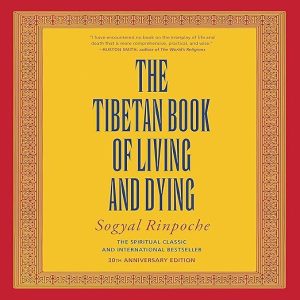
This 30th Anniversary edition, narrated by Lorraine Velez and published by Echo Point Books and Media, includes a foreword by the Dalai Lama. It represents one of the most significant texts in Tibetan Buddhist literature made available in audio form, and the production is thoughtful throughout. At twenty hours and forty-three minutes, this is not a casual listen. It is the kind of audiobook you return to in sections, sit with, and revisit as your life changes around it.
Our Take on The Tibetan Book of Living and Dying
Sogyal Rinpoche’s achievement here is making the complex bardic teachings of Tibetan Buddhism accessible to a Western reader without stripping them of their depth or their strangeness. He writes, as one reviewer put it, like a wise grandfather sitting down to tell you stories about life, bringing the soulful essence of the original teachings to the surface rather than burying them under technical apparatus. Another edition was described as laden with prayers in both the native language and English. Rinpoche’s version takes a different path entirely, prioritizing understanding over ritual completeness.
What the New York Times called the Tibetan equivalent of Dante’s Divine Comedy is not an overstatement, though it requires unpacking. Like Dante, this book is structured as a journey through states of being that the living cannot fully witness but can prepare for. Unlike Dante, it is not a poem but a guide, and its authority comes not from literary imagination but from a living tradition of practice and teaching transmitted across centuries.
Why Listen to The Tibetan Book of Living and Dying
One of the most striking testimonials for this book comes from a reader who listened while a close friend was dying of cancer. She had a year to read and prepare, she writes, and by the time his passing came, she was ready. She could celebrate his life instead of being grief-stricken. Whether or not you find that specific framing resonant, the underlying claim is significant: that engaging seriously with teachings on death before death arrives changes how you show up for it. That is the book’s core promise, and the reviews suggest it delivers.
Lorraine Velez’s narration is one of the recording’s genuine strengths. She reads with a steadiness and warmth that matches the text’s register, never rushing through the longer philosophical passages or flattening the emotional ones. Twenty hours in her voice does not feel like an endurance test. It feels appropriate for material that rewards slow absorption.
What to Watch For in The Tibetan Book of Living and Dying
This book asks something of the listener that most audiobooks do not: sustained attention to ideas that are genuinely foreign to Western frameworks of death and consciousness. The bardic teachings on what happens after death, the instructions for supporting a dying person, the meditative practices described throughout, these are not concepts that yield easily to a single listen at double speed while commuting. Readers who approach this as ambient content will get little from it.
It is also worth noting that Sogyal Rinpoche’s legacy is complicated. Following the original publication of this book, serious allegations of abuse were made against him by students. That context does not make the teachings less ancient or less valid, but listeners should be aware of it and make their own judgments about how to engage with the author’s work.
Who Should Listen to The Tibetan Book of Living and Dying
Anyone facing a serious illness, their own or someone close to them, will find this audiobook offers a framework that most Western culture does not provide. Practitioners of Buddhism at any level will find it an essential companion text. Academics teaching death and dying, as at least one reviewer does, will find Rinpoche’s version the most accessible and teaching-friendly of the available options. Casual spiritual seekers who want something gentle and unchallenging should look elsewhere. This book demands engagement.
Frequently Asked Questions
Do you need to be Buddhist to benefit from The Tibetan Book of Living and Dying?
No. Multiple reviewers note explicitly that the book offers value regardless of religious background. One reviewer describes being raised in a mainstream religion and finding the book deeply useful as supplementary study. Rinpoche explicitly addresses Western readers and does not assume prior Buddhist practice.
How does this 30th Anniversary edition differ from earlier versions of the book?
This edition includes a foreword by the Dalai Lama and represents an updated revision of the original text. The core teachings remain the same, but the additions and revisions reflect decades of feedback from readers and practitioners. The audio format is also new, narrated by Lorraine Velez.
Is Lorraine Velez a good narrator for this type of spiritual material?
The publisher describes her as masterfully narrating the text, and the Echo Point production has a reputation for quality. The overall rating for the book is 4.7, suggesting the audio experience satisfies. Her steady, unhurried reading style suits material that rewards patience.
Can The Tibetan Book of Living and Dying be listened to out of order, or does it need to be taken from beginning to end?
The book has an organized structure that moves from teachings on life, through the process of dying, to what Tibetan Buddhism describes as the bardos or transitional states after death. It benefits from sequential reading, but individual chapters can be revisited or consulted independently. Many readers return to specific sections during particular life circumstances.