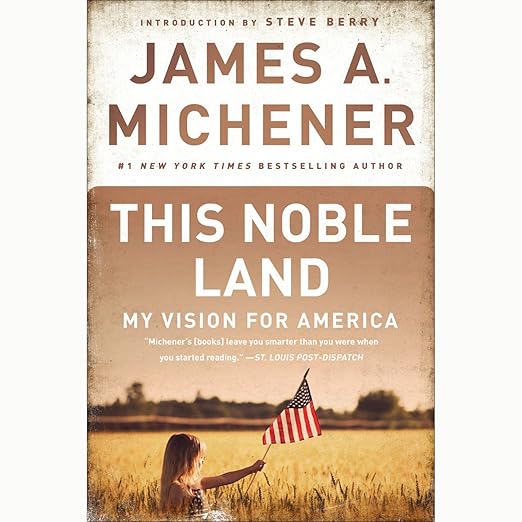
At a Glance
- Read by: Arthur Addison reads Michener's discursive, essayistic prose with measured authority, matching the tone of a wise elder who has earned the right to diagnose what ails his country.
- At its heart: American civic decline, racial and economic inequality, the obligations of democratic citizenship
- Vibe: Sober and purposeful, with the warmth of someone who loves the thing he is criticizing
- Short version: Michener's final major statement on American society arrives in audio as exactly what it was in print: a bracing, passionate argument from a writer who had earned the authority to make it.
James Michener finished This Noble Land in his late eighties, having spent decades writing the kind of massive, research-saturated novels that reshaped how popular fiction engaged with history and geography. He had covered Chesapeake Bay, the American West, Hawaii, Alaska, Texas. He had written about the Korean War from inside it. By the time he turned to a direct essay about the state of America, he was not theorizing from outside. Arthur Addison's narration of this audiobook carries that accumulated authority in every sentence, reading Michener's diagnostic prose as a man who has watched his country for nine decades and has specific, non-negotiable things to say about what he sees.
The audiobook covers seven and a half hours of Michener moving through what he identifies as the threats to American cohesion: racial conflict and its persistence, the widening gap between wealthy and poor, the decline of public education, inadequate healthcare access. These are familiar concerns, but Michener writes about them with a specificity born of attention rather than ideology. The Washington Post review quoted in the book's material describes it accurately as a book-length essay on the often worrying, often inspiring course of America across nine decades of Michener's life. That framing matters: this is not a think-tank white paper. It is a personal reckoning from a writer who considered his country a subject as worthy of sustained literary attention as any landscape he had documented in fiction.
Our Take on This Noble Land
Addison's narration is appropriate for Michener in a way that not all readers of essayistic nonfiction manage. The prose is discursive rather than propulsive; Michener builds his arguments through accumulation rather than through the kind of sharp-turn rhetoric that demands a faster pace. Addison does not rush, does not inflate dramatic moments that the text does not itself heighten, and keeps a consistent dignity that matches Michener's own register. One reviewer from the book's original publication noted that Michener is more interested in fixing the problems than in fixing the blame, which is an accurate description of the essay's temperament, and Addison's reading reflects that temperament with quiet precision.
The courage of the audiobook lies in what Michener does not soften. His criticism of what he calls petty, mean and vengeful people in American political culture arrives without euphemism. His prescriptions for education, for healthcare, for race relations, are presented as the considered views of a man who has spent a lifetime paying close attention, not as policy proposals hedged against political blowback. Whether you agree with his diagnoses or his remedies, the audiobook gives you nine decades of observation behind the argument rather than simple advocacy. Addison understands this distinction and reads accordingly, never allowing the narration to amplify the polemic beyond what Michener's measured prose actually contains.
Why Listen to This Noble Land
The audiobook format suits Michener's essay specifically because his prose benefits from being heard in sequence, without the temptation to flip ahead or skim sections that feel familiar. In seven and a half hours, Addison guides you through a sustained argument whose individual components depend on each other for their full effect. Michener does not write in disconnected chapters that can be consumed in any order; he writes in accumulating movements, and the audio experience respects that structure in a way that casual reading often cannot.
One reviewer who came to the audiobook as a re-reader of Michener's fiction found this nonfiction work rekindled interest in returning to his novels, describing it as a real treasure. That trajectory makes sense: hearing Michener's direct voice, unmediated by historical characters or novelistic form, gives you the intelligence that organized all of his fiction. Listening to This Noble Land is an experience of hearing that intelligence applied to the subject that always mattered most to him: his own country and its obligations to itself and to the generations who will inherit it.
What to Watch For in This Noble Land
This audiobook was written in the mid-1990s, and while the structural concerns Michener raises about American society have not faded, some of the specific figures and events he references require context that listeners unfamiliar with that era may want to supply separately. The racial and economic analyses remain largely current in their concerns even where specific references have dated. One reviewer who noted, with some amusement, that much of what Michener says sounds like more recent political discourse was observing something genuine and uncomfortable: the persistence of these particular American fault lines across decades of political change.
Michener's prescriptions for improving American life are specific enough that they will provoke disagreement from listeners across the political spectrum. He is a patriot in the old-fashioned sense of the word, someone who believes fiercely in his country's best aspirations and is willing to hold it accountable to them. That position generates as much criticism from ideological purists on both sides as it does admiration, and listeners should approach the audiobook knowing they will be challenged rather than merely validated regardless of where they sit politically.
Who Should Listen to This Noble Land
Listeners who have read Michener's fiction and want to hear his direct voice on the American experiment will find this audiobook the most personal and unmediated access to his thinking available in audio format. Those interested in mid-1990s assessments of American civic life that have aged with unusual relevance will find this a rewarding seven and a half hours with a writer who took his responsibilities seriously.
Listeners looking for a comprehensive, data-driven analysis of American social policy will want supplementary reading alongside this essay: Michener is essayistic rather than empirical, and his authority is earned through witness and reflection rather than through statistical rigor. As an audiobook, This Noble Land is best understood as the testimony of an exceptionally attentive witness, delivered with the calm of someone who waited until he had something worth saying, and then said it without flinching.
Does Arthur Addison's narration suit Michener's essayistic prose style in this audiobook?
Yes. Addison reads with measured authority that matches Michener's own deliberate, accumulating argument style. He does not impose pace or drama onto prose that works through patient observation rather than rhetorical flourish, which is precisely what the material requires.
Is the This Noble Land audiobook appropriate for listeners unfamiliar with Michener's other work?
Yes, it stands entirely on its own. The audiobook is Michener's most direct statement about America, requiring no prior knowledge of his fiction. Familiarity with his novels adds resonance but is not necessary to follow or appreciate the argument.