David's Own Arm Turns Up in the Pile
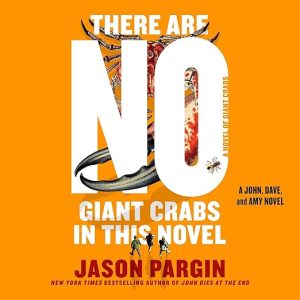
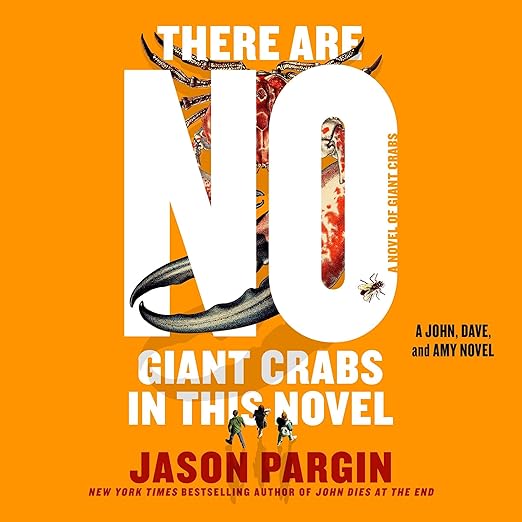
Book five of Jason Pargin's John Dies at the End series begins with a promise that is technically accurate and functionally a lie, and it proceeds from that premise with the confidence of a writer who has spent four previous volumes earning the right to do exactly this. There Are No Giant Crabs in This Novel, a twelve-hour audiobook in the nightmarishly funny tradition Pargin established with the original entry, opens with a massive sticky pile of severed human limbs appearing in the parking lot of a vacant department store in a depressed small town. One pair of footprints leads away through the snow. The fingerprints on the severed arms belong to living people who still possess all their appendages. And David's own arm is in the pile, which presents a philosophical difficulty, given that both of David's arms are still attached to his body. This is the kind of opening sentence that immediately classifies a reader: either this is your kind of thing, or it is very much not.
Pargin, originally writing as David Wong for a generation of internet humor culture, has built the John Dies at the End series on a specific synthesis that is rarer than it appears: genuine cosmic horror rendered through comedy that never defuses the horror. The series does not treat its supernatural elements as jokes. The entities Pargin creates operate with the actual logic of nightmare, which is to say without comprehensible motivation and with a quality of wrongness that accumulates rather than resolving. The comedy comes from the characters' response to this environment, from David's exhausted sardonic narration, from John's approach to existential threats that suggests he has simply made a different accommodation with dread than the rest of us, and from Amy's particular quality of competence under pressure.
Pargin's Pace Only Works as an Audiobook
Pargin's first-person narration through David makes this series specifically well-suited to audio. The voice is the book's primary instrument, the weary, sardonic tone of a man who has seen too much to be fully surprised by a parking lot full of extra limbs but still has the ordinary human response to finding his own arm among them. That tonal precision is considerably easier to maintain in an audio listen than in a reading experience where the pace is self-determined, and a reader who moves through the text quickly may slide past the specific quality of each observation. The audiobook format enforces the pace Pargin intended, which means the accumulation of dread underneath the comedy registers more fully.
The series mythology deepens with each installment, and this entry adds a doppelganger element that connects to the larger questions about identity, reality, and the stability of selfhood that the series has been building across five books. The title's meta-joke structure, the opening of the synopsis explicitly promising no giant crabs while maintaining ambiguity about everything else, is a fourth-wall maneuver that only a writer deeply aware of his genre and his audience's awareness of it could execute effectively. Pargin knows exactly what kind of book he is writing, and this entry demonstrates that knowledge with particular confidence. The mysterious man who arrives at David's door claiming to be in pursuit of something he calls the Penetrator follows the series' established pattern of apparent allies who are more ambiguous than they initially appear, and the specific quality of the threat he describes, clear enough to follow and vague enough to be genuinely unsettling, is one of the book's better atmospheric constructions.
One Word, 'Again,' Assumes a Shared History
Pay close attention to the parenthetical word "again" in the threat of federal agents wiping the town off the map. That single word assumes a shared history between the series and its reader, implying the town has already survived one near-erasure, and Pargin trusts the reader to carry that weight without explanation. It is the kind of shorthand a series writer earns across multiple installments, and it positions the stakes efficiently while also being darkly funny to anyone who has spent enough time in this fictional geography to understand what it has already survived. The accumulating mythology of the town itself is one of the series' underappreciated pleasures, and this entry continues to develop it.
The structural ingenuity of the no-giant-crabs framing is worth examining beyond its joke function. Pargin is making a genuine argument about reader expectation management: by explicitly stating what the novel does not contain, he is drawing attention to everything else it might contain, which is a form of misdirection that works at a meta level. The limbs-without-owners opening, the doppelganger arm, the Penetrator's pursuer, and the accumulated threat of federal intervention all exist in the space the title has prepared by denial. If there are no giant crabs, there may be things considerably stranger, and the book delivers on that implicit promise.
Darkly Amused Rather Than Disturbed Is the Test
Readers already invested in John, David, and Amy's ongoing nightmare will find this entry delivers everything the series has established as its core pleasure: the compressed timeline, the external threat triggering civic intervention, the specific flavor of absurdist dread that distinguishes Pargin's work from both straight horror and standard comedy. The accumulated mythology and the character dynamics carry weight that assumes four books of prior investment, and new listeners who start here will follow the immediate plot while missing the deeper resonance.
New listeners who are curious about the series should begin with the first book. The opening chapter of any Pargin novel will tell a reader within a few pages whether his sensibility matches theirs. If you find a parking lot full of extra limbs darkly amusing rather than simply disturbing, you are the intended audience. If you require horror to be solemn and comedy to be separate from it, Pargin's particular combination will not satisfy. But for readers who have spent four books in this world and find themselves relieved that there are no giant crabs, the fifth installment rewards the investment with the confidence of a writer at home in his own mythology.
- Subjects: cosmic horror comedy, doppelgangers and identity, small-town weird mythology
- Tone: Chaotic, absurdist, unexpectedly dark underneath
- Bottom line: Pargin's fifth John Dies at the End audiobook proves the formula still generates genuine invention and is best enjoyed by readers who have put in the series time.
Frequently Asked Questions
The title promises no giant crabs. Is this audiobook actually funny, or is it primarily horror?
It is genuinely both simultaneously, which is Pargin's specific achievement across the series. The limb-pile opening is played for both genuine unease and absurdist comedy, and neither register defuses the other. The tone is not parody.
At over 12 hours, does this audiobook sustain its energy across the full runtime?
The series maintains narrative momentum through multiple threat vectors, accumulating mythology, and Pargin's first-person narration voice. The runtime rarely drags because the cosmic-horror and comedy elements each provide a different kind of momentum.
Does this audiobook resolve the central mystery of the limb pile and the Penetrator, or does it leave the series arc open?
Individual installments provide satisfying local resolutions to the immediate crisis while the larger series mythology continues to develop. Book five follows this pattern: the parking lot situation reaches a conclusion, but the world Pargin has built continues to be its reliably wrong self.