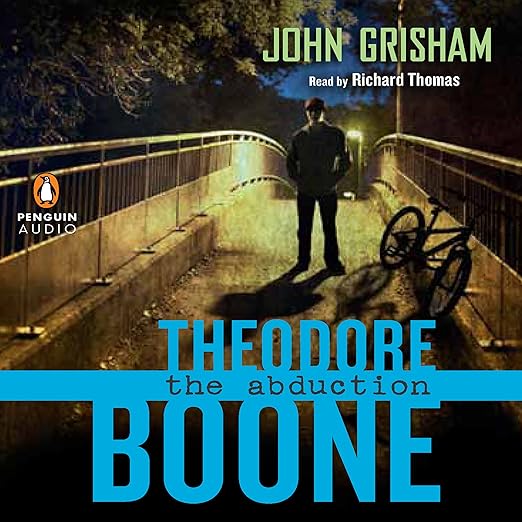
I listened to Theodore Boone: The Abduction on a long drive, which turned out to be exactly the right context. Four hours of plot-driven, cleanly written storytelling that kept me engaged without demanding the kind of close attention that makes audiobooks while driving a questionable idea. John Grisham has spent decades mastering narrative momentum in legal thrillers written for adults, and it shows in how he constructs even this much shorter work for younger readers. The machine runs efficiently.
The setup is immediate: April, Theo's best friend, vanishes from her bedroom overnight. The police hit dead ends. Theo, a thirteen-year-old with an unusual depth of legal knowledge and an earnest belief in the system, decides to use what he knows to help find her. This is the second Theodore Boone novel, following on from the original Kid Lawyer, and the stakes here are meaningfully higher than in book one.
First, the Big Picture
Grisham is doing something specific with this series: he is writing legal procedure for an audience that has not yet developed the cynicism about institutions that most adult crime fiction assumes. Theo trusts the law, trusts that investigative skill and proper process lead to justice, and the books validate that trust. That is a deliberate editorial choice, and it gives the series a distinctive warmth. One reviewer who is a retired English teacher noted Grisham's evident respect for young readers and his understanding of their age group. That reads accurately. Theo is treated as a capable protagonist, not a cute stand-in for adult competence.
The moral dilemma at the center of the second act, whether Theo should contact his parents when he decides to leave town in pursuit of a lead, is the kind of genuinely interesting ethical question that respects its audience. A reviewer called it a major dilemma for a thirteen-year-old, which is exactly right. Grisham does not resolve it cheaply.
The Best Parts of Theodore Boone: the Abduction
Richard Thomas narrates with the kind of steady, engaged delivery that middle-grade fiction benefits from. He does not inflate the drama unnecessarily or pitch his voice at the condescending register that plagues some children's audiobooks. Theo's world feels grounded in Thomas's reading, which helps listeners accept the somewhat idealized version of small-town America and a legal system that consistently does the right thing. At four hours, the pacing is brisk without feeling rushed.
What Might Not Land
Adult listeners should calibrate expectations around the target audience. Multiple reviewers noted the book's simplicity, and one described it as not overly challenging while acknowledging that this was partly the point. The plotting is clean and the mystery resolves satisfyingly, but it does not attempt the misdirection or moral complexity that adult crime fiction depends on. For the intended readership, this is a feature rather than a flaw.
The legal elements are accurate in broad strokes without becoming technical. Grisham uses Theo's knowledge to let young readers understand how investigations and legal procedures actually function, which gives the series an educational dimension that never feels like homework.
The Right Listener for Theodore Boone: the Abduction
Middle-grade listeners aged nine to thirteen are the natural audience, particularly those who enjoy mysteries with capable protagonists who solve problems through intelligence rather than physical confrontation. Adults who want an easy, genuinely pleasant listen during commutes or light household tasks will find it holds up. One reviewer described reading both the first and second books as a grown adult and finding them thrilling and plain nice. That seems like an honest accounting. Start with the first book, Kid Lawyer, though The Abduction can be followed without it.
Parents listening alongside children will find the ethical questions Grisham embeds in the narrative worth discussing afterward. Should Theo have called his parents? What does it mean to trust the legal system? The series works as a conversation starter about justice, responsibility, and the limits of individual action in a way that feels natural rather than didactic. That may be its most durable quality.
In Brief
- Narration: Richard Thomas delivers Theo's world with warmth and clarity, matching the book's middle-grade register without condescension.
- Themes: Friendship and loyalty, legal knowledge in action, adolescent judgment and consequence
- Mood: Propulsive and reassuring, with genuine suspense
- Verdict: A confident sequel that raises the stakes without losing the characteristics that make Theo Boone an engaging protagonist for middle-grade listeners.
Is the legal content accurate enough to teach young readers anything real about how investigations work?
Broadly, yes. Grisham keeps the legal and investigative elements realistic in their general shape, and Theo's knowledge of procedure reflects how these processes actually function. It is simplified for the audience, but not misleadingly so.
How does Richard Thomas's narration compare to his other audiobook work?
Thomas is a reliable narrator for middle-grade and family-oriented fiction, and his work here is warm and clear. He keeps Theo's voice consistent across the series and handles the supporting cast without exaggerated character voices that can feel patronizing in children's audiobooks.
At four hours, is this long enough to feel like a complete story?
Yes. The pacing is tight without feeling compressed. Grisham structures the mystery to use the runtime efficiently, and the resolution feels complete. The brevity works in the book's favor for its target audience.