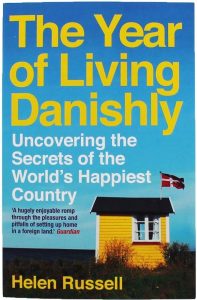
Helen Russell's Year of Living Danishly audiobook begins from a deceptively simple premise: rather than analyzing Danish happiness rankings from the outside, she moved inside them. When her husband was offered a job at Lego's headquarters in rural Jutland, she made the decision that generated this book: she followed him, and she spent the year that followed attempting to understand what the Danes are actually doing differently. The Year of Living Danishly is simultaneously a personal memoir of expatriate adjustment and a rigorously reported cultural investigation, and it is the combination that makes both elements stronger than they would be independently. Lucy Price-Lewis narrates this audiobook with warmth and genuine comedic timing, and her handling of Russell's self-deprecating voice is one of the production's considerable pleasures. The book runs just under ten hours, a comfortable length for the memoir-investigation hybrid it is.
The synopsis attached to this audiobook edition is unfortunately an artifact of a book-listing system rather than a content description, but the three reviewers included in the metadata give a reliable account of what the book delivers. One gifted it repeatedly, including to a pregnant acquaintance interested in European child-rearing. Another found it cleared up misconceptions about Danish cultural practices while remaining honest about complexity. A third describes it as an easy and quick book with a great storyline that she has passed on multiple times. These are not descriptions of a difficult or challenging read. They are descriptions of a book that is genuinely enjoyable to spend time in while also being substantive, which is a rarer combination than it should be.
The Best Parts of The Year of Living Danishly
Russell is a journalist by training, and the book reflects that discipline in its resistance to the idealization that can sink this genre. Expat cultural-discovery books have a tendency to either romanticize their subject culture at the expense of critical analysis or to produce the opposite, the visiting British journalist who finds continental habits slightly absurd. Russell manages a third path: she researches the things she observes, interviews experts, and tests her own assumptions against the evidence, including evidence that complicates the picture. The happiness rankings that prompted the investigation are not taken at face value; she interrogates what they measure, how they might distort, and what elements of the Danish model are prerequisites that are difficult or impossible to replicate in other contexts.
The personal memoir dimension keeps the investigation from becoming academic. Russell is funny about her own disorientation, about the specific challenges of adjusting to rural Danish winters with their particular quality of darkness and cold, about her husband's progressive absorption into the Lego corporate universe, and about the cultural misreads that accumulate when you are trying to decode a new society from within it. Price-Lewis handles the comedy sections with the timing they need, and her rendering of Russell's voice maintains the warmth and intelligence that the book's audience responds to. This is a narrator-author match that works because both voices are intelligent, dry about the right things, and ultimately affectionate toward their subject in a way that is earned rather than assumed.
Before You Commit to The Year of Living Danishly
The chapters on Danish parenting philosophy are the book's most substantive and practically transferable content. Russell examines the specific ways Danish schools and families approach childhood autonomy, risk tolerance, and emotional education with the rigor of someone who has spent time inside the system rather than simply reading about it. The pedagogical philosophy she describes, which allows Danish children a degree of physical independence and emotional latitude that would make British or American parents anxious, is presented with enough contextual evidence that the reader can assess it rather than simply accept it. Reviewer Bookaholic's choice to gift the book specifically to someone interested in European child-rearing practices suggests this section resonates independently of the broader Denmark-appreciation argument.
Pay attention also to how Russell handles the structural conditions that underpin Danish happiness. She is honest about the things that make the model difficult to export: the taxation levels that fund the social infrastructure, the institutional trust that makes the welfare state functional, the relative cultural homogeneity that is itself under pressure from ongoing demographic change. The book is not an advocacy document for adopting Danish practices wholesale; it is a curious and honest investigation of what one country has constructed and what maintaining it costs. That analytical honesty is what distinguishes this from the genre of aspirational cultural tourism that typically surrounds happiness research, and it makes the book more useful for readers trying to think seriously about what the data actually shows.
Who Should Pick Up The Year of Living Danishly
Readers interested in comparative culture, happiness research, and European social models will find this among the most enjoyable introductions available. The memoir framing makes the research accessible to a broad general audience, and the humor prevents it from becoming the self-help book dressed in cultural reporting clothes that lesser versions of this premise produce. Anyone who has found themselves genuinely curious about why Nordic countries dominate quality-of-life metrics will find Russell's investigation both answering and deepening that curiosity, leaving them with better questions than they came in with.
Listeners who prefer straight memoir over cultural analysis, or who want a travel book focused primarily on landscapes and personal experience rather than social investigation, may find the intellectual dimension more prominent than they prefer. The book is primarily a cultural inquiry with memoir scaffolding, not the other way around. But for listeners who want something in the territory between Elizabeth Gilbert's personal curiosity and genuinely research-backed sociology, this audiobook represents a particularly satisfying combination. Price-Lewis's narration ensures that the ten hours pass with consistent pleasure, and the book's reputation as something people give to each other speaks accurately to what it delivers.
The Short Version
- Narration: Lucy Price-Lewis brings warm comic timing to Russell's self-deprecating voice, handling the shift between personal memoir and cultural investigation with genuine ease.
- Themes: Danish happiness culture, expatriate adjustment, comparative social models
- Mood: Warm, gently satirical, genuinely illuminating
- Verdict: Russell's year embedded in rural Jutland produces the most enjoyable and honest investigation of Danish happiness culture available in audio form.
A Few Questions About The Year of Living Danishly
Is this audiobook suitable for listeners already familiar with books about Nordic happiness research?
Readers with prior exposure to the Nordic happiness literature will find Russell's personal embedded investigation adds dimensions that purely researched books lack. Her year in rural Jutland produces observations that differ from the more frequently cited urban and institutional accounts.
How does Lucy Price-Lewis's narration of this audiobook compare to the print reading experience?
Price-Lewis is particularly strong with Russell's comic timing and cultural observation passages, both of which benefit from audio delivery that modulates between dry wit and genuine warmth. Listeners who have read the print version report the narration adds rather than merely reproduces.
Does this audiobook address the question of whether Danish parenting practices are transferable to other cultures?
Yes, and with appropriate nuance. Russell examines the structural conditions of Danish society that underpin the parenting philosophy and is honest about the elements that require broader social infrastructure to function. The treatment is descriptive and analytical rather than prescriptive.