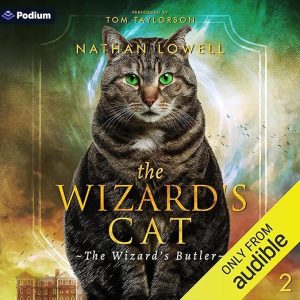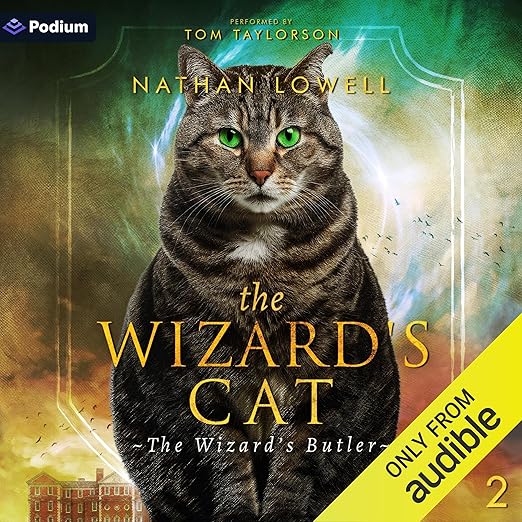
I finished The Wizard's Butler late on a weeknight and immediately queued up The Wizard's Cat, which is the clearest possible signal that the first book had done its job. Nathan Lowell is not writing high-stakes epic fantasy. He is writing about a man who takes a butler position in a strange old house and finds that the strangeness is more literal than it first appeared. The scale is domestic. The magic is adjacent to rather than overwhelming the daily rhythms of the household. And the pleasure of following Roger Mulligan through these books is the pleasure of watching someone find their place in a world that is genuinely unusual without requiring him to save it.
The Wizard's Cat picks up with Roger settled into Shackleford House, his big bonus claimed, his life more stable than it has been in some time. The stability is, of course, temporary. A dandelion on the immaculate grounds of the estate sets the plot in motion, followed by Old Man Shackleford's concerned reports about fairy problems and failing house energy, and eventually a stray cat who turns out to have very particular opinions about the food he is being served.
First, the Big Picture
The talking cat is the book's centerpiece, and Lowell handles it with exactly the right tonal control. The cat is not a wise guide or a magical advisor. He is a cat who has developed the ability to communicate and has priorities that are, categorically, cat priorities. A passage quoted by one reviewer captures this perfectly: the cat's lengthy complaint about the monotony of his food, delivered with complete feline self-importance, is exactly the kind of comedy that this series does particularly well. The humor comes from the specificity of the characters rather than from joke mechanics, and Tom Taylorson's narration makes it land with the timing it requires.
The mystery at the book's center, involving the weakening of Shackleford House's protections, Herne the Hunter's involvement, and a network of fairy and pixie troubles that escalates from inconvenience to genuine danger, is handled with appropriate stakes for a story of this register. This is not a thriller. The tension is real but not overwhelming, and the resolution is satisfying without requiring the world to end. One reviewer described it as relaxing and engaging at the same time, which is an accurate description of Lowell's particular calibration.
The Best Parts of The Wizard's Cat
Tom Taylorson's narration is a consistent strength across both books in this series. He plays Roger's bewilderment with the right quality of someone who has accepted that extraordinary things are simply part of his current employment, and his handling of the cat's dialogue is comic without being silly. The domestic scenes, breakfasts and dinners and household logistics that multiple reviewers mention, could easily feel like filler in other hands. Taylorson delivers them with enough lived-in warmth that they function as grounding rather than padding, giving the fantastical elements room to be genuinely surprising when they arrive.
At nearly ten hours, this is a comfortable listen across a weekend. The pacing is leisurely in the early chapters before accelerating as the plot consolidates, and one reviewer noted that it starts slow but that this is fine. The patience required in the opening hours is rewarded by the time the actual stakes emerge, and Lowell earns the reader's patience by making the slow sections interesting in their own right rather than merely necessary.
A Few Reservations
One reviewer who loved the first book found this sequel less immediately gripping, noting the ability to put it down for several days at a time as evidence of slightly reduced engagement compared to The Wizard's Butler. The middle section does drag somewhat, and the protagonist's extended hand-wringing about his situation, noted in reviews as a recurring complaint, becomes more pronounced here than in the first book. If the specific quality of Roger's uncertainty read as charming in book one, it will read as familiar rather than fresh in the second.
The book is also explicitly a sequel, and while Lowell provides enough context that new listeners could follow the plot, the emotional investment in Roger's situation and the texture of Shackleford House are richer for having experienced the first book. Starting here is possible but not ideal.
Who Should Listen to The Wizard's Cat
This audiobook is well-suited to fans of cozy fantasy who have already read The Wizard's Butler and want to continue Roger's story. It is a natural fit for listeners who enjoy fantasy grounded in domestic detail rather than epic confrontation, and for those who appreciate humor that comes from character specificity rather than genre parody. Readers looking for high-stakes fantasy, fast-paced plotting, or worldbuilding at scale will find this too small and too quiet. For readers who find most fantasy too loud, it is exactly the right volume.