Quick Take
- Narration: Cat Gould narrates with a composed authority that respects the weight of the personal stories without making the analytical sections feel like testimony.
- Themes: Women and alcohol culture, the liquor industry’s targeting of women, ‘Wine Mom’ social media mythology
- Mood: Unflinching and purposeful, with moments of genuine tenderness in the personal accounts
- Verdict: Lotta Dann’s examination of women’s drinking is rigorously researched, personally honest, and long overdue, one of the few books in this space to name the industrial and cultural machinery driving the problem.
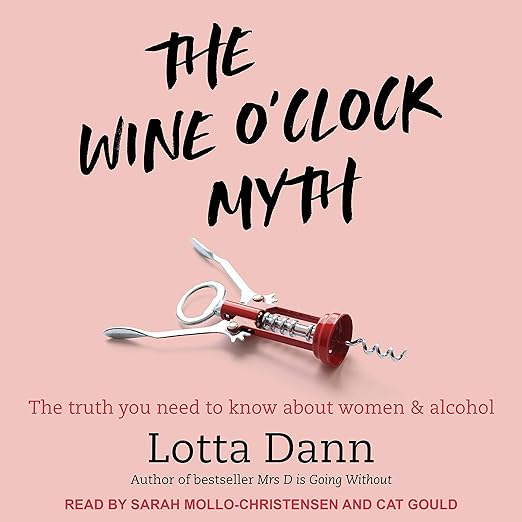
I was halfway through the chapter on the liquor industry’s marketing to women when I went and looked at my own social media feed and noticed three separate wine-related memes that I had scrolled past without registering as anything. Lotta Dann’s point is made before she even makes it, we’ve normalized a specific relationship between women, stress, and alcohol so thoroughly that we can no longer see the water we’re swimming in. The Wine O’Clock Myth is, at its best, the book that holds up a mirror.
Dann is New Zealand’s Mrs. D, she built a prominent recovery blog before writing two previous books about her own relationship with alcohol. Her third book shifts focus from the personal to the systemic: away from her own story and toward the broader landscape of why women specifically, in this specific cultural moment, are drinking at rates that epidemiologists describe as historically unprecedented. That systemic lens is what makes this one feel different from the large body of women’s recovery memoir. Dann isn’t just asking why she drank. She’s asking what conditions made it almost inevitable.
The Industry and the Mythology
The chapters on how the alcohol industry deliberately targeted women are among the strongest in the book. Dann traces the evolution of marketing from beer-as-masculine to wine-as-feminine, from rosé as a lifestyle to the “mommy wine culture” that saturated social media through the 2010s. The wine bottle as reward. The glass as self-care. The “I deserve this” ritual that Dann quotes in the book’s opening paragraphs. She documents the industry’s role in constructing these messages with enough sourced detail that it’s difficult to dismiss as conspiratorial.
The personal accounts from other women are the book’s emotional core. Dann interviewed a number of women who share their stories with what she describes as brave intimacy, stories that are, as reviewers note, sometimes brutal and sometimes inspiring. These accounts resist the recovery memoir’s tendency toward triumphalism. Some are still in the middle of their struggles. Some are clear-eyed survivors. Some are both, at different times.
Cat Gould’s Narration and the Register of Hard Truths
Cat Gould narrates the analytical sections with a measured confidence and the personal accounts with a slightly softer register that distinguishes them without becoming melodramatic. This is exactly the right call for a book that needs to hold both the systemic argument and the human cost at the same time. The seven-and-a-half-hour runtime flows well because Dann’s structure alternates between evidence-heavy chapters and narrative ones, which provides natural rhythm changes for the listener.
Reviewers who describe being “glued to this book” and “more aware of how women are targeted by the alcohol industry” are responding to Dann’s success at connecting the personal and the structural without losing either. One listener who was four months sober at the time of writing called it essential reading for anyone exploring their relationship with alcohol, that specific phrasing, “exploring your relationship,” captures the book’s tone: not prescriptive, but illuminating.
Who Should Listen, Who Should Skip
This belongs on the reading list of anyone who has ever questioned their own drinking and suspected the questioning was harder than it should be. It’s also valuable for people who work in addiction treatment and want a cultural-analysis complement to clinical frameworks. Men who want to understand what their female partners, friends, or clients navigate in relation to alcohol culture will find it clarifying. Listeners who want a personal recovery memoir with a narrative arc will find this more analytical than they’re expecting, but the interviews with other women give it emotional texture that pure journalism doesn’t always achieve.
Frequently Asked Questions
Is this book specifically written for women in recovery, or does it have broader appeal?
The book’s argument is feminist and structural, it analyzes how women specifically are targeted and affected, but it’s valuable for anyone interested in the intersection of alcohol culture, gender, and industry. It’s not a recovery manual, and readers who aren’t in recovery will still find the cultural analysis useful.
Does Lotta Dann’s recovery perspective come through as preachy, or does she maintain journalistic distance?
Dann is upfront about her own recovery while maintaining genuine curiosity about the broader landscape. The tone is more investigative than evangelizing, she lets the evidence and the women she interviews make the argument rather than insisting on a single prescriptive conclusion.
How does The Wine O’Clock Myth compare to Holly Whitaker’s Quit Like a Woman?
Both examine the intersection of feminism, alcohol culture, and recovery, though from different angles. Whitaker’s book is more personal essay and recovery-memoir in structure, while Dann’s is more journalistic and interview-driven. They complement each other well.
Does the book address non-wine alcohol consumption, or is it narrowly focused on wine culture?
Despite the title’s wine focus, Dann’s analysis extends to alcohol culture broadly, the wine framing is about the specific cultural mythology attached to it as a feminine consumer category, but the book’s scope covers women’s drinking patterns across all types of alcohol.