Quick Take
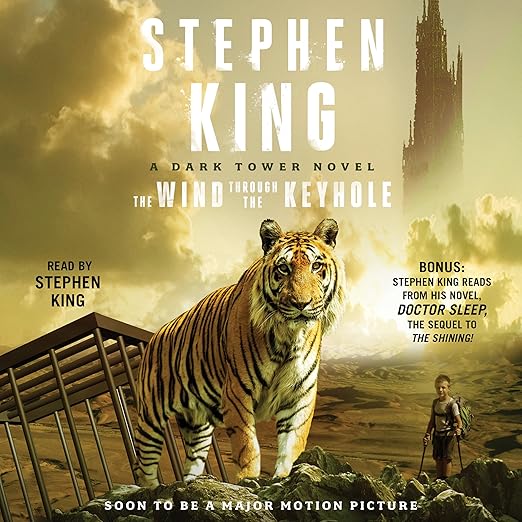
- Narration: Stephen King reading his own Dark Tower work is the only correct version of this book, his cadence, his pauses, his evident affection for Roland and the ka-tet make every frame of the nested story structure feel inhabited.
- Themes: nested storytelling and the persistence of myth, a young gunslinger’s guilt and its long shadow, the starkblast as metaphor for life’s interruptions
- Mood: Nostalgic, mythic, and quietly devastating, this is the most intimate entry in the Dark Tower series
- Verdict: Essential for Dark Tower readers and surprisingly accessible for newcomers; King’s self-narration turns a structural experiment into something deeply felt.
I was about midway through a long Sunday of rain when I started The Wind Through the Keyhole, expecting to check in on an old favorite and instead spending the entire afternoon in it. I have read the Dark Tower series three times, beginning with The Gunslinger in my early twenties, and this book, the one that slots between books four and five, the one King published two decades after the main sequence, remains the strangest and most affecting entry in the whole saga. It does something none of the other Dark Tower books do quite as explicitly: it puts Roland in the role of storyteller, and in doing so, it reveals the old gunslinger’s relationship to narrative itself.
The structure is the first thing to understand. This is a Russian doll of a novel, King’s phrase, and an accurate one. The outer frame is Roland and his ka-tet sheltering from a starkblast, a weather event of terrifying intensity. Within that frame, Roland tells the group a story from his youth, sent by his father to investigate a murderous shape-shifter and finding himself responsible for a traumatized boy named Bill Streeter. And within that story, Roland reads young Bill a tale from the Book of Eld, the Wind Through the Keyhole story of the title, a fairy tale that functions as the novel’s emotional and thematic core. Three stories, nested, each one inflecting the meaning of the others.
Our Take on The Wind Through the Keyhole
King’s narration of his own work here is not a vanity project. He understands Roland in a way no other narrator can, and the sections where the young Roland comforts the frightened boy by reading from the Book of Eld carry a quality of care that only works because we can hear the author’s investment in both the character and the material. The fairy tale within the story is the most purely fantastical writing King has done in the Dark Tower series, and his reading of it has the quality of someone who genuinely believes in the imaginative act of storytelling as a form of human consolation. The line Roland offers Bill, a person is never too old for stories, lands as a statement of authorial faith, not just character dialogue.
The guilt-ridden young Roland of the story’s inner frame is one of King’s most affecting characterizations of this figure. We see him in the aftermath of his mother’s death, which Dark Tower readers will know is one of the series’ most significant wounds, sent on a mission that requires him to be something other than who he is. The shape-shifter investigation is a genre thriller, efficiently executed. But what surrounds it, the boy Bill, the story Roland uses to quiet him, the memory of his mother reading from the same Book of Eld, is where the novel’s emotional weight lives.
Why Listen to The Wind Through the Keyhole
The question of where to place this book in a Dark Tower read is one that longtime fans debate. King and the reviewers here suggest between books four and five, and that is the right answer for series veterans. The starkblast that traps Roland and the ka-tet creates a holding-pattern structure that justifies the extended story-within-a-story without requiring the main quest to advance. For newcomers, however, this is also a genuinely viable entry point. The inner stories are sufficiently self-contained that they function independently, and the outer frame provides enough context about the ka-tet that an uninitiated listener is not lost.
At ten and a half hours, this is one of the shorter Dark Tower volumes, which contributes to its intimacy. The series’ longest entries, Wizard and Glass, The Wolves of the Calla, have an epic sprawl that is part of their appeal. This one is quieter, more concentrated, and in some ways more emotionally direct than any of the others.
What to Watch For in The Wind Through the Keyhole
Readers who come to the Dark Tower series primarily for action and forward momentum may find this book slower than they expect. It is a meditation more than an adventure, and the fairy tale at its center requires a certain patience with the traditional storytelling mode. The starkblast that provides the frame narrative is a vivid set piece, but it is there to create space for storytelling rather than to generate threat in the way the series’ monster set pieces do.
One French reviewer’s note of apprehension about reconnecting with the Dark Tower universe via a smaller novel is a useful caution: this is not the entry point for readers who want to be sold on the scale of Mid-World. It is a book that assumes you already love the place and offers you one quiet, rainy afternoon inside it.
Who Should Listen to The Wind Through the Keyhole
Dark Tower readers who have completed the main sequence and want to return without re-reading everything will find this perfect, it slots in cleanly and illuminates the characters without requiring you to be mid-quest. Newcomers who are curious about King’s most sustained fantasy universe can start here as a lower-commitment entry point. Skip it if you have not read any of the series and want the full experience, start with The Gunslinger. Skip it if you are in this series primarily for action rather than atmosphere and character.
Frequently Asked Questions
Do I need to have read the Dark Tower series to enjoy The Wind Through the Keyhole?
No, the nested fairy tale at the book’s core is fully self-contained, and the outer frame provides enough context about Roland and his companions. But readers who know the series will find the emotional resonance considerably deeper.
Does Stephen King narrate the entire audiobook, or just portions of it?
King narrates the complete audiobook. This is not a full cast production, it is one author reading his own work across all three nested story levels, which is part of what makes the nested structure feel so coherent.
Is this book appropriate for younger readers or listeners given the fairy tale structure?
The fairy tale within the novel is accessible to older children or young adults, but the outer frame and the shape-shifter investigation in the inner story contain violence and mature themes consistent with King’s general body of work. Parental discretion applies.
Where exactly should The Wind Through the Keyhole be inserted in a Dark Tower series read?
Between Wizard and Glass (book 4) and Wolves of the Calla (book 5). King designed it to slot there specifically, the starkblast that opens the outer frame follows directly from where book 4 ends, and the ka-tet configuration matches that moment in the series.