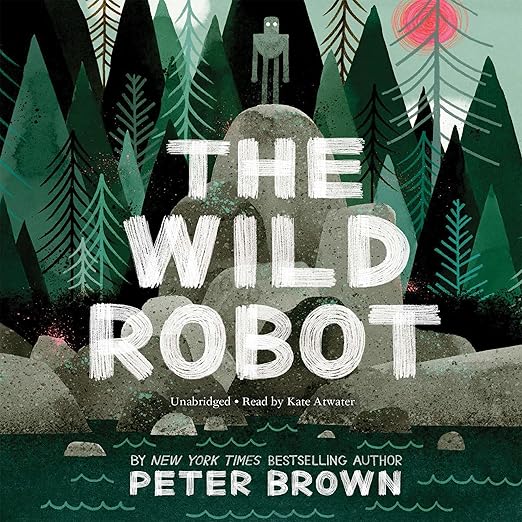
Roz opens her eyes on an island she has never seen, with no memory of arriving and no notion of what she is for. That is where the novel starts and where this audiobook starts, four hours and fourteen minutes read by Kate Atwater, and it remains one of the cleanest opening premises in middle grade fiction: a machine with no instructions, entirely alone, in weather that does not care. Nothing about the premise needs explaining to a first grader, and nothing about it condescends to one either.
Machine Logic That Produces Emotional Results
Peter Brown wrote and illustrated the book, and the description leads with exactly that: a Caldecott Honor winner, a number one bestselling illustrated middle grade novel, an award-winning author and illustrator. Every one of those claims points at pictures. The product on sale here contains none, which is less a criticism of the recording than an observation about the distance between what the copy advertises and what the format can physically deliver. Buyers should read that opening line as a description of the hardcover and everything after it as a description of the story.
Four hours and fourteen minutes is a fine length for a read-aloud, and the reviews confirm that is how the book actually gets used. One homeschooling parent describes a preschooler and a first grader listening together, the older child able to read it independently and choosing not to. That is this book's natural habitat: a family in one room, rather than a solo child with headphones. Nothing stops a confident reader taking it alone, but the reviews suggest the book is better shared, and that the sharing is half the reason it works.
The story is a survival story with the violence left in. Roz comes ashore after a storm, escapes a bear attack, and works out that her only route to staying operational is learning from animals who want nothing to do with her. Then she adopts a gosling. The description promises that a mysterious past eventually comes back for her, which is the hook that carries a listener into the next book. What makes it more than a premise is that Roz solves problems the way a machine would and gets emotional results anyway, which is the whole engine of the thing.
Booksellers Are a Better Signal Than a Review
Kate Atwater is the only credit on the record, which for this book means voicing a robot learning animal speech, an island's worth of species with different registers, and a gosling growing up over the course of the story. Nothing on the page indicates how any of that is handled. No sample note, no cast, no mention of sound design. For a book whose central character is a machine learning to sound alive, that is the fact worth having, and it is the one thing this page declines to supply.
Little, Brown Young Readers published it in April 2016, and this entry is numbered one in the Wild Robot series. That much is clear enough. Less clear is why two reviewers mention a film adaptation, one wanting to watch it and one having just discovered it exists, while the record itself mentions no adaptation anywhere. The people posting are further ahead than the listing that hosts them.
Coralie Terry's response is the most interesting one here because of where it comes from. It describes picking the book up as part of middle grade market research, after several booksellers reported children devouring it and copies leaving the shelves quickly. That is a trade observation rather than a reader's reaction, and it explains the near-perfect star average better than any of the enthusiasm surrounding it does. Booksellers watching what children pick up voluntarily are a better signal than almost any review, and that sentence is the most persuasive line anywhere on this record.
A Sentence About Artwork Stops at Illust
Illustrations are what does not survive the crossing. One reviewer counts chapters running two or three pages apiece and starts a sentence about the artwork that breaks off after the word illust, mid-thought. Short chapters travel to audio without loss. Drawings do not. A parent choosing between formats should know the printed edition carries something the recording cannot, and that the description leads with that something. A household intending to own only one version should think about which half of the book matters more to the child in question.
Sixteen people rated this and the badge shows 4.8. All five written grades sitting under it are fives, so nothing here is contested by anybody. The least effusive opinion on the page belongs to a reader who liked it and wanted to see the movie. Consensus that uniform usually means everyone arrived already convinced, which is worth remembering when a single number is doing your deciding for you. Sixteen votes is also a very small pool, and small pools move quickly in either direction.
Every claim the description makes about meaning works harder than the story needs. Nature and technology collide, it says, and large questions follow. What actually happens is smaller and better: a machine works out that surviving means becoming useful to somebody else, and the book lets a child reach the implication without ever stating it aloud. That restraint is why adults reading it out loud do not get bored, and why the book survives repeat listens better than most of what sits beside it on this shelf.
It Names Atwater and Stops Right There
Families with children anywhere from preschool upward are the audience these reviewers describe themselves, one of them reporting a twelve-year-old who enjoyed it just as much. The short chapters create natural stopping points, which matters more in audio than on paper, because a listener cannot see how far away the next break is. Four hours and fourteen minutes divides comfortably into short sittings, and the story never punishes a listener for stopping in the middle of one.
Purists who came for Peter Brown's artwork should understand that the artwork is precisely what an audio edition cannot carry, whatever the opening line of the description implies. Anyone hoping this page will describe the reading will come away empty, because it names Kate Atwater and stops there. Save the illustrated hardcover for the shelf and take the recording for the car. A household that does both ends up owning the whole thing, which for once is a reasonable answer rather than a way of selling two copies.
Quick Take
- Narration: Kate Atwater is the only name attached, voicing a robot learning animal speech, an island of species, and a gosling growing up.
- Themes: Survival by adaptation, an unlikely adoption, machinery meeting wilderness, belonging that has to be earned.
- Mood: Gentle and wide open, with genuine danger under the calm.
- Verdict: Excellent as a family listen, though the format drops the illustrations its own description leads with.